
 BreachModal
- Published
- Under
- Threat Intelligence
- Reference
- CVE-2026-15409
- Reading time
- 5 min
SonicWall SMA1000 Zero-Days Actively Exploited (CVE-2026-15409)
Summary
Urgent analysis of chained SonicWall SMA1000 zero-days (CVE-2026-15409, CVE-2026-15410) exploited by INC ransomware. BreachModal provides PoC, IoCs, and mitigation steps.

Unpatched SonicWall Secure Mobile Access (SMA) 1000 series appliances are not just vulnerable; they are compromised command posts for ransomware groups.
Since at least June 22, 2026, threat actors including the group Volexity tracks as UTA0533 and operators of the INC ransomware have been exploiting a devastating chain of two zero-day vulnerabilities. The flaws, now identified as CVE-2026-15409 (opens in a new tab) (a CVSS 10.0 unauthenticated SSRF) and CVE-2026-15410 (opens in a new tab) (a CVSS 7.2 authenticated code injection), grant attackers root-level remote code execution on the very devices meant to secure network perimeters. According to SonicWall's own advisory, the exploitation began weeks before patches were issued on July 14, 2026, a critical window of exposure that CISA has underscored by adding both flaws to its Known Exploited Vulnerabilities (KEV) catalog (opens in a new tab).
Note what this means: The appliance you trust for secure remote access became the threat actors' primary entry point. This is a systemic failure of perimeter security design, where a single, internet-facing 'black box' becomes a catastrophic point of failure. Why does this keep happening? Because network appliances are treated as infallible gatekeepers, yet they are complex systems that are infrequently audited and represent an extraordinarily high-value target for any adversary seeking initial access.
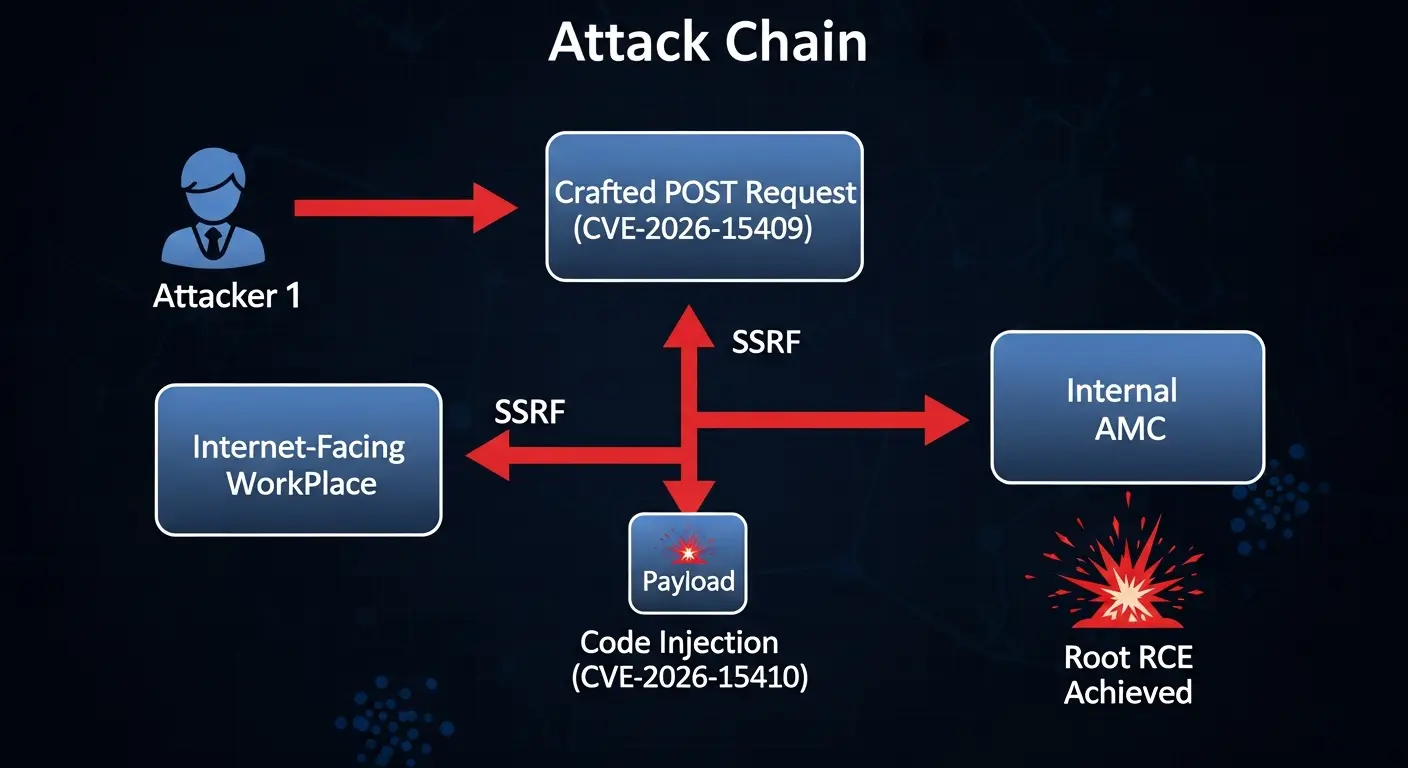
The Unauthenticated Chain: From SSRF to Root
The attack's brilliance lies in its simplicity. It chains two distinct flaws to bypass all authentication and gain complete control of the target system.
First, attackers leverage CVE-2026-15409, a Server-Side Request Forgery vulnerability in the public-facing WorkPlace interface. With a perfect CVSS score of 10.0, this flaw is the skeleton key. An unauthenticated attacker can send a specially crafted request to the login portal, forcing the SMA appliance itself to issue requests to internal-only services. The primary target of this forced request is the Appliance Management Console (AMC), which should never be exposed to the internet.
Second, with the SSRF acting as a tunnel to the AMC, the attacker exploits CVE-2026-15410. This is a post-authentication code injection vulnerability. Since the SSRF makes the request appear to come from the appliance itself (a trusted, authenticated source for the AMC), the attacker can inject and execute arbitrary operating system commands. The result is unauthenticated remote code execution as the root user.
This attack chain demonstrates the cascading failure that a single critical vulnerability can trigger, turning a defensive asset into an offensive launchpad.
Attacker Playbook: UTA0533 and INC Ransomware
Once root access is achieved on the SonicWall SMA1000 appliance, the device is fully compromised. Threat intelligence from firms like Volexity shows that actors are not merely passing through; they are colonizing these devices for long-term persistence and deeper network infiltration.
Operators have been observed deploying custom malware tailored for the SMA appliance's environment. This includes Knuckleball, a Python-based loader that injects hidden Java components into legitimate SonicWall processes, and Orangetail, a sophisticated web shell for persistent access. This isn't smash-and-grab; this is a methodical takeover of your network's front door.
From this beachhead, the attackers pivot into the internal network. Their goals are clear: credential access and lateral movement, hallmarks of a pre-ransomware intrusion. Tools like Impacket's Secrets Dump and DCSync are used to harvest credentials from Active Directory, targeting the core of the enterprise identity infrastructure. The attackers systematically exfiltrate local credentials, active session databases, and even MFA seeds directly from the compromised appliance, rendering multi-factor authentication ineffective for compromised accounts. This is a textbook execution of MITRE ATT&CK T1190: Exploit Public-Facing Application (opens in a new tab) followed immediately by credential access and discovery.
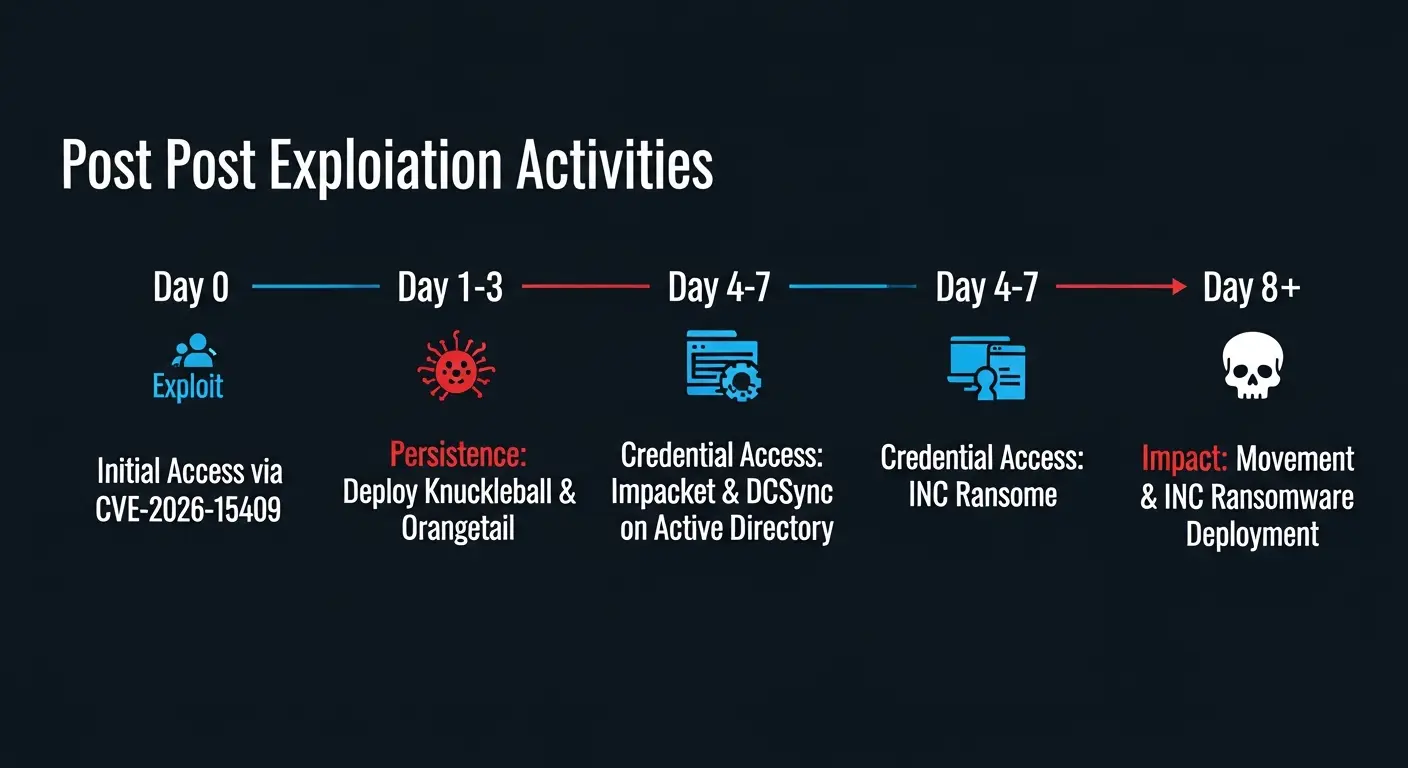
The irony of a 'Secure Mobile Access' appliance providing insecure, wide-open access to ransomware groups is a lesson written in compromised data and extortion payments.
Proof of Concept: Reproducing the SonicWall SMA1000 Zero-Day Exploit
This section provides a technical walkthrough to demonstrate the chaining of CVE-2026-15409 and CVE-2026-15410. This is for educational and defensive purposes only. Do not attempt against systems you do not own.
Identify Vulnerable Target: The first step is to confirm the target is running an affected firmware version. These include 12.4.3 releases prior to
12.4.3-03453and 12.5.0 releases prior to12.5.0-02835.Craft SSRF Payload (CVE-2026-15409): The attacker crafts a POST request to the
/__api__/loginendpoint. The payload tricks the server into making a request to the internal-only AMC endpoint responsible for executing commands, smuggling the payload for the second vulnerability inside it.
    POST /__api__/login HTTP/1.1
    Host: <vulnerable-sma-host>
    Content-Type: application/json

    {
        "username": "admin",
        "password": "password",
        "domain": "LocalDomain",
        "ssrf_target": "http://127.0.0.1/cgi-bin/viewlog?log=;id"
    }
Trigger Code Injection (CVE-2026-15410): The
ssrf_targetparameter in the above request points to an internal administrative endpoint (/cgi-bin/viewlog). The vulnerability in this endpoint allows for command injection by appending a semicolon followed by an OS command (e.g.,;id). The SSRF flaw forces the appliance to send this malicious request to itself.Achieve Remote Code Execution: The
viewlogscript executes the injectedidcommand with the privileges of the web server, which runs as root on the appliance. The output of the command is then returned in the HTTP response, confirming successful RCE.
Forensics and Mitigation: The CISO's Action Plan
There are no workarounds. Organizations using affected SonicWall SMA1000 appliances (models 6210, 7210, 8200v) must take immediate action.
1. Patch Immediately: The only effective mitigation is to upgrade to a patched firmware version. The fixed releases are 12.4.3-03453 and 12.5.0-02835. These are available on mysonicwall.com.
2. Hunt for Compromise: Assume you have been compromised. Conduct a forensic analysis of appliance logs. According to SonicWall, look for:
Suspicious requests to
/__api__/login,/__api__/logout, and/wsproxyinextraweb_access.log.Log entries in
ctrl-service.logcontaining the string "hotfix removal" that include a path traversal name.
3. Remediate if Compromised: If any IoCs are found, patching is not enough. The appliance is under attacker control. You must:
Re-image the hardware appliance or re-deploy the virtual appliance from a clean build.
Reset every user and administrator password associated with the appliance.
Reset all TOTP (MFA) seeds, as they may have been exfiltrated.
Organizations that fail to perform these remediation steps after finding evidence of compromise are simply patching a system the attacker already owns.
FINAL VERDICT
The active exploitation of the SonicWall SMA1000 zero-day vulnerabilities represents a catastrophic failure of perimeter security. The risk is not merely unauthorized access; it is total network compromise leading directly to ransomware deployment. The burden of this risk falls squarely on every organization that deployed these devices without a rapid patching and incident response capability. This incident proves, yet again, that any internet-facing system, especially a security appliance, must be treated with zero trust and subjected to constant vigilance. The necessary change is a shift in mindset: your firewall is not a fortress wall, it is a high-value target on the front line.
***
BreachModal's Adversary Simulation and Red Team services can identify and validate critical exposures in your perimeter before threat actors do. Contact us to secure your network's edge. (opens in a new tab)