
 BreachModal
- Published
- Under
- Threat Intelligence
- Reference
- CVE-2026-102764
- Reading time
- 3 min
BeyondTrust CVE-2026-102764: ARMORY CASTLE Exploitation
Summary
Analysis of CVE-2026-102764, a critical CVSS 9.3 zero-day in BeyondTrust Remote Support exploited by ARMORY CASTLE. Read the BreachModal incident report.
The perimeter is dead, and the very tools designed to secure remote access have become the primary vectors for state-sponsored espionage.
In mid-October 2026, BeyondTrust issued security advisory BT26-05, exposing a critical vulnerability—CVE-2026-102764 (opens in a new tab)—in its Remote Support (RS) appliances. According to forensic telemetry and incident response data, this CVSS 9.3 flaw was actively exploited as a zero-day starting August 29, 2026. The threat actor, a suspected PRC-nexus cyber espionage group tracked as ARMORY CASTLE (previously identified by Mandiant as UNC5221 or Warp Panda), utilized the flaw to bypass origin validation and upload arbitrary files. By manipulating internal messaging components, ARMORY CASTLE achieved host-level execution, extracting brokered session credentials and API keys to move laterally into highly restricted corporate networks. Following confirmed in-the-wild exploitation, CISA immediately added the flaw to its Known Exploited Vulnerabilities (KEV) catalog (opens in a new tab).
Note what this means: We have structurally incentivized attackers to target our security infrastructure. When organizations consolidate all privileged access brokering into a single edge appliance, that appliance becomes a single point of catastrophic failure. The economic and operational logic for an espionage group is clear—why spend months phishing end-users when a single HTTP request to an unpatched remote support gateway yields the keys to the entire kingdom?
The Anatomy of the Breach
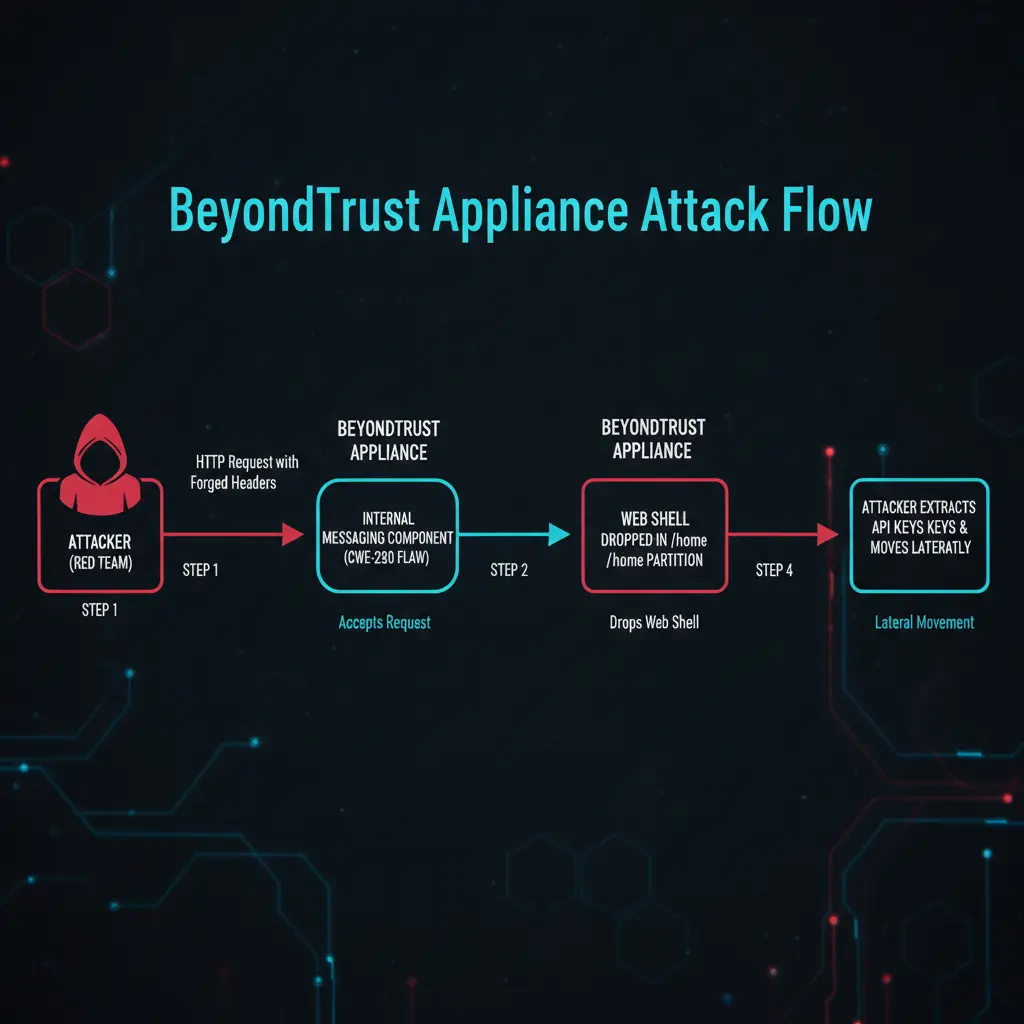
ARMORY CASTLE has a well-documented history of targeting edge and remote access devices, having previously weaponized zero-days in Citrix NetScaler and Ivanti Connect Secure. Their exploitation of BeyondTrust RS (versions ≤ 26.2.3) follows a nearly identical playbook. The vulnerability stems from CWE-290 (Improper Origin Validation). Internal messaging components failed to cryptographically verify the source of incoming messages.
If you were the CISO here, you would have seen nothing in your standard perimeter alerts. The initial access vector (T1190: Exploit Public-Facing Application (opens in a new tab)) occurs over standard, encrypted web ports. The attackers forged origin headers to interact directly with the internal thin-scc and brain components, dropping web shells (T1505.003: Server Software Component: Web Shell (opens in a new tab)) directly onto the appliance's encrypted /home storage partition.
Timeline and Quantification of Risk
The zero-day window for this vulnerability spanned a staggering 41 days. ARMORY CASTLE began exploitation on August 29. It wasn't until late September that public reporting of anomalous edge-device activity prompted threat hunts across BeyondTrust's telemetry.
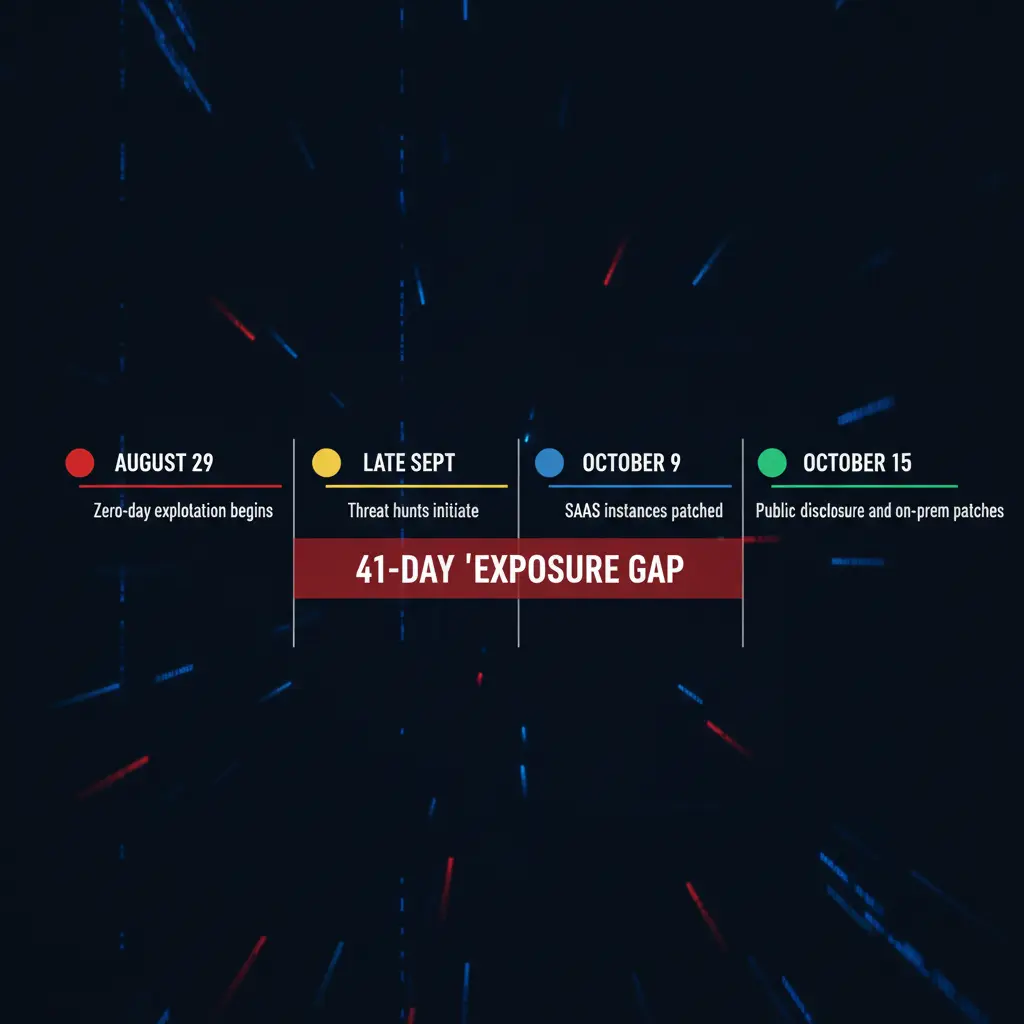
BeyondTrust pushed automated remediations to SaaS-hosted instances on October 9, but on-premise and self-hosted customers were left exposed until the public disclosure on October 15. For 41 days, any self-hosted BeyondTrust RS appliance exposed to the internet was effectively an open door.
It is a special kind of irony when the appliance brokering your most sensitive administrative sessions decides to broker a session for a Beijing-nexus APT instead.
Forensic Artifacts and Detection
To determine if your environment was compromised during the zero-day window, security teams must examine appliance-specific log files. Look for abnormal outbound network traffic originating directly from the appliance management interface, and audit the syslog, messages, access, and SSL logs for unauthorized script execution or unexpected session brokering requests.
Proof of Concept
To understand the mechanics of CVE-2026-102764, we must look at how the improper origin validation is triggered. The following steps demonstrate the conceptual attack path used to bypass authentication and write arbitrary files.
Environment Setup & Reconnaissance: The attacker identifies a BeyondTrust RS appliance and checks the version via publicly exposed headers or login portals.
Forging the Origin: The attacker crafts an HTTP request targeting the internal messaging API, spoofing the
X-Forwarded-ForandOriginheaders to simulate a trusted internal component.Payload Delivery: A multipart form-data request is sent containing a malicious payload (e.g., a web shell) intended for the
/homepartition.
(See the detailed PoC walkthrough below for technical specifics).
FINAL VERDICT
CVE-2026-102764 is not just a software bug; it is a systemic architectural failure in how we deploy edge security appliances. The risk is borne entirely by organizations that self-host these appliances without strict network segmentation. If you are running BeyondTrust RS versions 26.2.3 or older, you must assume breach. Apply patch BT26-05-RS immediately, isolate the management interfaces to trusted subnets, and initiate a full credential rotation for all secrets brokered by the appliance.
Need immediate incident response or a comprehensive edge-device compromise assessment? [Contact BreachModal's Adversarial Simulation and Response team today.]