
 BreachModal
- Published
- Under
- Threat Intelligence
- Reference
- CVE-2026-20253
- Reading time
- 7 min
Splunk RCE Flaw (CVE-2026-20253) Actively Exploited
Summary
Critical RCE vulnerability CVE-2026-20253 in Splunk Enterprise is under active attack. Learn mitigation steps, IOCs, and how to secure your deployment from this threat.

Executive Summary of the Threat
A critical, unauthenticated Remote Code Execution (RCE) vulnerability, identified as CVE-2026-20253 with a CVSS base score of 9.8, is under active exploitation in Splunk Enterprise deployments. The U.S. Cybersecurity and Infrastructure Security Agency (CISA) has added this vulnerability to its Known Exploited Vulnerabilities (KEV) catalog, mandating immediate action from federal agencies and signaling a severe threat to the private sector.
The vulnerability exists within the PostgreSQL Sidecar Service, a component present in specific versions of Splunk Enterprise, including default Amazon Machine Image (AMI) deployments. Successful exploitation allows an unauthenticated remote attacker to write arbitrary files to the host system, which can be trivially escalated to execute code with the permissions of the Splunk service account. This grants the adversary a persistent foothold for lateral movement, data exfiltration, or deployment of further malware such as ransomware.
This advisory provides a complete technical breakdown, strategic mitigation protocols, and threat hunting guidance to counter this threat. Immediate patching is the only effective long-term remediation.
Technical Deep Dive: CVE-2026-20253 Anatomy
Understanding the mechanics of this vulnerability is critical for effective detection and response. The flaw is not in the core Splunk search or indexing engine, but in an auxiliary service that lacks fundamental security controls.
The Attack Vector: PostgreSQL Sidecar Service
The root cause of CVE-2026-20253 is a lack of authentication on two specific endpoints of the PostgreSQL Sidecar Service: /v1/postgres/recovery/backup and /v1/postgres/recovery/restore. This service is designed to manage database operations for certain Splunk applications. By default, it listens for requests, and without any authentication check, it will process commands from any source that can reach it over the network.
An attacker can initiate the exploit by sending a crafted HTTP POST request to one of these endpoints. The request body contains parameters that the service will use to perform a database backup or restore operation.
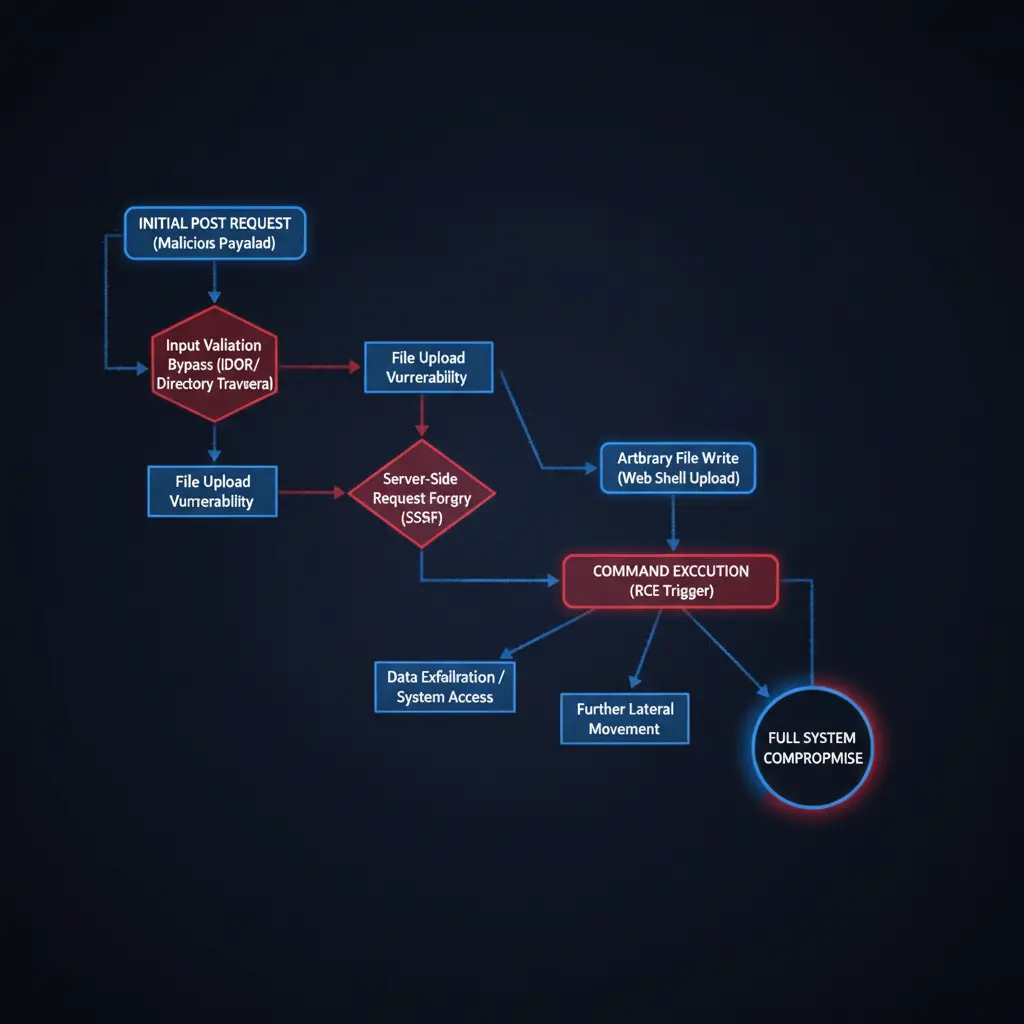
Exploitation Chain Analysis
The path from initial request to full RCE is a multi-step process:
Arbitrary File Write: The attacker leverages the
backupFileparameter within the POST request's JSON body. By manipulating this parameter, they can specify an arbitrary path and filename on the target server's filesystem. The service will write to this location, creating a new file or truncating an existing one.Payload Delivery: The initial file write is used to place a malicious script—typically a Python script—in a location that Splunk is known to execute periodically. A common target is
/opt/splunk/etc/apps/splunk_secure_gateway/bin/ssg_enable_modular_input.pyor a similar script within the Splunk application directory structure.Code Execution: Once the malicious script is in place, the attacker waits for Splunk's internal scheduler or a specific function to execute it. When the script runs, it does so with the privileges of the Splunk user, achieving remote code execution.
Advanced exploitation techniques have also been observed. One method weaponizes the lo_export function in PostgreSQL to write attacker-controlled data to a file. Another involves smuggling a hostaddr parameter within the dbname argument, forcing the Splunk instance to connect to an attacker-controlled external database, further expanding the compromise vector.
Affected Versions and Default Configurations
Immediate verification of Splunk Enterprise versions is required. The following versions are confirmed vulnerable:
Splunk Enterprise: 10.0.0 through 10.0.6
Splunk Enterprise: 10.2.0 through 10.2.3
Crucially, Splunk Enterprise deployments on AWS using the official AMI are vulnerable by default, as the sidecar service is pre-installed and active. Splunk Cloud Platform is not affected.
A Secondary Threat: CVE-2026-20163 Authenticated RCE
While CVE-2026-20253 is the most critical unauthenticated threat, security teams must also be aware of a separate, authenticated RCE vulnerability: CVE-2026-20163.
Command Injection via unarchive_cmd
This vulnerability is a classic command injection flaw (CWE-77) in the /splunkd/__upload/indexing/preview REST endpoint. An authenticated user can inject arbitrary shell commands into the unarchive_cmd parameter during a file upload process. This allows for direct execution of commands on the underlying operating system.
The Role of edit_cmd Privilege
Exploitation of CVE-2026-20163 is not possible for all users. It requires the edit_cmd capability, a high-level privilege typically reserved for Splunk administrators. This makes the vulnerability a significant threat in scenarios involving insider threats, compromised administrator accounts, or privilege escalation chains.
Strategic Mitigation and Hardening Protocol
Response must be swift and multi-faceted, combining immediate remediation with long-term hardening to build resilience.
Immediate Remediation: Patching and Upgrades
Patching is the definitive solution. Upgrade all Splunk Enterprise instances to a non-vulnerable version immediately.
For CVE-2026-20253:
Upgrade to Splunk Enterprise 10.2.4, 10.0.7, or 10.4.0 (or later).
For CVE-2026-20163:
Upgrade to Splunk Enterprise 10.2.0, 10.0.4, 9.4.9, or 9.3.10 (or later).
Tactical Containment: Service Disablement and Access Control
If immediate patching is not feasible, the following temporary mitigations can reduce risk:
Disable PostgreSQL Sidecar Service: For CVE-2026-20253, disabling the service entirely will close the attack vector. This may impact the functionality of applications that rely on it, so testing is required.
Audit and Restrict
edit_cmd: For CVE-2026-20163, conduct a thorough audit of all user roles. Adhere to the Principle of Least Privilege and revoke theedit_cmdcapability from any account that does not absolutely require it for its core function.
Proactive Defense: Architectural Hardening
Go beyond the patch to strengthen your overall security posture:
Network Segmentation: Restrict network access to the Splunk management interface and associated services. The PostgreSQL Sidecar Service should not be exposed to the internet or untrusted internal networks.
Web Application Firewall (WAF): Deploy a WAF to monitor and block suspicious requests targeting Splunk endpoints, including patterns associated with command injection.
Endpoint Detection and Response (EDR): Ensure EDR agents are deployed on Splunk servers to detect anomalous process execution, such as the Splunk service spawning unexpected shells or running unusual Python scripts.
Threat Hunting and Incident Response
Assume compromise and actively hunt for evidence of exploitation.
Indicators of Compromise (IoCs)
Search for the following activity in your logs and on your systems:
Inbound HTTP POST requests to
/v1/postgres/recovery/backupor/v1/postgres/recovery/restorefrom unknown or untrusted IP addresses.Unexpected file creation or modification in Splunk application directories, particularly Python (
.py) files.Anomalous child processes spawned by the main
splunkdprocess. Look for shells (sh,bash,powershell.exe) or interpreters (python,perl) executing unfamiliar scripts.Outbound network connections from Splunk servers to unusual IP addresses or ports.
FINAL VERDICT
CVE-2026-20253 is a top-tier vulnerability that demands the immediate and focused attention of security leaders and practitioners. Its unauthenticated nature, combined with the high-value status of Splunk as a target and active exploitation in the wild, creates a perfect storm of risk. The public release of PoC exploits has removed any barrier to entry for a wide range of threat actors, from opportunistic cybercriminals to sophisticated APT groups.
Simple compliance with patching is the bare minimum. A mature response involves treating this as a potential breach, initiating threat hunting protocols, and using the event as a catalyst to implement more robust architectural hardening. The security of your entire data ecosystem may depend on how decisively you act.