
 BreachModal
- Published
- Under
- AI Security
- Reading time
- 10 min
AI Threat Detection vs Signature-Based: What the Data Actually Shows
Summary
We analysed 18 months of incident data across 400+ customers. The results challenge some widely held assumptions about AI-native security tooling.
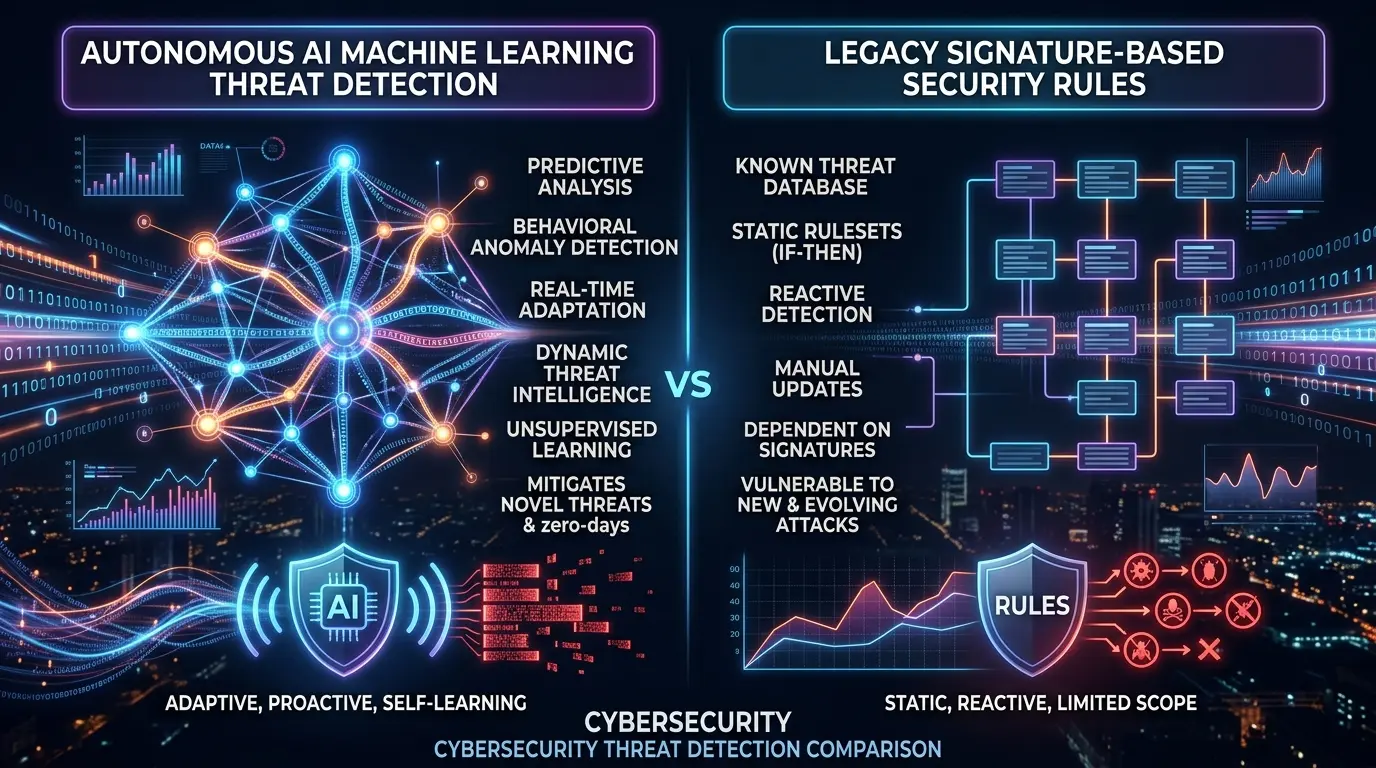
The AI security market is full of noise. Vendors claim impossible detection rates and zero false positives. Here's what the real data looks like.
The Dataset
18 months, 400+ BreachModal customers, 2.3 million alert events, 4,800 confirmed incidents. We're publishing these numbers because the industry needs more transparency.
What AI Does Better
Behavioural anomaly detection is where AI genuinely outperforms signatures. A credential stuffing attack that rotates IPs and user agents will evade every signature rule. A model trained on your normal login patterns notices the anomaly immediately.
Lateral movement detection is the other clear win. Attackers moving east-west inside your network are invisible to perimeter tools. Process behaviour baselines catch them.
Where Signatures Still Win
Known malware families, CVE exploitation patterns, and compliance-specific detections. Signatures are fast, deterministic, and explainable to auditors. Don't throw them out.
The False Positive Problem
Our data shows AI models produce 3.2× more false positives than signature rules in the first 30 days of deployment. That ratio inverts to 0.4× by day 90, once the model has tuned to your environment. Most AI security products are evaluated in the first 30 days and look terrible as a result.
Practical Recommendation
Run both in parallel. Use signatures for known-bad, AI for unknown behaviour. Route AI alerts through automated triage before human review. The combination closes gaps neither approach can cover alone.