
 BreachModal
- Published
- Under
- Supply Chain Security
- Reading time
- 9 min
Atomic Arch Campaign: AUR Supply Chain Backdoors 1,500+ Packages
Summary
BreachModal analyzes the Atomic Arch campaign, a sophisticated supply chain attack exploiting AUR's trust model to backdoor over 1,500 packages with eBPF rootkits and infostealers.

The Atomic Arch Campaign: Deconstructing a Sophisticated AUR Supply Chain Compromise
On June 11, 2026, the cybersecurity landscape witnessed a significant event: the emergence of the "Atomic Arch" campaign. This sophisticated supply chain attack targeted the Arch User Repository (AUR), ultimately compromising over 1,500 legitimate packages. The campaign represents a calculated exploitation of structural properties within the AUR ecosystem, specifically leveraging the process for adopting orphaned packages to inject malicious code into projects that had already garnered community trust. This incident underscores the persistent and evolving threat to open-source software supply chains, demanding a re-evaluation of trust models and defensive strategies.
BreachModal's analysis of the Atomic Arch campaign provides a detailed examination of its mechanics, the underlying vulnerabilities, the sophisticated payload, and critical mitigation strategies. Understanding this attack is paramount for organizations leveraging Arch Linux or its derivatives, particularly those with self-hosted build environments or extensive open-source dependencies.
Understanding the Attack Vector: AUR's Structural Vulnerabilities
The success of the Atomic Arch campaign was predicated on exploiting three fundamental, structural properties inherent to the Arch User Repository. These are not software vulnerabilities in Arch Linux itself, but rather design characteristics of the community-driven AUR that, when abused, create a fertile ground for supply chain compromise.
Orphaned Package Adoption: A Gateway for Adversaries
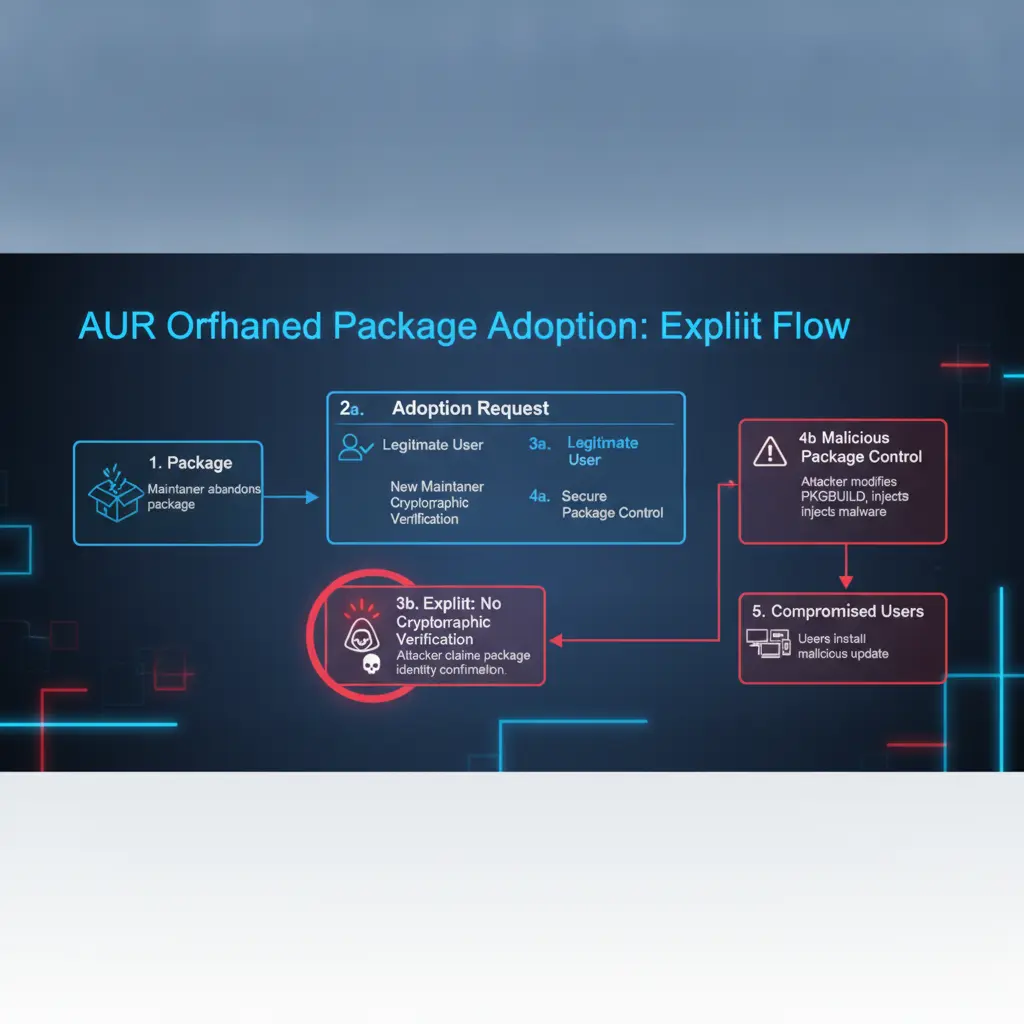
AUR packages are maintained by community members. When a maintainer ceases activity, a package can become "orphaned." The AUR system allows other users to request ownership of these orphaned packages. Crucially, this adoption process lacks cryptographic binding between a package's historical identity and its new maintainer. This procedural gap enables attackers to acquire control over projects that have accumulated significant community trust and user bases over time, without a robust verification of the new maintainer's legitimacy or continuity of trust.
Arbitrary Code Execution: The Core Trust Model
By design, the AUR build process inherently involves the execution of arbitrary code. This occurs primarily through PKGBUILD scripts and .install hooks, which are executed on the user's system with full user privileges. The security model of the AUR fundamentally relies on the trustworthiness of the package maintainers. When this trust is breached, as in the Atomic Arch campaign, the system becomes a direct conduit for arbitrary code execution on unsuspecting user systems.
Lack of Cryptographic Continuity: Eroding Trust
Ownership transfers within the AUR are procedural, not cryptographic. This means that when a new maintainer assumes control, there is no cryptographic link or audit trail that binds their identity or modifications to the original project's integrity. This absence of cryptographic continuity makes it exceptionally difficult for users to verify the authenticity and integrity of a package across ownership changes, allowing malicious modifications to blend seamlessly with legitimate project history.
Campaign Mechanics: Two Waves of Compromise
The Atomic Arch campaign unfolded in a calculated, multi-wave approach, demonstrating the threat actor's agility and intent to maximize impact.
Initial Infiltration: The First Wave (June 11, 2026)
The campaign commenced on June 11, 2026, with an initial wave targeting approximately 408 AUR packages. In this phase, attackers modified PKGBUILD files to inject a specific malicious line: npm install atomic-lockfile. This command was designed to pull down a seemingly innocuous npm package that, in reality, served as the initial stage of the malicious payload delivery.
Rapid Evolution: The Second Wave (June 12, 2026)
Within a mere 24 hours, the attackers adapted their methodology, pivoting to a new payload delivery mechanism. The second wave, occurring on June 12, 2026, saw the introduction of bun install js-digest, expanding the total number of affected packages to over 1,500. This rapid shift indicates a sophisticated adversary capable of quick iteration and evasion. Other malicious packages identified in the campaign include lockfile-js, further illustrating the breadth of their malicious dependency injection strategy.
The Exploit Chain: From Adoption to Execution
The attack chain was meticulously executed:
Package Adoption: Attackers systematically identified and claimed ownership of hundreds of dormant AUR packages that possessed established user bases and community trust.
Malicious Build Script Injection: Once ownership was secured, the attackers modified the
PKGBUILDfiles or.installhook scripts of the adopted packages. These modifications introduced post-install scripts designed to execute the maliciousnpmorBuninstall commands.Payload Delivery: The malicious dependencies (
atomic-lockfile,js-digest,lockfile-js) acted as loaders for a sophisticated, multi-stage payload.
The Malicious Payload Chain: Deepening the Compromise
The payload deployed by the Atomic Arch campaign is indicative of a highly capable adversary, designed for comprehensive data exfiltration and stealthy persistence.
Credential Stealer: A Rust-Written ELF Infostealer
Bundled within the malicious npm/Bun packages was a Rust-written executable, identified as a Linux ELF infostealer. This payload is engineered to harvest an extensive array of sensitive data, including:
GitHub keys and tokens
SSH data (keys, configurations)
HashiCorp Vault tokens
Browser cookies and session data
Saved data from communication tools: Slack, Discord, Microsoft Teams, Telegram
Docker and Podman credentials
VPN profiles
Shell histories
OpenAI/ChatGPT bearer tokens
The breadth of targeted credentials demonstrates a clear intent for lateral movement, cloud environment compromise, and access to intellectual property and sensitive communications.
eBPF Rootkit: Kernel-Level Concealment
On systems where the malware managed to obtain root access, it deployed an optional eBPF (extended Berkeley Packet Filter) rootkit, exemplified by scales.bpf.c. This rootkit represents a significant escalation in stealth capabilities. By leveraging eBPF, the malware achieves kernel-level concealment, specifically by hooking getdents64 to hide malicious processes, files, and network activity. This technique renders traditional detection and cleanup methods significantly more challenging, as the malicious components operate below the visibility of many standard security tools.
Persistence and Command and Control (C2)
Beyond data exfiltration and stealth, the malware established systemd persistence to ensure its continued operation across reboots. For command and control, the infostealer communicated with a Tor hidden service C2 server (olrh4mibs62l6kkuvvjyc5lrercqg5tz543r4lsw3o6mh5qb7g7sneid.onion). A temp.sh fallback mechanism was also identified, indicating redundant C2 channels for resilience against disruption.
Threat Actor Analysis and Attribution
While no specific threat actor group has been officially attributed to the Atomic Arch campaign, intelligence analysis indicates a high confidence assessment that it is operated by the same entity or utilizes the same toolkit as the previously observed "IronWorm" campaign. This assessment is based on a confluence of shared characteristics and tradecraft:
Shared Tooling: Both campaigns utilized a Rust-async ELF payload and deployed an eBPF rootkit.
C2 Infrastructure: The use of a Tor C2 server with an
/api/agentendpoint andtemp.shtradecraft is common to both.Naming Conventions: Similar
atomic-*npm naming conventions were observed across both campaigns.
The attackers further demonstrated sophistication by impersonating trusted maintainers, including accounts like "arojas," "krisztinavarga," "custodiatovar," and "veramagalhaes." They also spoofed Git commit metadata, making their malicious modifications appear legitimate and harder to discern during casual review.
Operational Impact and Affected Systems
The Atomic Arch campaign primarily impacts users of Arch Linux and its derivatives, particularly those interacting with the AUR. It is crucial to note that the official Arch Linux repositories were not affected by this campaign; the compromise was specific to the community-maintained AUR.
Directly affected user environments include:
Arch Linux and Arch-based distributions: This encompasses popular distributions such as EndeavourOS and Manjaro, where users install or update AUR packages.
Self-hosted CI runners or build agents: Any CI/CD infrastructure running Arch Linux that installs AUR packages as part of its build process is at risk.
Windows developers running Arch under WSL2: Developers utilizing Windows Subsystem for Linux 2 (WSL2) with Arch instances that install AUR packages are also vulnerable.
Strategic Mitigations and Response
Effective response to the Atomic Arch campaign requires both immediate incident response actions and long-term strategic adjustments to an organization's security posture. BreachModal emphasizes a proactive, defense-in-depth approach.
Immediate Incident Response Actions
Identify Affected Systems: Conduct a thorough enumeration of all Arch and Arch-derivative systems within your environment. This includes laptops, lab machines, and especially self-hosted CI runners or build agents. Review AUR install and upgrade histories since early June 2026, cross-referencing against known-bad package lists identified during the campaign.
Assume Compromise and Rotate Credentials: If any malicious package was executed on a system, assume full credential exposure. Immediately rotate all sensitive credentials that were present or used on affected machines. This list is extensive and includes:
SSH keys
GitHub tokens
npm tokens
Cloud API keys
Vault tokens
Any other secrets stored in configuration files or environment variables. Additionally, invalidate browser sessions and regenerate passkeys, particularly for administrative and Single Sign-On (SSO) accounts.
System Rebuild: For any host where the malicious payload may have run, especially if it obtained root access (due to the eBPF rootkit), treat the system as fully compromised. A complete system rebuild from trusted media is the only reliable mitigation. Re-provision the system with fresh credentials. A one-off malware scan is insufficient due to the eBPF rootkit's stealth capabilities, which can conceal malicious processes and files from standard detection tools.
Proactive Defense and Hardening Strategies
AUR Usage Policy Review: Temporarily cease installing or updating any AUR packages until the Arch Linux community provides a definitive "green signal" that the situation is fully handled and mitigated. In the long term, establish strict policies for AUR package usage, prioritizing official repositories and verified sources where possible.
Enhanced Behavioral Monitoring: Implement robust behavioral monitoring on all build hosts and CI/CD runners. Focus on detecting anomalous activities such as:
Unexpected package manager calls during build steps.
Unusual network egress, especially during non-standard build phases.
Creation of suspicious
systemdunits or eBPF objects.Anomalous outbound connections to paste sites, file-sharing services, or Tor network endpoints.
Scrutinize
PKGBUILDand.installScripts: Develop and enforce a policy of rigorous review for allPKGBUILDand.installscript changes, even for packages from established projects. Attackers exploit trust in existing legitimate packages. Automated tooling forPKGBUILDanalysis and diffing can significantly aid in identifying injected malicious lines.Software Supply Chain Risk Management (SCRM): Integrate comprehensive SCRM practices. This includes maintaining an inventory of all open-source dependencies, assessing their provenance, and continuously monitoring them for known vulnerabilities or suspicious activity. Implement automated scanning for malicious packages within build pipelines.
The Broader Implications for Software Supply Chain Security
The Atomic Arch campaign is not an isolated incident but rather a potent illustration of a growing trend: the targeting of open-source, community-maintained software ecosystems. As organizations increasingly rely on open-source components, the attack surface expands dramatically. Adversaries recognize that compromising a widely used open-source package offers a scalable vector for infiltrating numerous downstream targets.
This campaign underscores several critical considerations for modern cybersecurity strategy:
Trust in Open Source: The implicit trust placed in open-source communities, while foundational to their success, is also their most significant vulnerability. Robust verification mechanisms, independent auditing, and cryptographic assurances are no longer optional but essential.
The Evolving Linux Threat Landscape: Linux environments, once perceived as less targeted than Windows, are now prime targets for sophisticated, multi-stage malware, including advanced rootkits like those leveraging eBPF.
CI/CD Pipeline Security: Self-hosted CI/CD runners and build agents are high-value targets. Compromising these allows attackers to inject malicious code directly into production artifacts or gain access to sensitive build secrets.
FINAL VERDICT
The Atomic Arch campaign represents a sophisticated and impactful supply chain attack that exploited fundamental trust mechanisms within the Arch User Repository. Its use of advanced techniques, including eBPF rootkits and multi-stage payloads, underscores the evolving threat landscape for Linux environments and open-source software supply chains. Organizations must move beyond reactive security measures and adopt a proactive, intelligence-driven approach to defend against such pervasive threats.
BreachModal's expertise in adversarial simulation, breach response, and digital defense strategy positions us uniquely to assist organizations in fortifying their defenses against complex supply chain attacks like Atomic Arch. Our intelligence-led approach ensures that your security posture is resilient against the most sophisticated adversaries.