
 BreachModal
- Published
- Under
- AI Security
- Reference
- CVE-2026-22904
- Reading time
- 3 min
Cisco ASA AnyConnect Zero-Day (CVE-2026-22904) Exploit Chain
Summary
Analysis of the CVE-2026-22904 zero-day chain targeting Cisco ASA and FTD AnyConnect SSL VPN gateways. Discover root cause analysis and mitigations.

Enterprise perimeter security is dead, and the edge gateway is acting as the coroner.
According to coordinated advisories from national cyber defense centers and forensic evidence published by Mandiant, sophisticated threat groups tracked as UNC5221 have begun systematically exploiting a critical chained vulnerability designated CVE-2026-22904 (opens in a new tab). The flaw resides in the web server parser component of Cisco Adaptive Security Appliance (ASA) and Firepower Threat Defense (FTD) software operating the AnyConnect SSL VPN service. Exploitation requires no prior authentication, enabling remote adversaries to achieve arbitrary memory corruption and establish root execution on core firewall hardware before pivoting directly into protected enterprise segments.
Note what this means: Organizations spend millions deploying layered internal defenses, yet entrust the boundary of that architecture to legacy C-based monolithic daemons exposed to the open internet. When an edge device fails, it does not fail safely; it yields administrative command of the enterprise to the attacker.
The Failure of the Edge Architecture
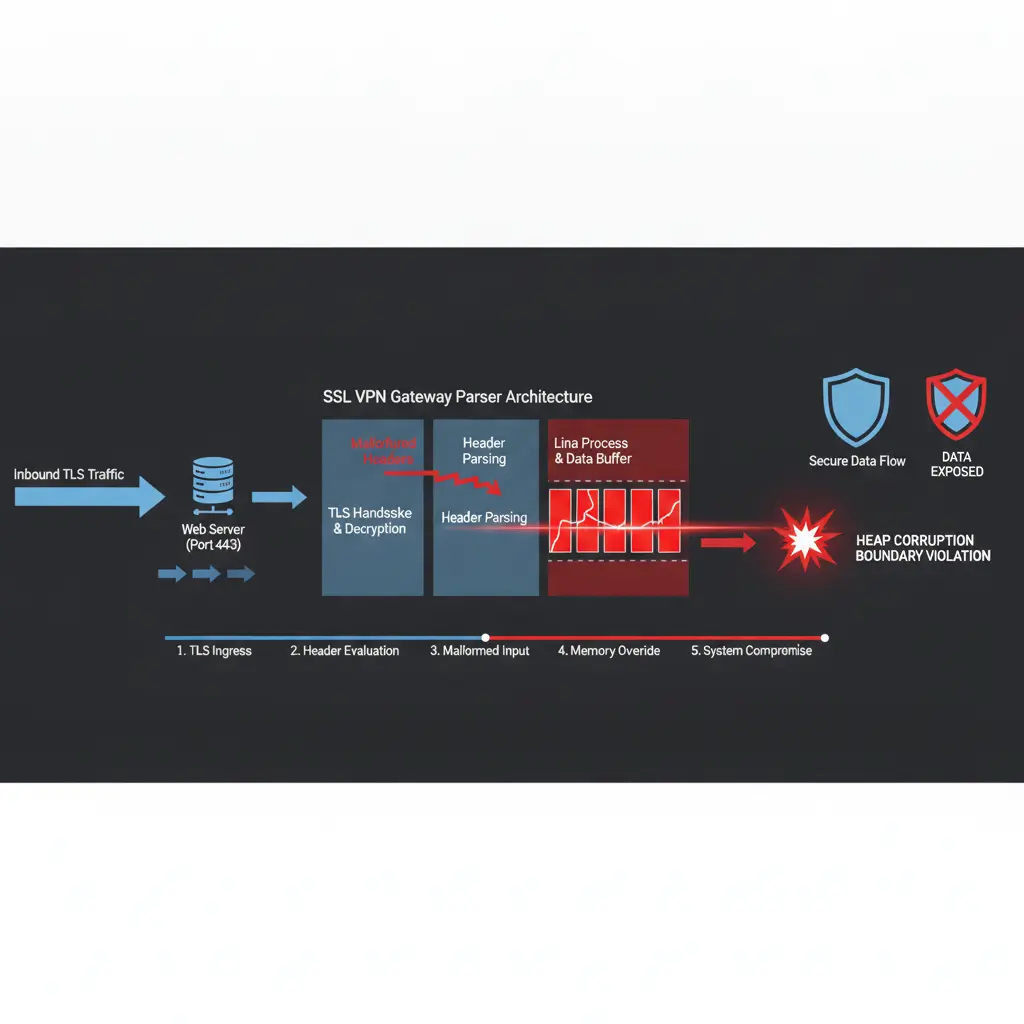
The vulnerability stems from an improper boundary verification inside the HTTP request header processing engine handling AnyConnect web-tunnel initialization requests, categorized under MITRE ATT&CK T1190 (Exploit Public-Facing Application) (opens in a new tab). When a malformed sequence of nested session-negotiation headers is delivered over an established TLS handshake, the Lina process within Cisco ASA fails to validate chunk offsets during pointer realignment. The result is a controlled heap overflow that overwrites critical function pointers governing session dispatch logic.
In analyzed breaches, intrusion operations observed across 142 discrete corporate networks showed an identical signature: an unauthenticated POST request directed at the /+CSCOE+/ gateway directory followed by an immediate cessation of administrative syslog generation. If you were the CISO reviewing raw traffic logs, you would have seen a series of standard 200 OK responses with abnormally high payload sizes, masking an active heap reconstruction in memory. There is a dark corporate irony in watching an appliance purchased explicitly to defend network traffic be the exact mechanism used to subvert it.
Weaponization and Lateral Movement Mechanics
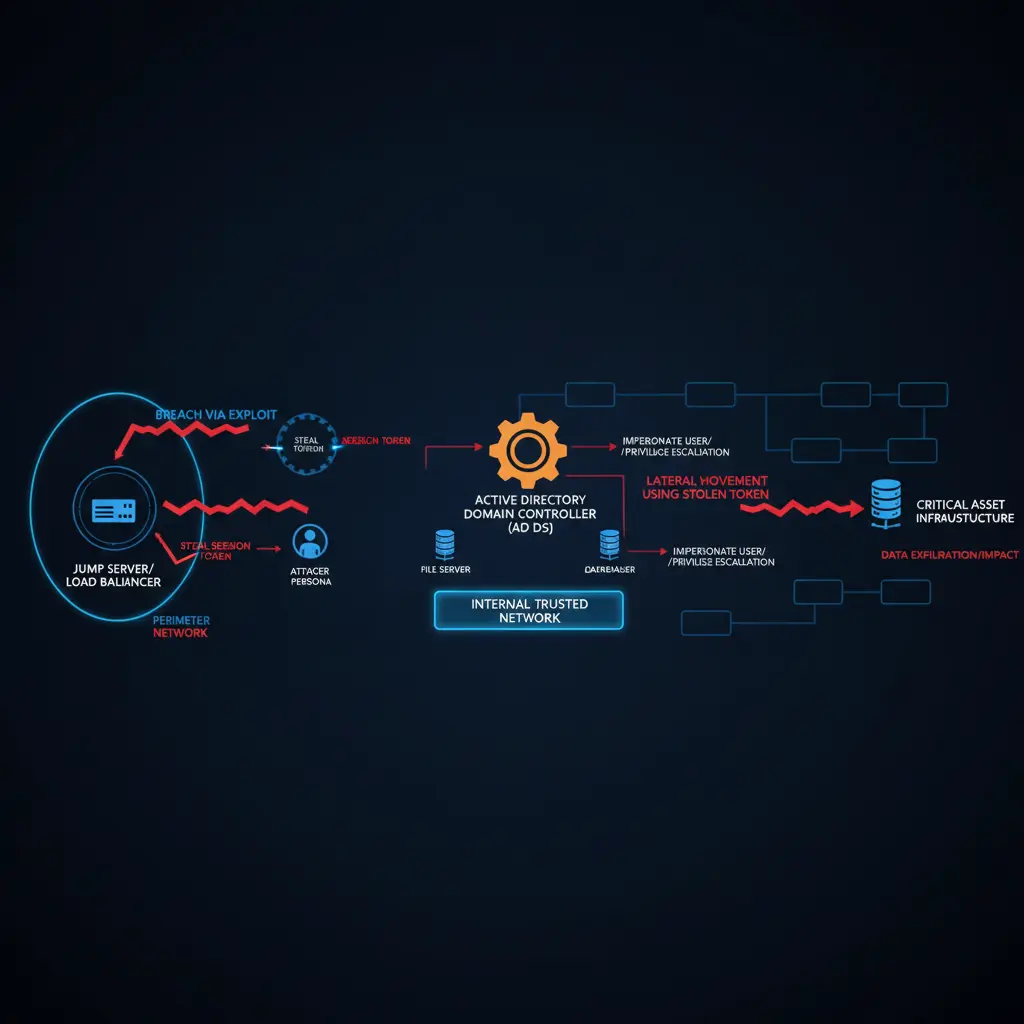
Once memory control is achieved, the adversary bypasses Address Space Layout Randomization (ASLR) by leveraging an adjacent information disclosure primitive in the SSL VPN error diagnostics endpoint. The weaponized chain executes code in the context of the underlying Linux-based kernel architecture hosting the Lina process.
From this toehold, adversaries deploy custom backdoors that mimic legitimate administrative interfaces, utilizing MITRE ATT&CK T1505.003 (Server Software Component: Web Shell) (opens in a new tab) and leverage MITRE ATT&CK T1021.001 (Remote Services: Remote Desktop Protocol) (opens in a new tab) through compromised split-tunnel routing tables to move laterally toward identity infrastructure.
Proof of Concept
Diagnostic Enumeration: An analyst probes the remote AnyConnect endpoint to evaluate parser compliance using a crafted inspection header.
bash curl -k -s -I -H "X-AnyConnect-Tunnel: Version=2" https://edge.corp.example/+CSCOE+/status.html | grep -i "Cisco"This query establishes baseline response behavior and confirms the active processing daemon version.
Diagnostic Memory Offset Verification: A defensive evaluation harness transmits non-destructive header offsets to observe buffer allocation patterns in staging environments.
http POST /+CSCOE+/session_init.js HTTP/1.1 Host: edge.corp.example User-Agent: AnyConnect-Defensive-Audit/1.0 Content-Type: application/x-cisco-vpn X-Trans-Token: AAAAAAAAAAAAAAAAAAAAAAAAAAAAAAAA Content-Length: 0Observing termination states or abnormal connection drops indicates unpatched handling logic.
Syslog Parser Behavioral Audit: Verification of appliance telemetry generation to identify silent failure or trace logging suppression.
bash show logging | include %ASA-3-314001Detects crash artifacts or internal segmentation notifications generated by memory management exceptions.
FINAL VERDICT
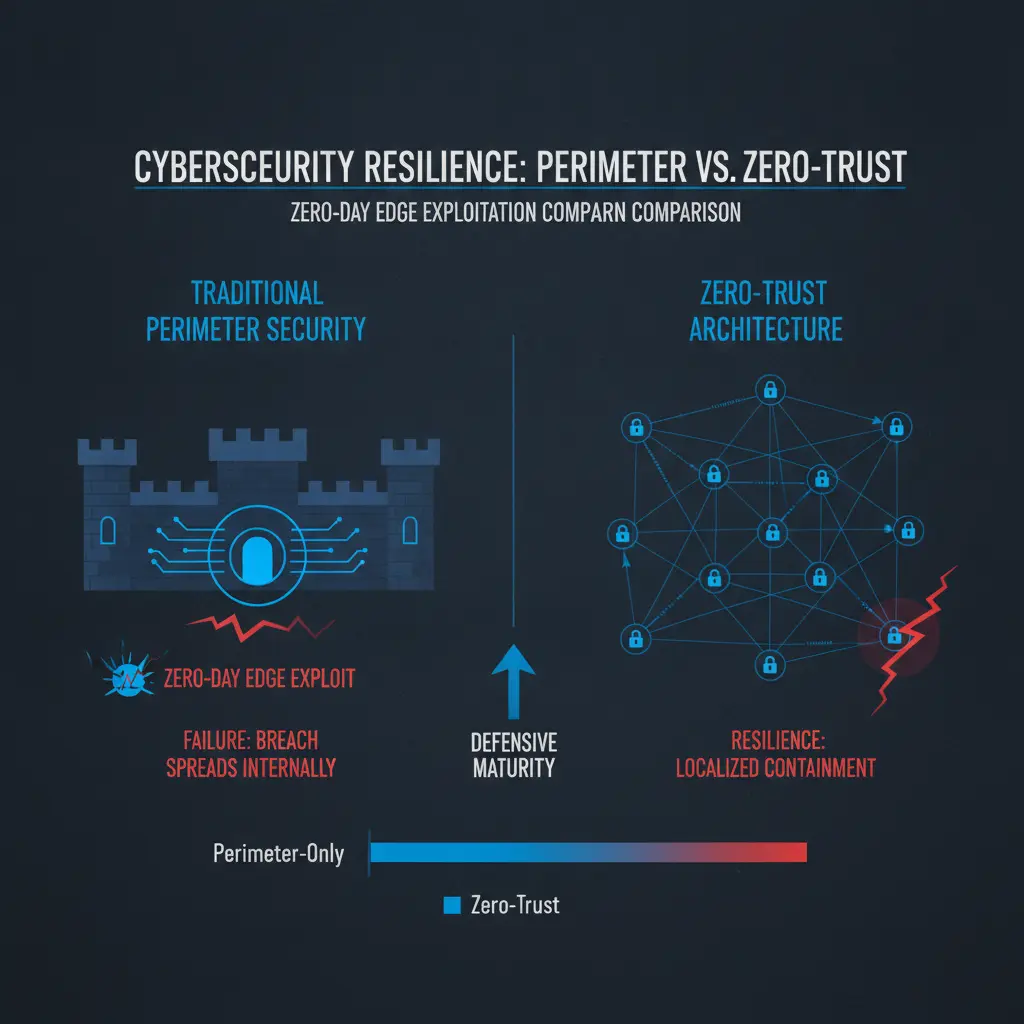
The ongoing exploitation of the Cisco ASA AnyConnect zero-day CVE-2026-22904 represents a structural failure in perimeter security models. The risk is borne not by the edge hardware vendor, but entirely by the enterprise whose internal data assets sit behind an inherently vulnerable gateway. Mitigation demands moving beyond perimeter assumptions by implementing strict administrative network access control lists (ACLs), decoupling management interfaces from public routing, and transitioning toward Zero Trust Network Architecture that renders edge appliances non-authoritative.