
 BreachModal
- Published
- Under
- Supply Chain Security
- Reading time
- 5 min
Jscrambler npm Compromise Deploys Rust Infostealer
Summary
Analysis of the jscrambler npm supply chain attack. Version 8.14.0 was compromised to deliver a Rust infostealer targeting developer secrets. Learn IoCs & mitigation.
A compromised release of the popular jscrambler npm package transformed developer machines into data harvesting nodes, deploying a sophisticated Rust-based infostealer via a trusted installation process.
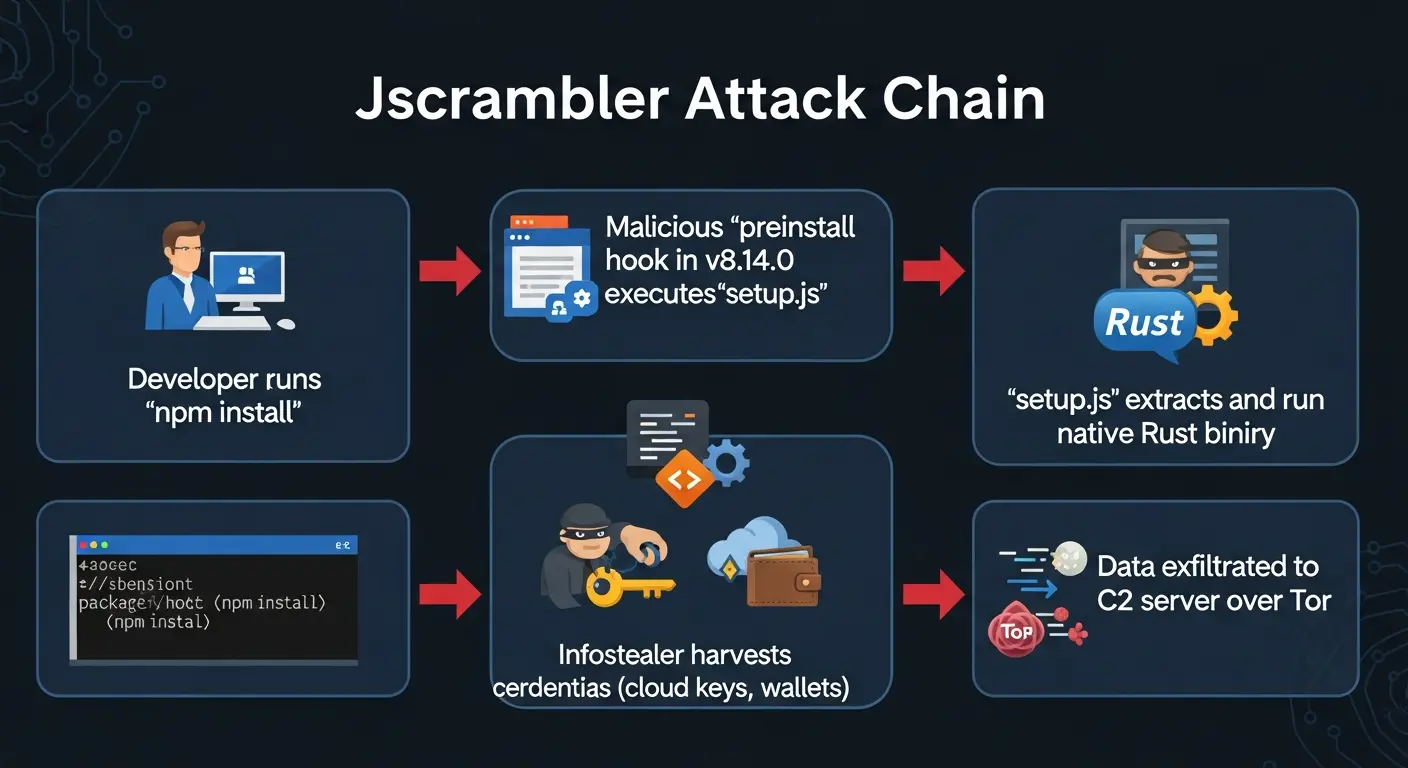
On July 11, 2026, threat actors published jscrambler version 8.14.0 to the official npm registry, embedding a malicious preinstall hook. According to security researchers who first identified the anomaly, this hook automatically executed a setup.js script (SHA256: a742de963f14a92d24ebcbc7b44ac867e23a20d31d1b0094a13a4f83287f4e60) upon installation. This script then unpacked a platform-specific Rust infostealer from a file named intro.js (SHA256: a41a523ef9517aab37ed6eea0ec881821bdcb7aefcb5c5f603adc7907f868c86), which was not a script but a container for gzip-compressed binaries for Windows, macOS, and Linux.
Note what this means: the fundamental trust model of open-source package management has been weaponized. The attack did not require a vulnerability in Node.js or npm itself, but rather exploited a standard, documented feature—preinstall scripts—that developers rely on for legitimate package setup. This incident is a systemic failure, highlighting how economic incentives to steal high-value developer credentials (cloud keys, crypto wallets) directly target the weakest points in the software development lifecycle: dependency management.
Anatomy of the Jscrambler NPM Compromise
The attack vector was brutally efficient. By compromising the legitimate jscrambler npm account or its build pipeline, the adversary pushed a trojanized version directly to the public registry. Any developer, build server, or CI/CD pipeline that ran npm install or npm update and pulled in jscrambler@8.14.0 was immediately compromised.
The execution chain began with the package.json file's "preinstall": "node dist/setup.js" directive. This command is a tripwire; it executes before the package's own dependencies are even installed, guaranteeing the malware runs early. The setup.js script performed OS detection, extracted the correct native binary for the host system, wrote it to a temporary directory with a randomized name, and executed it as a detached, hidden process.
This jscrambler npm compromise demonstrates a mature understanding of developer workflows, turning a routine package installation into an unauthenticated remote code execution event.
The Rust Infostealer: A Developer's Worst Nightmare
Once active, the Rust-based payload was a digital vacuum cleaner for developer secrets. It was not a generic commodity malware; it was purpose-built to target the high-value assets present on engineering workstations and build servers. The malware, whose Windows PE hash is b7ca95d1b23c8e67416a25cedf741de0917c2096bbc9d24649eea7853d054903, systematically exfiltrated a specific and devastating list of credentials.
Mandiant research on similar infostealers confirms that threat actors prioritize data that offers immediate financial return or deeper network access. The jscrambler stealer targeted:
Cloud Credentials: AWS, Azure, and Google Cloud keys, including those exposed via instance metadata endpoints common in CI runners.
Cryptocurrency Wallets: Seed phrases and private keys for MetaMask, Phantom, and Exodus.
Password Managers: Local vaults for Bitwarden.
Session Tokens: Active sessions for Discord, Slack, Telegram, and Steam.
Browser Data: Stored passwords, cookies, and browsing history.
The payload used a combination of hard-coded IP addresses and Tor for its command-and-control (C2) communications, making network-based detection more challenging. This was a targeted credential harvesting campaign against the most privileged users in any organization: its developers.
Persistence and Evasion
The attackers planned for the long term. The rust infostealer was not a simple smash-and-grab tool; it established persistence to survive reboots and maintain access. On Windows systems, it created a hidden scheduled task configured to relaunch the malware every minute. On macOS, it installed a LaunchAgent that re-executed the payload upon user login.
This tactic aligns with the MITRE ATT&CK technique T1195.001: Compromise Software Supply Chain (opens in a new tab), where initial access leads to persistent footholds. The malware also included anti-debugging checks to hinder analysis by security researchers. If you were the CISO here, you would have seen anomalous process executions spawning from node.exe or your build runner, followed by outbound connections to unknown IPs—a clear signal of compromise.
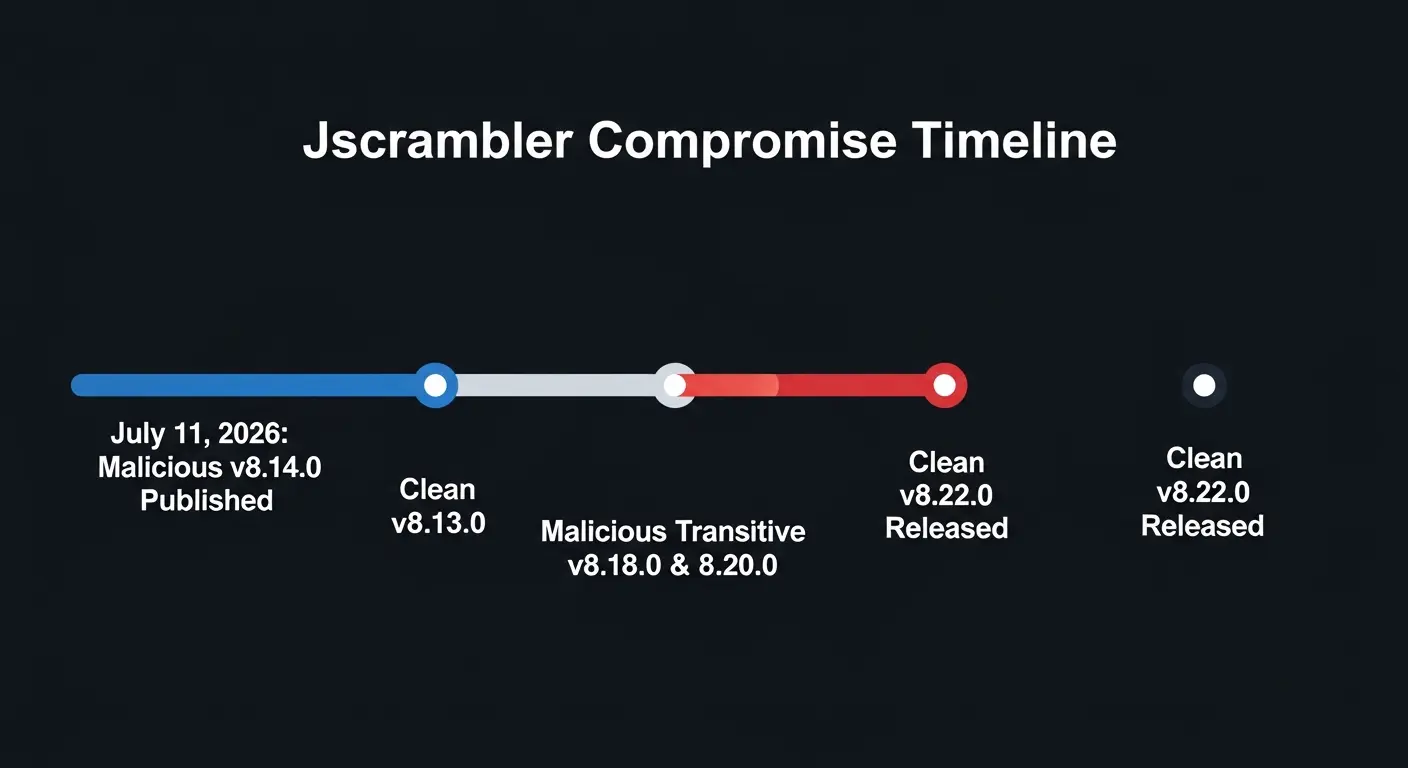
The use of transitive dependencies also broadened the victim pool. Researchers found that versions 8.18.0 and 8.20.0 of jscrambler also pulled in the malicious release, compromising teams who may not have directly specified the originally tainted version. This highlights the cascading risk inherent in modern software development.
Proof of Concept
This walkthrough demonstrates how to safely observe the behavior of a preinstall hook exploit in a controlled environment. Do not use the actual malicious hashes or packages. This is a simulation using benign stand-in files.
Environment Setup: Create a new directory and initialize a new npm project.
bash mkdir jscrambler-poc && cd jscrambler-poc npm init -y mkdir -p node_modules/malicious-pkg/distThis creates a project and a fake package directory to simulate the compromised dependency.
Create Malicious
preinstallScript: Create a filenode_modules/malicious-pkg/dist/setup.jsthat simulates the malware dropper.javascript // node_modules/malicious-pkg/dist/setup.js const fs = require('fs'); const path = require('path'); console.log('!!! MALICIOUS PREINSTALL SCRIPT TRIGGERED !!!'); const droppedFilePath = path.join(__dirname, 'payload.txt'); fs.writeFileSync(droppedFilePath, 'This file represents the dropped binary.'); console.log(`Payload dropped to: ${droppedFilePath}`);This script logs a warning and writes a harmless text file to simulate the binary being dropped.
Define the Malicious Package: Create the
package.jsonfor the fake malicious package.json // node_modules/malicious-pkg/package.json { "name": "malicious-pkg", "version": "1.0.0", "description": "", "main": "index.js", "scripts": { "preinstall": "node dist/setup.js" }, "author": "", "license": "ISC" }The critical line here is
"preinstall": "node dist/setup.js".Trigger the Exploit: In the root of your
jscrambler-pocdirectory, modify your mainpackage.jsonto include the malicious package as a dependency and runnpm install.bash **Add this to your dependencies in package.json:** **"malicious-pkg": "file:node_modules/malicious-pkg"** npm installThis command forces npm to process the local fake package, triggering its
preinstallhook.
FINAL VERDICT
The jscrambler npm compromise is a definitive statement on the state of software supply chain security: implicit trust is a critical vulnerability. The risk is borne not just by the developers who install these packages, but by every organization whose data, infrastructure, and intellectual property are managed by code built with them. What must change is the default posture. Organizations must move from a model of blind trust in public registries to one of proactive verification, implementing policies that disable or sandbox package installation scripts and employing runtime monitoring that can detect the anomalous behavior of a compromised build process. The rust infostealer wasn't just code; it was the invoice for our collective technical debt in supply chain security.
BreachModal's Adversarial Simulation and Breach Response teams specialize in identifying and neutralizing these advanced supply chain threats. Contact us to secure your development lifecycle. (opens in a new tab)