
 BreachModal
- Published
- Under
- Threat Intelligence
- Reference
- CVE-2026-64638
- Reading time
- 5 min
WordPress XSS to RCE (CVE-2026-64638): A Critical Analysis
Summary
Deep-dive into CVE-2026-64638, a critical WordPress XSS to RCE vulnerability. Understand the XSS2Shell attack chain and apply immediate mitigations.

A fundamental disagreement between two core WordPress sanitization functions has created a pre-authentication attack path allowing full server compromise via the login page.
The vulnerability, tracked as CVE-2026-64638 (opens in a new tab) and dubbed "XSS2Shell," was discovered by researchers at the firm pwn.ai on July 26, 2026. According to their disclosure report, the flaw allows an unauthenticated attacker to achieve stored Cross-Site Scripting (XSS) on the WordPress login screen, which can be chained to achieve Remote Code Execution (RCE). The flaw affects WordPress versions 6.4 through 7.0.2 and was patched in the emergency security release 7.0.3, detailed in advisory GHSA-52p2-r8wf-jcrf (opens in a new tab).
Note what this means: The entire security model of the world's most popular content management system rested on the flawed assumption that two different sanitization functions—strip_tags() and wp_kses_post()—would interpret malformed HTML identically. This is not a bug in a single feature; it is a systemic failure in defensive programming, where inconsistent parsing logic becomes an exploitable vector. It appears that after two decades, convincing PHP to agree with itself on what constitutes an HTML tag remains a surprisingly difficult problem.
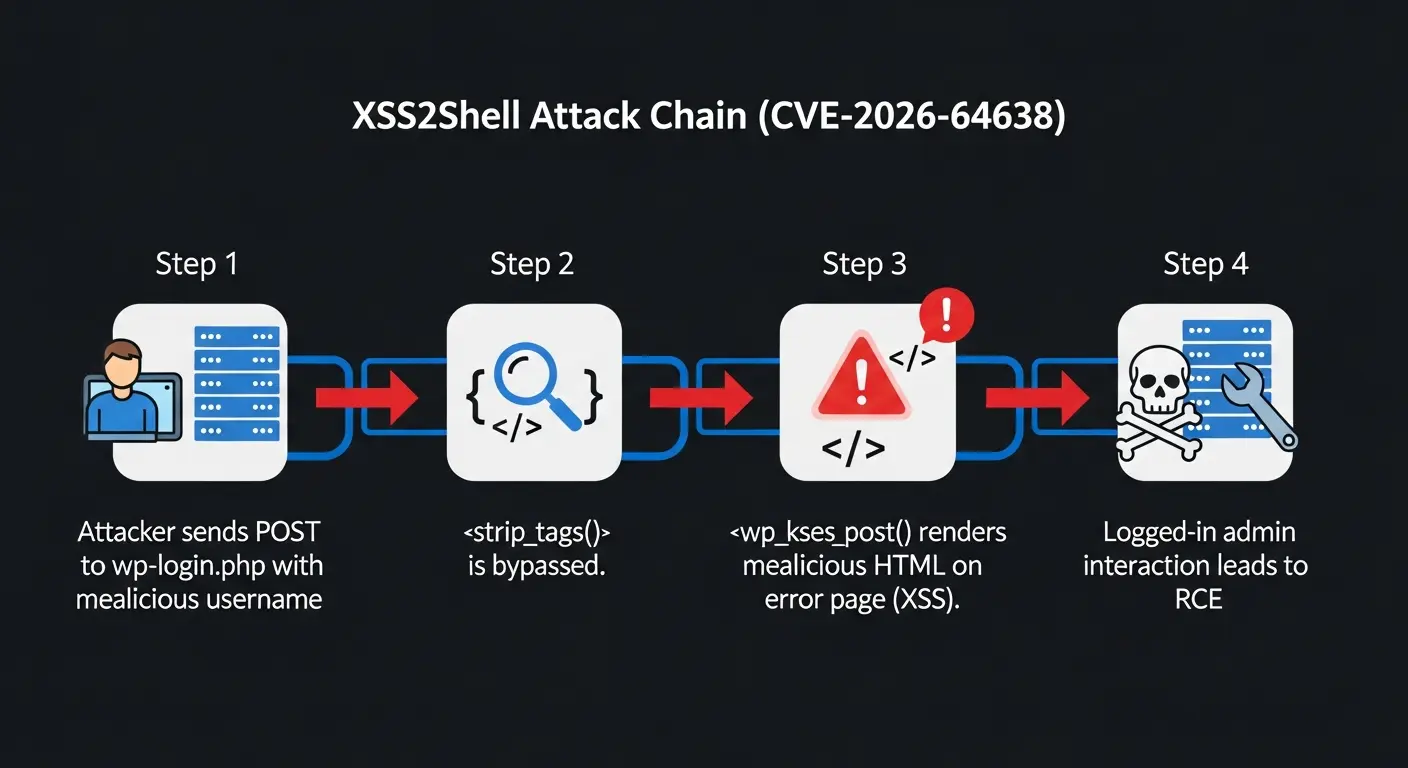
Anatomy of the WordPress XSS to RCE Attack
The XSS2Shell exploit leverages a subtle but critical discrepancy in HTML parsing. An attacker submits a failed login attempt with a specially crafted username, such as user< area onmouseover=alert(1)>. WordPress's initial sanitization using PHP's strip_tags() function fails to recognize < area as a valid tag due to the trailing space and leaves the string intact.
However, when this username is later passed to wp_kses_post() for display on the login error page, its more lenient parser interprets < area ...> as a valid HTML element. This allows the attacker to inject arbitrary DOM elements and, consequently, execute JavaScript in the context of the site's origin. This initial vector requires zero authentication and a single HTTP request.
Escalating this XSS to RCE requires a second stage. The pwn.ai researchers demonstrated a chain using a Same Origin Method Execution (SOME) technique, first detailed by researcher Paulos Yibelo in 2022. This requires a logged-in administrator to interact with an attacker-controlled page, which then uses the initial XSS vulnerability to perform privileged actions on their behalf, such as uploading a malicious plugin or creating a new admin user. This escalation path is a classic example of why even a simple reflected XSS can become a critical incident.
Technical Breakdown: The Parser Disagreement
The root cause lies in wp-login.php and the inconsistent data handling between two security functions. The login error message flow in WordPress 6.4 and later routes the failed username through wp_kses_post() to prevent HTML injection. The vulnerability exists because the upstream validation does not use the same parsing rules.
Here’s the evidence chain:
Attacker Request: An attacker sends a POST request to
/wp-login.phpwith a username likebadactor< area onmouseover=alert(document.domain)>.Initial Check (Bypass): The
strip_tags()function is called at an early stage. It sees< areaand considers it plain text, not a tag, so the string passes through unmodified.Error Page Render (Exploit): The unmodified username is embedded in the error message. This message is then sanitized by
wp_kses_post(). Its parser recognizes<area>as a valid tag, allowing theonmouseoverevent handler to be injected into the page's DOM.Execution: The JavaScript payload executes automatically on the login page via
user-profile.js, achieving pre-authentication XSS.
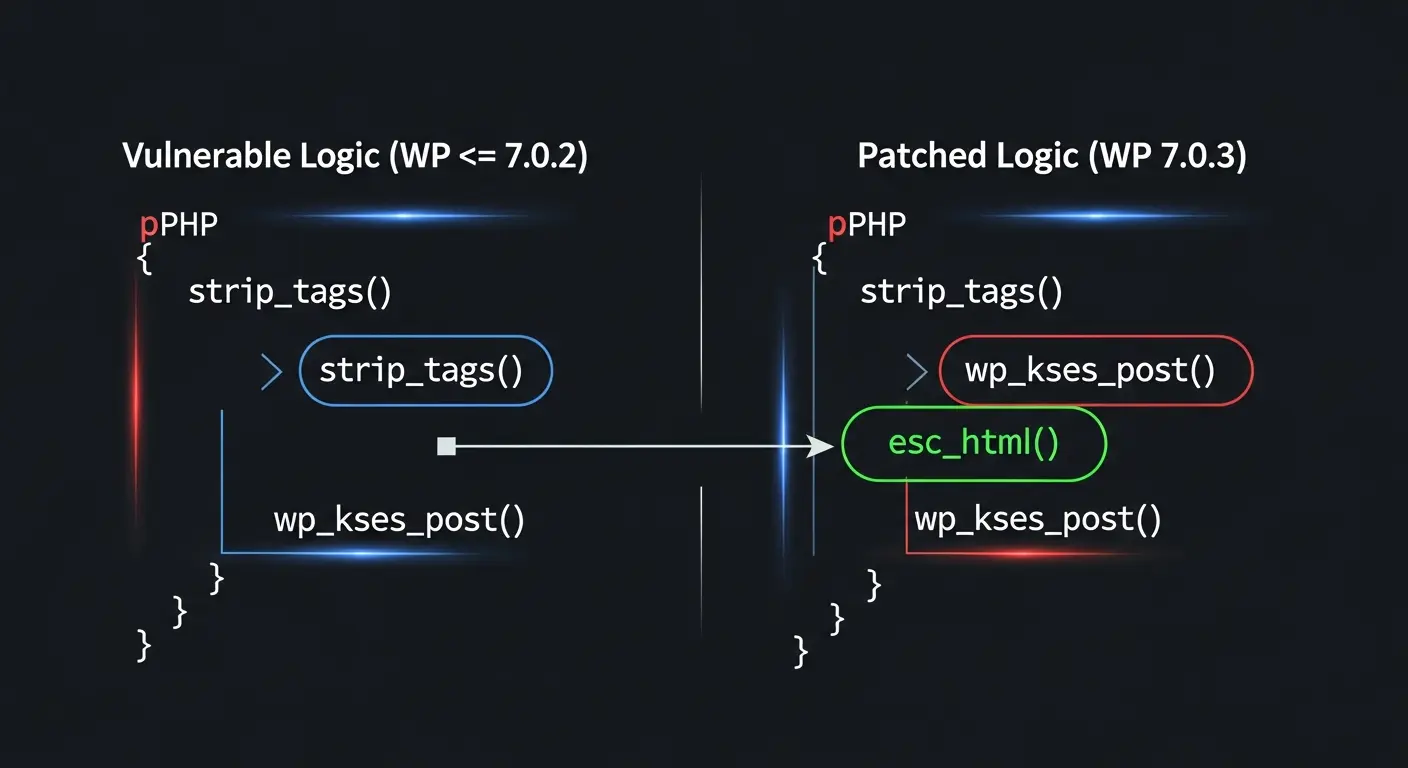
This core parser flaw is the linchpin of the entire WordPress XSS to RCE attack. The fix implemented in WordPress 7.0.3 involves adding stricter escaping functions like esc_html() before the data reaches wp_kses_post(), ensuring that any potentially malicious characters are neutralized before they can be misinterpreted as HTML.
Proof of Concept
This walkthrough demonstrates the initial pre-authentication XSS vector of CVE-2026-64638. This requires a vulnerable WordPress instance (versions 6.4 to 7.0.2) accessible over the network.
Identify Target: Locate the login page of a vulnerable WordPress installation, typically at
https://target-domain.com/wp-login.php.Craft Payload: Create the malicious username payload. This uses a malformed HTML tag that bypasses one filter but is interpreted by another. The
onmouseoverevent is a simple way to trigger the JavaScript without user interaction, as it fires when the mouse moves over the page body.http POST /wp-login.php HTTP/1.1 Host: target-domain.com Content-Type: application/x-www-form-urlencoded log=x<area onmouseover=alert('XSS-PoC-Success')>&pwd=fakepassword&wp-submit=Log+InSend Request: Use a tool like
curlor Burp Suite to send the crafted POST request to the login page.bash curl -X POST -d "log=x<area onmouseover=alert('XSS-PoC-Success')>&pwd=fakepassword&wp-submit=Log+In" https://target-domain.com/wp-login.phpObserve Result: Load the
/wp-login.phppage in a web browser. The server's response from the failed login will contain the injected<area>element. As soon as you move your mouse over the page, the JavaScriptalert()will execute, confirming the XSS vulnerability.
Mitigation and Strategic Response
Immediate patching is the only effective primary mitigation for CVE-2026-64638. Organizations running WordPress must upgrade to version 7.0.3 or a patched version of their respective branch (backports are available down to 4.7).
For organizations where immediate patching is not possible, the following layered defenses are critical:
WAF Rule Implementation: Deploy a virtual patch at the network edge (e.g., via a Web Application Firewall) to block requests to
/wp-login.phpcontaining the pattern<\s+[a-zA-Z]in thelogparameter.Disable Unused Features: The RCE escalation path demonstrated by pwn.ai leverages Application Passwords. If this feature is not in use, disable it to reduce the attack surface.
Harden
wp-config.php: Add the constantdefine('DISALLOW_FILE_MODS', true);to yourwp-config.phpfile. This prevents administrators from using the dashboard to edit plugin and theme files, thwarting a common RCE payload delivery mechanism.
Ultimately, this incident highlights the significant risk posed by ubiquitous, self-hosted applications. Failure to maintain a constant patching cadence is not a technical debt problem; it is an active security failure. The CISA KEV catalog is filled with vulnerabilities just like this one—known, patched, and actively exploited against organizations that failed to act.
FINAL VERDICT
The CVE-2026-64638 WordPress XSS to RCE vulnerability is a critical failure of input validation within the world's most dominant CMS, creating an unauthenticated attack vector that is trivial to trigger. The risk is borne by millions of businesses, publishers, and government agencies who rely on WordPress. The only acceptable response is immediate patching to version 7.0.3. This incident is a stark reminder that security is not a feature but a process, and that trust in core software components must be continuously verified, not assumed.
***
BreachModal's Adversarial Simulation teams specialize in testing for complex application logic flaws like CVE-2026-64638. Contact us to validate your defenses against real-world attack chains before they become a breach headline.