
 BreachModal
- Published
- Under
- Threat Intelligence
- Reference
- CVE-2026-0257
- Reading time
- 8 min
PAN-OS GlobalProtect Flaw (CVE-2026-0257) Actively Exploited
Summary
Palo Alto Networks PAN-OS GlobalProtect VPNs are under active attack via CVE-2026-0257 and CVE-2024-3400. Learn mitigation steps and IoCs from BreachModal.

Introduction: The Perimeter Has Been Breached
The digital perimeter, long considered the primary line of defense, is under sustained assault. Palo Alto Networks’ PAN-OS, the operating system powering a significant portion of the world's enterprise firewalls, is the current focal point for sophisticated threat actors. Two critical vulnerabilities in the GlobalProtect VPN feature, CVE-2026-0257 and the preceding CVE-2024-3400, are being actively exploited in the wild. This is not a theoretical threat; it is an active campaign.
The U.S. Cybersecurity and Infrastructure Security Agency (CISA) has added CVE-2026-0257 to its Known Exploited Vulnerabilities (KEV) catalog, a directive for federal agencies to patch and a clear signal to the private sector of the imminent threat. This vulnerability allows unauthenticated attackers to bypass authentication mechanisms and gain illicit access to secure networks. It represents a fundamental breakdown in the trust placed in perimeter security appliances.
This BreachModal intelligence briefing deconstructs the technical underpinnings of these vulnerabilities, details the observed threat actor activity, and provides actionable, strategic guidance for mitigation, threat hunting, and long-term defense hardening. The time for passive monitoring is over; decisive action is required.
Deep Dive: CVE-2026-0257 - The Authentication Bypass Flaw
CVE-2026-0257 is an authentication bypass vulnerability affecting the GlobalProtect portal and gateway components of PAN-OS. Its exploitation allows an adversary to establish an unauthorized VPN connection without valid credentials, effectively walking through the front door.
Technical Breakdown: A Flaw in Trust and Validation
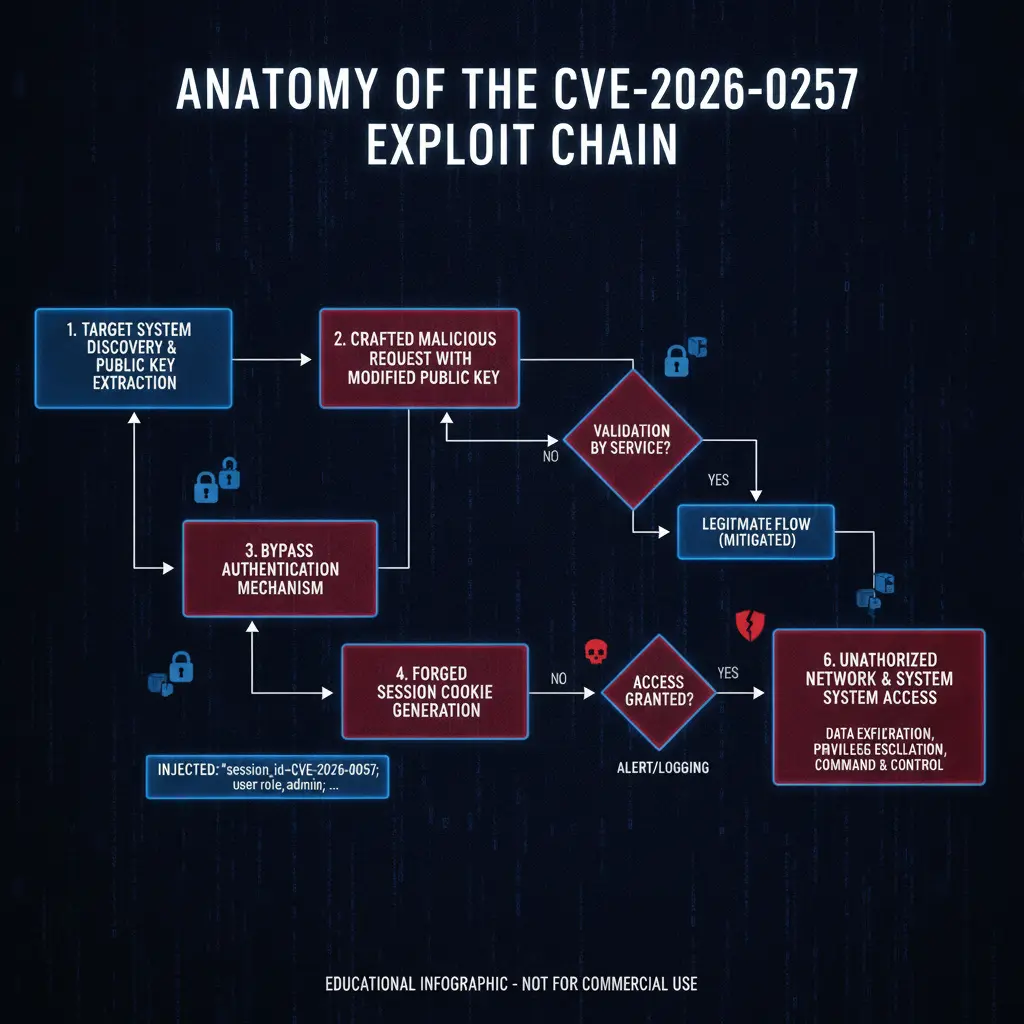
The vulnerability's root cause lies in a flawed implementation of authentication override cookies. In specific configurations, the firewall relies on these cookies to maintain user sessions without performing sufficient validation and integrity checking. The critical misstep occurs when the same certificate used to encrypt and decrypt these sensitive cookies is also used for the portal or gateway's public-facing HTTPS service.
This configuration flaw allows an attacker to:
Connect to the public-facing HTTPS service of the GlobalProtect portal.
Obtain the public key of the certificate used for the TLS session.
Use this public key to forge a cryptographically valid, but completely unauthorized, authentication override cookie.
Present this forged cookie to the VPN gateway.
The gateway, trusting the cookie's cryptographic signature, accepts it as valid and grants the attacker a VPN session, complete with an internal IP address. The trust model is broken; the attacker has minted their own valid credentials.
Attack Vector & Impact
The impact is direct and severe: an unauthenticated attacker on the internet gains authenticated access to the internal network. Palo Alto Networks' Unit 42 and security firm Rapid7 have observed active exploitation campaigns targeting this flaw. Threat intelligence indicates at least two distinct waves of attacks, likely from the same actor, characterized by consistent spoofed MAC addresses.
While widespread post-exploitation activity has not yet been detailed in all public reporting, the initial access achieved is the critical first step in nearly every major breach. Successful exploitation grants the adversary a foothold from which to conduct internal reconnaissance, move laterally, escalate privileges, and ultimately achieve their objectives, whether espionage or financial gain.
Affected PAN-OS Versions
Organizations must verify their PAN-OS versions against the following list. If your version is listed as 'earlier than' a patched version, you are vulnerable.
PAN-OS 12.1: Versions earlier than 12.1.4-h6 or 12.1.7.
PAN-OS 11.2: Versions earlier than 11.2.4-h17, 11.2.7-h14, 11.2.10-h7, or 11.2.12.
PAN-OS 11.1: Versions earlier than 11.1.4-h33, 11.1.6-h32, 11.1.7-h6, 11.1.10-h25, 11.1.13-h5, or 11.1.15.
PAN-OS 10.2: Versions earlier than 10.2.7-h34, 10.2.10-h36, 10.2.13-h21, 10.2.16-h7, or 10.2.18-h6.
Prisma Access is also confirmed to be affected.
Cloud NGFW and Panorama appliances are not impacted by this specific vulnerability.
The Precedent: CVE-2024-3400 - A Critical Command Injection Flaw
To fully understand the current threat landscape, it is essential to view CVE-2026-0257 in the context of its predecessor, CVE-2024-3400. This vulnerability set the stage and demonstrated threat actor focus on PAN-OS.
Anatomy of a Perfect 10.0 CVSS
CVE-2024-3400 is a command injection vulnerability in the GlobalProtect feature with a CVSS base score of 10.0—the highest possible severity. It allows an unauthenticated attacker to execute arbitrary code with root privileges on the firewall. This level of access effectively hands over complete control of the security appliance to the adversary.
This vulnerability, also added to CISA's KEV catalog, was actively exploited in the wild, with public exploit code becoming available shortly after its disclosure. It served as a clear warning of the intense adversary interest in PAN-OS devices.
The Telemetry Misconception
Initial reporting from Palo Alto Networks suggested that the device telemetry feature needed to be enabled for the firewall to be vulnerable to CVE-2024-3400. However, this was later corrected; telemetry is not a prerequisite for exploitation. This clarification significantly broadened the scope of vulnerable devices and underscored the complexity of assessing exposure during a developing threat.
Strategic Mitigation and Threat Hunting
Defending against these threats requires a multi-pronged approach encompassing immediate patching, tactical mitigation, and proactive threat hunting.
Immediate Patching Protocol
The primary and most effective defense is to apply the security updates provided by Palo Alto Networks immediately. The risk of exploitation far outweighs the operational risk of deploying a patch. A structured, emergency patching process should be initiated.
Identify: Use asset management systems to identify all PAN-OS devices running vulnerable versions.
Prioritize: Prioritize internet-facing devices with GlobalProtect enabled.
Test & Deploy: Apply the relevant patches during an emergency maintenance window.
Verify: Confirm that the patch has been successfully applied and the device is operating as expected.
Compensating Controls for CVE-2026-0257
If immediate patching is not feasible, implement the following mitigations. These are temporary measures and not a substitute for patching.
Disable Authentication Override: In the GlobalProtect portal and gateway configuration, disable the feature that allows for authentication override with cookies. This directly removes the vulnerable component from the equation.
Generate a Dedicated Certificate: If the feature cannot be disabled, generate a new, unique certificate to be used exclusively for the authentication override cookie feature. Ensure this certificate is not used for the gateway's HTTPS service or any other function. This breaks the attacker's ability to obtain the public key needed to forge cookies.
Threat Prevention Signatures for CVE-2024-3400
For CVE-2024-3400, customers with an active Threat Prevention subscription can leverage specific signatures to block exploitation attempts. Ensure that Threat IDs 95187, 95189, and 95191 are active and applied to the GlobalProtect interface's vulnerability protection profile.
Proactive Threat Hunting
Do not assume your organization is unaffected. Proactive hunting for Indicators of Compromise (IoCs) is critical. Security Operations Centers (SOCs) should immediately begin querying logs for evidence of exploitation.
Focus on GlobalProtect logs and firewall traffic logs. Look for:
Anomalous or unexpected successful VPN connections, especially from unusual geographic locations or IP ranges.
Connections matching known malicious IP addresses or hostnames provided in threat intelligence feeds.
VPN authentications associated with the spoofed MAC addresses identified by security researchers.
Any evidence of subsequent anomalous internal network traffic originating from a newly assigned VPN client IP address.
FINAL VERDICT
The active exploitation of CVE-2026-0257 and CVE-2024-3400 is a stark reminder that the network perimeter is no longer a fortified wall but a dynamic, high-risk attack surface. Trust in these critical devices cannot be implicit. The ability of an unauthenticated attacker to gain privileged network access by exploiting flaws in a trusted security appliance represents a worst-case scenario for many organizations.
Reactive patching, while essential, is insufficient. A modern defense strategy requires a proactive posture built on the assumption of compromise. This includes continuous monitoring, aggressive threat hunting, and—most importantly—adversarial simulation to validate that security controls and response procedures function as intended against real-world attack vectors.
Your firewall is being targeted. The time to act is now.