
 BreachModal
- Published
- Under
- Threat Intelligence
- Reading time
- 6 min
ShieldBreak: Microsoft Defender Zero-Day Patch Bypass Analysis
Summary
BreachModal analysis of CVE-2026-50656 (RoguePlanet) and the ShieldBreak exploit, a zero-day patch bypass for Microsoft Defender's EoP flaw.

A patched Microsoft Defender is no defense at all against the ShieldBreak exploit, a zero-day that fully bypasses Microsoft's fix for the critical CVE-2026-50656 local privilege escalation vulnerability.
The initial vulnerability, dubbed "RoguePlanet" and tracked as CVE-2026-50656, was disclosed by a researcher known by the handles "Chaotic Eclipse" and "INFINITE NIGHTMARE." It affects the Microsoft Malware Protection Engine (mpengine.dll) across all modern Windows platforms. According to the researcher's public disclosure, the flaw allows any low-privilege local user to escalate to NT AUTHORITY\SYSTEM. Microsoft addressed this with an engine update to version 1.1.26060.3008 in July 2026, but on August 12, 2026, the same researcher released ShieldBreak, a complete and functional patch bypass.
Note what this means: the very tool designed to protect Windows endpoints is itself the vector for total system compromise. When a security agent can be turned against the kernel, the traditional model of endpoint protection collapses. Why does this keep happening? Because security products operate at the highest privilege levels, making them the most valuable targets for attackers seeking to bypass the entire security stack in a single move.
Anatomy of the RoguePlanet Vulnerability (CVE-2026-50656)
The original RoguePlanet exploit targets a classic vulnerability pattern: a Time-of-Check to Time-of-Use (TOCTOU) race condition. Classified under CWE-362 (Race Condition) (opens in a new tab) and CWE-59 (Improper Link Resolution Before File Access) (opens in a new tab), the flaw exists in Defender's file scanning and quarantine pipeline.
The Microsoft Malware Protection Engine service (MsMpEng.exe) runs as NT AUTHORITY\SYSTEM. When it scans a file, it first checks the file's attributes and path. An attacker can create a scenario where, in the minuscule time gap between this check and the subsequent action (like deletion or quarantine), the original file is replaced with a symbolic link pointing to a protected system file. Defender's engine, having already validated the original path, proceeds to perform a privileged file operation on the attacker's chosen target.
If you were the CISO here, your logs would show MsMpEng.exe performing what looks like a legitimate quarantine operation, but the target file would be a highly sensitive system binary. The implication is that reliance on patching alone for critical infrastructure components is a failed strategy.
The ShieldBreak Exploit: A Failure of Logic
Microsoft's patch for CVE-2026-50656 attempted to close the TOCTOU window by improving path validation. However, the ShieldBreak exploit demonstrates this fix was insufficient. It doesn't re-exploit the original race condition but instead abuses a more complex logic flaw in how Defender handles specific file system interactions and scheduled tasks.
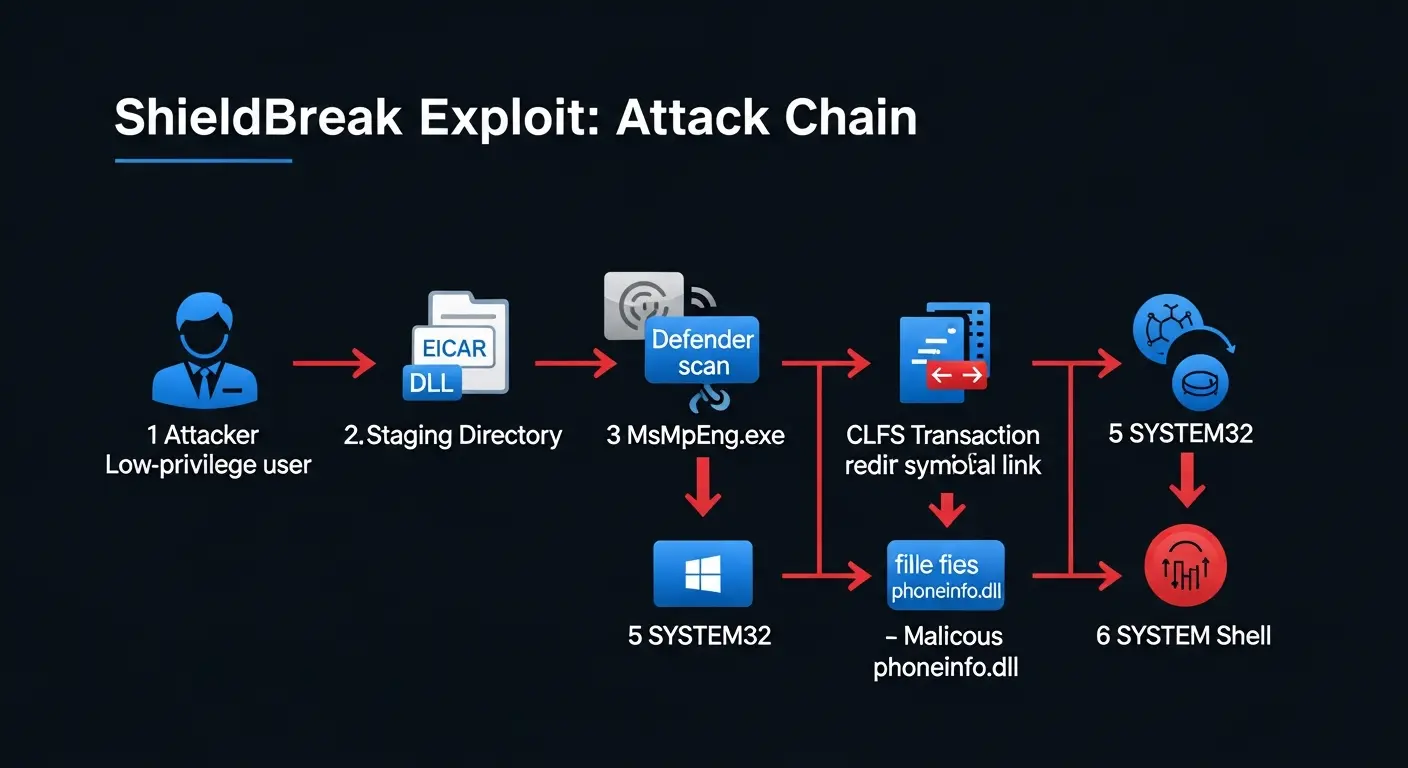
The attack chain, as detailed by Chaotic Eclipse, is precise and unforgiving:
Directory Setup: The attacker creates a temporary directory and registers it as a Cloud Sync provider, a legitimate Windows feature.
Bait and Scan: An EICAR test file (a standard, harmless string used to test antivirus software) is placed in the directory to trigger a Defender scan.
Path Manipulation: The exploit manipulates Defender's scan path to point towards the protected
C:\Windows\System32directory.CLFS Transaction: Using the Windows Common Log File System (CLFS), the exploit swaps identity and data to target
phoneinfo.dll, a legitimate but hijackable library inSystem32.Execution: The attacker triggers the
QueueReportingscheduled task. This task, part of standard Windows operations, loadsphoneinfo.dllwithSYSTEMprivileges, executing the attacker's payload.
Microsoft fixed the front door but left the side window open, assuming no one would bring a ladder built from the Common Log File System. The ShieldBreak exploit is a masterclass in abusing obscure but powerful Windows subsystems that often escape the scrutiny applied to more common attack vectors.
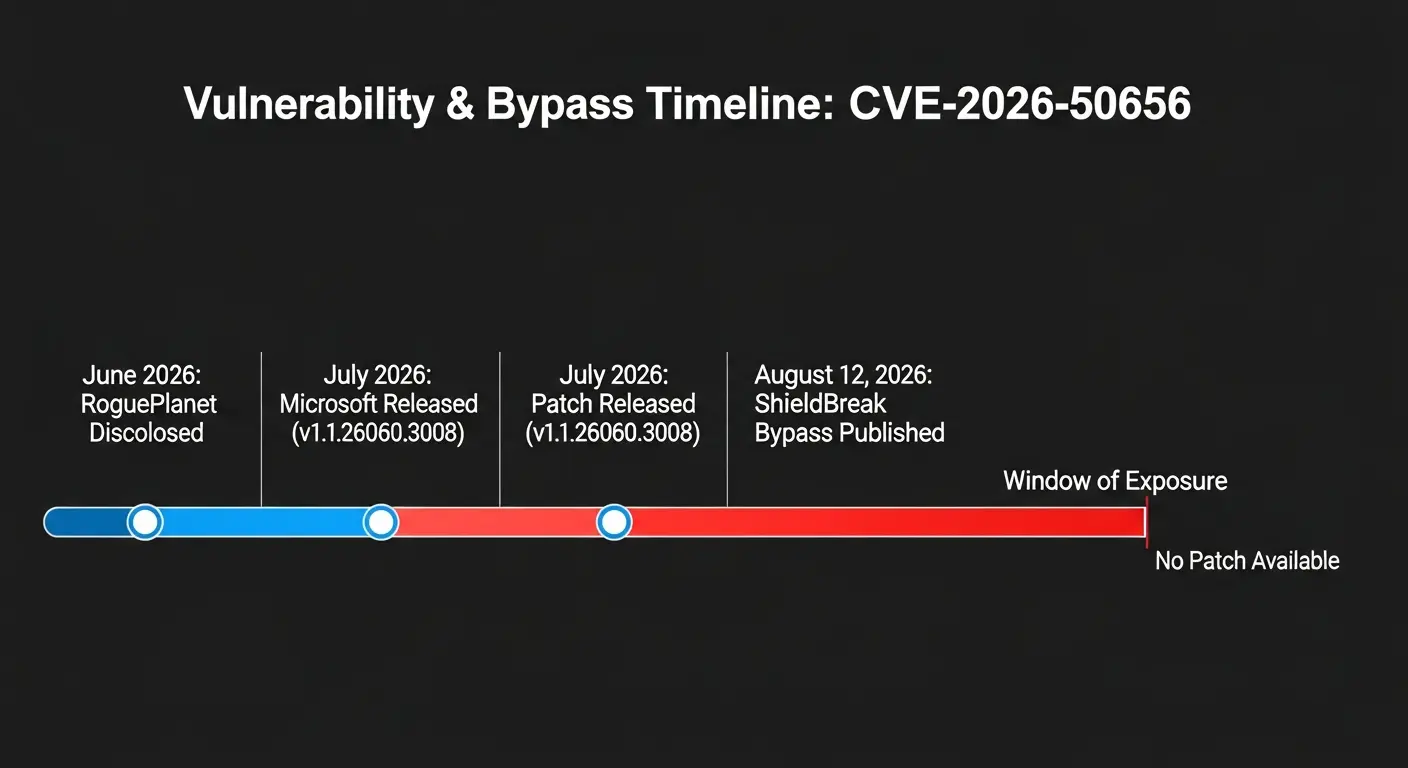
The existence of the ShieldBreak exploit means any organization that installed the July 2026 patch and considered the matter closed is now completely exposed.
Impact and Affected Systems: A Universal Windows Threat
The scope of this vulnerability is maximal. All current Windows platforms running Microsoft Defender are affected. This includes the entirety of the modern Windows ecosystem:
Windows 11: All versions, including 25H2 and Canary channel insider builds.
Windows 10: All supported versions.
Windows Server 2025: And prior supported server versions.
The specific component at risk is the Microsoft Malware Protection Engine. Versions below 1.1.26060.3008 are vulnerable to the original RoguePlanet exploit. Version 1.1.26060.3008 and potentially later versions remain vulnerable to the ShieldBreak patch bypass. As of this writing, Microsoft has not released a second patch to address ShieldBreak.
This is not a theoretical vulnerability. The public release of the ShieldBreak exploit code means that it is available to every threat actor, from script kiddies to APTs. The MITRE ATT&CK framework (opens in a new tab) documents Exploitation for Privilege Escalation as a foundational tactic for nearly all advanced intrusions.
Proof of Concept
This proof of concept outlines the steps to replicate the ShieldBreak exploit, escalating from a low-privilege user to NT AUTHORITY\SYSTEM on a machine with the patched Defender engine.
Payload Preparation. First, create a malicious DLL that will be executed by the privileged process. This DLL will spawn a
cmd.exeprocess. For this example, we'll name itmalicious.dll.Directory and Link Setup. Create the necessary directories and symbolic links to stage the attack. This PowerShell script prepares the environment to trick Defender.
powershell **Create a staging directory** New-Item -Path "C:\Temp\ShieldBreak" -ItemType Directory **Place the malicious payload** Copy-Item .\malicious.dll C:\Temp\ShieldBreak\phoneinfo.dll **Create a junction point to the target directory** cmd.exe /c mklink /J C:\Temp\ShieldBreak\link C:\Windows\System32Trigger Defender Scan. Plant the EICAR test string in a file to lure the Defender engine into scanning the staging directory. The engine will follow the links during its remediation process.
powershell Set-Content -Path "C:\Temp\ShieldBreak\eicar.com" -Value 'X5O!P%@AP[4\PZX54(P^)7CC)7}$EICAR-STANDARD-ANTIVIRUS-TEST-FILE!$H+H*'Execute Privileged Task. Trigger the scheduled task that loads the target DLL. By the time this runs, the malicious DLL will have been moved into
System32by Defender itself, thanks to the symbolic link.powershell schtasks /run /tn "\Microsoft\Windows\Device Information\QueueReporting"
Upon successful execution, a new command prompt window will appear, running with NT AUTHORITY\SYSTEM privileges.
Detection and Mitigation: Beyond the Missing Patch
With no official patch for the ShieldBreak exploit, organizations must deploy compensating controls immediately.
BreachModal recommends the following layered defense strategy:
Attack Surface Reduction (ASR): Implement and tune Microsoft's ASR rules. Start in audit mode to identify potential conflicts, then move to block mode. Rules that block process creation from WMI or PSExec can help disrupt later stages of an attack following escalation.
Application Control: Use AppLocker or Windows Defender Application Control (WDAC) to prevent the execution of unauthorized DLLs from protected locations. Whitelisting known-good versions of
phoneinfo.dllcan break this specific exploit chain.Tamper Protection: Ensure Microsoft Defender's Tamper Protection feature is enabled via Intune or Group Policy. While not a direct fix, it prevents unauthorized changes to Defender's configuration, which can be a follow-on action post-escalation.
Least Privilege Principle: Aggressively audit and restrict local administrative rights. An attacker with only standard user permissions has fewer tools to stage complex exploits like the ShieldBreak exploit.
These controls acknowledge the reality that the endpoint agent itself can be the source of compromise.
FINAL VERDICT
The ShieldBreak exploit is a critical failure of patch management and security design, demonstrating that a fix for a vulnerability is not the end of the story. The ultimate risk of complete system compromise via a trusted security agent falls squarely on every organization that uses Microsoft Defender as a primary endpoint protection solution. Relying on vendor patches as the sole line of defense is negligent. The only viable path forward is a defense-in-depth strategy built on the assumption that your endpoint agent is already compromised, requiring robust, independent monitoring of kernel-level activities and strict application control.
***
BreachModal's Adversarial Simulation and Red Team services specialize in testing for complex patch bypasses and logic flaws. Contact us to validate your defenses against threats like the ShieldBreak exploit before they become a breach.