
 BreachModal
- Published
- Under
- Threat Intelligence
- Reading time
- 6 min
N-able N-central Exploit: Storm-1175 Deploys Ransomware
Summary
Critical N-able N-central vulnerability CVE-2026-18577 is actively exploited by Storm-1175 to deploy ransomware. MSPs must patch immediately.

A critical authentication bypass in N-able's N-central platform has become the fulcrum for a widespread ransomware campaign, turning the trusted tools of Managed Service Providers (MSPs) into weapons against their own clients.
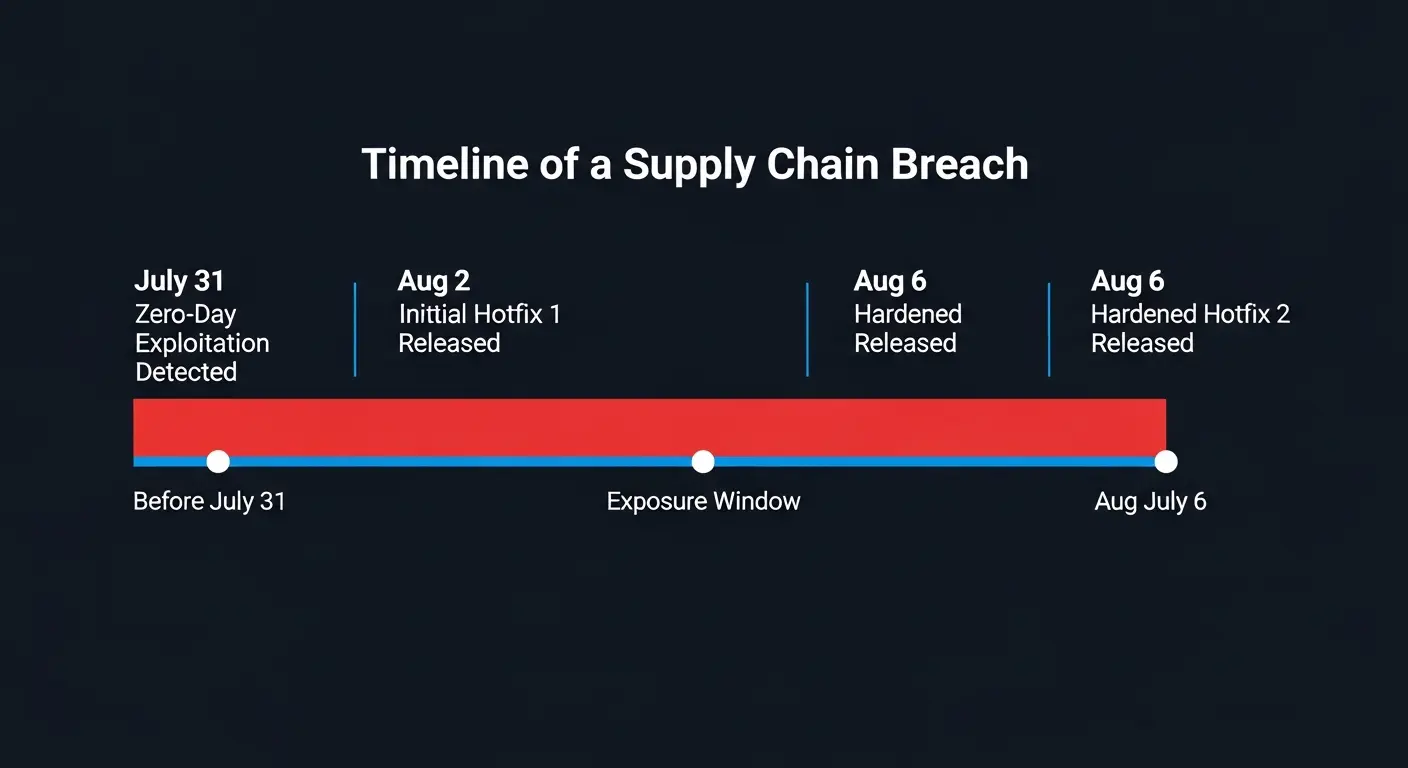
The threat actor, identified as Storm-1175, is systematically exploiting CVE-2026-18577, an 8.2 CVSS score vulnerability, to gain unauthenticated administrative access to N-central servers. According to N-able's own security team, their Adlumin MDR solution first detected active exploitation on July 31, 2026. This vulnerability is a result of an incomplete patch for a prior issue, CVE-2026-18556, affecting all N-central versions prior to the emergency hotfix 2026.3.1.7. Storm-1175, previously linked to Medusa ransomware, is now deploying a new strain named StormEncryptor across compromised MSP client networks.
Note what this means: the foundational trust model of the entire MSP ecosystem is being weaponized at scale. When an RMM (Remote Monitoring and Management) platform is compromised, it is not a single-company breach. It is a catastrophic supply chain event where attackers inherit the MSP's administrative keys to hundreds or thousands of downstream businesses. Why does this keep happening? Because RMM platforms represent the highest possible concentration of privileged access, making them an irresistible target for ransomware groups seeking maximum leverage with minimal effort.
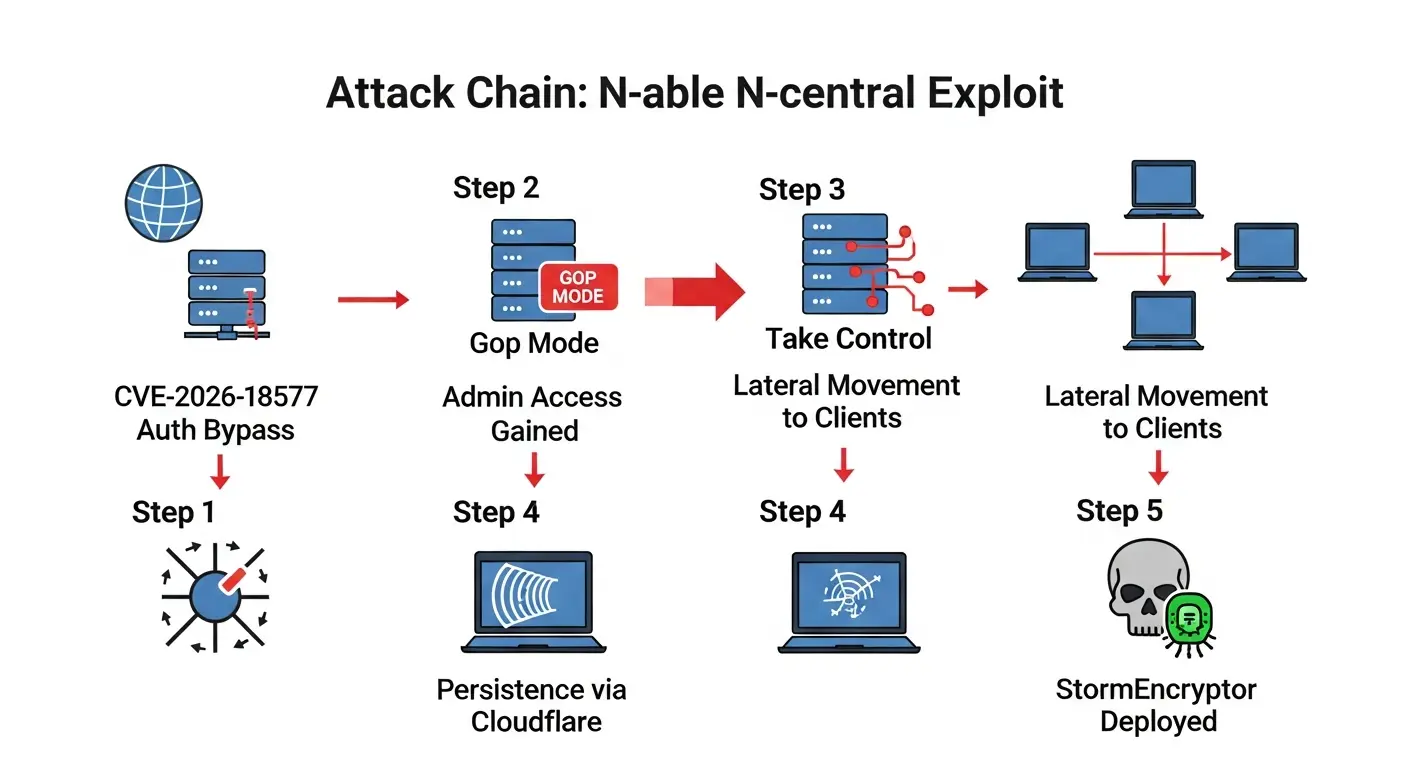
The Anatomy of a Supply Chain Compromise
The exploit chain begins with the authentication bypass flaw, CVE-2026-18577. This is not a subtle misconfiguration; it is a direct path to what is effectively "god mode" on the N-central console, requiring no prior credentials. It seems the first fix for CVE-2026-18556 was less a locked door and more a slightly-ajar window.
Once inside, Storm-1175 operators live off the land, using N-central's own powerful features against its intended users. Researchers observed the attackers leveraging the "Take Control" feature, a legitimate remote access tool, to pivot directly from the compromised N-central server into the networks of the MSP's clients. This provides immediate, privileged access to sensitive systems, including domain controllers, bypassing traditional perimeter defenses.
To ensure their access survives discovery, Storm-1175 has been documented deploying Cloudflare-based tunnels as a service on critical client endpoints. This technique, a form of Remote Access Software (T1219) (opens in a new tab), creates a persistent and encrypted command-and-control channel that is difficult to detect and can survive the MSP revoking the initial N-central access. The implication is clear: even after patching N-central, the client networks may remain compromised.
Storm-1175: From Access to Ransomware in Days
Storm-1175 is an operator that values speed. Mandiant analysis of similar MSP-targeting groups shows that the time from initial access to ransomware deployment is often less than 72 hours. This group, which has been associated with the Medusa ransomware family in past campaigns, demonstrates a practiced and efficient post-exploitation playbook.
After gaining a foothold via the N-able N-central exploit, the group's operators use common dual-use tools to map the victim environment. Advanced IP Scanner is used for network discovery, and other RMM tools like AnyDesk or SimpleHelp are deployed as secondary backdoors. The final objective is credential theft, accomplished by dumping the LSASS process memory using tools like Mimikatz, a technique cataloged by MITRE as OS Credential Dumping: LSASS Memory (T1003.001) (opens in a new tab).
With domain administrative credentials in hand, Storm-1175 deploys its proprietary StormEncryptor ransomware. The attack is devastating because it originates from the trusted RMM agent already installed on every machine. Security tools that are configured to trust processes initiated by N-central are rendered blind to the attack as it unfolds.
The pattern of abusing trusted RMM platforms is not new. The 2021 Kaseya VSA attack by the REvil ransomware group, which leveraged a similar zero-day vulnerability (CVE-2021-35211), impacted over 1,500 downstream businesses and should have served as a final warning. This incident proves the lesson was not learned.
Proof of Concept: Simulating the N-central Authentication Bypass
The following is a conceptual demonstration of how an attacker might verify and exploit CVE-2026-18577. It is for educational purposes only.
Target Identification: The attacker first identifies an internet-exposed N-able N-central login portal. This is often done using search engines like Shodan or by scanning IP ranges known to belong to MSPs.
Vulnerability Check: The attacker sends a specially crafted HTTP POST request to a specific, unauthenticated API endpoint. This request includes parameters that trick the server's authentication logic into believing a valid session already exists for a high-privileged user.
http POST /api/v2/auth/session-check HTTP/1.1 Host: ncentral.msp.com Content-Type: application/json { "session_id": null, "user_id": "1", "force_new_session": true, "bypass_token": "INJECTED_PAYLOAD_HERE" }The
bypass_tokenis constructed to exploit the parsing flaw in the vulnerable component, causing the server to grant a new session token for the administrative user (often user ID '1').Session Hijacking: If the server is vulnerable, it responds with a valid session cookie for the administrative account. The attacker captures this cookie from the HTTP response headers.
http HTTP/1.1 200 OK Content-Type: application/json Set-Cookie: ncentral_session=ADMIN_SESSION_TOKEN_ABC123; Path=/; Secure; HttpOnly { "status": "success", "session_valid": true }Authenticated API Access: The attacker now uses this stolen session cookie to make authenticated API calls. For example, they can list all managed devices to begin planning their lateral movement strategy.
bash curl -k -X GET 'https://ncentral.msp.com/api/v2/devices' \ -H 'Cookie: ncentral_session=ADMIN_SESSION_TOKEN_ABC123'Remote Code Execution: The final step is to use the authenticated API access to execute code on a managed endpoint. The attacker crafts a request to create a new script or job and schedules it to run immediately on a high-value target like a domain controller.
bash curl -k -X POST 'https://ncentral.msp.com/api/v2/jobs/run' \ -H 'Cookie: ncentral_session=ADMIN_SESSION_TOKEN_ABC123' \ -d '{ "device_id": "101", "script_payload": "powershell.exe -enc aW52b2tl...", "run_now": true }'The Base64-encoded PowerShell payload typically establishes a reverse shell or downloads the next stage of the attack, such as the Cloudflare tunnel binary.
Urgent Mitigation and Remediation Steps
N-able responded by releasing Hotfix 1 (version 2026.3.1.7) on August 2, 2026, followed by a superseding Hotfix 2 (version 2026.3.1.10) with further hardening on August 6. All on-premises customers must upgrade immediately. Hosted N-central instances were patched automatically by N-able.
If patching is not immediately possible, take the N-central server offline or restrict all access to a set of trusted IP addresses via firewall rules. This is a temporary stopgap, not a solution. The long-term strategy requires implementing a Zero Trust architecture for all administrative platforms.
FINAL VERDICT
The N-able N-central exploit is a systemic failure of the trust-based model that underpins the Managed Service Provider industry. The risk is borne not just by the MSPs who failed to patch or adequately secure their RMM instances, but by every single one of their clients whose data is now encrypted and held for ransom by Storm-1175. This incident is a direct consequence of treating RMM platforms as simple administrative tools instead of what they are: highly privileged, internet-exposed attack surfaces. Until the industry mandates stringent security baselines for RMM deployment—including mandatory MFA, network segmentation, and the principle of least privilege—these supply chain compromises will continue to be the most devastatingly effective tactic in an adversary's arsenal.
Your RMM platform is your single greatest point of failure. BreachModal's Adversarial Simulation services can validate your defenses before an actor like Storm-1175 does. Contact us to secure your supply chain (opens in a new tab).