
 BreachModal
- Published
- Under
- Compliance
- Reading time
- 6 min
Ivanti EPMM Flaws to Cloud Takeover: Storm-1289 TTPs
Summary
Analysis of threat actors chaining Ivanti EPMM vulnerabilities to pivot from edge appliances to full Microsoft Entra ID and cloud infrastructure takeover.

Edge management infrastructure has become the single most reliable backchannel for total enterprise cloud compromise. The operational reality confronting identity architects is stark: threat actors do not breach modern cloud tenants by breaking multi-factor authentication or cryptographic primitives; they walk through the unauthenticated administrative backdoors of neglected on-premises appliances wired directly into Microsoft Entra ID.
Over the past twenty-four months, telemetry observed across enterprise incident response engagements has tracked advanced threat clusters—chiefly tracking operations aligned with Storm-0501, alongside tracking identifiers colloquially referenced as Storm-1289 and Storm-2603—systematically exploiting Ivanti Endpoint Manager Mobile (EPMM, formerly MobileIron Core). According to technical reporting from the Cybersecurity and Infrastructure Security Agency via the CISA Known Exploited Vulnerabilities Catalog (opens in a new tab) and vendor disclosures, threat actors are leveraging cascading vulnerabilities including the critical API bypass CVE-2023-35078 (opens in a new tab) (CVSS 10.0), arbitrary file writes under CVE-2023-35081 (opens in a new tab), and authenticated injection vectors such as CVE-2025-4428 (opens in a new tab). While security operations teams historically treated MDM compromise as an isolated telecommunications incident, threat actors treat EPMM as what it genuinely is: an unmonitored directory synchronization bridge holding enterprise-wide keys to cloud federation.
Note what this means: enterprise security models predicated on perimeter segmentation have collapsed into identity monocultures where an edge Linux appliance possesses broader administrative capability than your primary domain controllers. The failure is neither accidental nor purely technical; it is economic. Organizations routinely deploy edge MDM solutions to enforce zero-trust device compliance without auditing the hyper-privileged service principals, Active Directory sync accounts, and mutual-TLS administrative certificates stored inside local appliance databases. When the appliance falls, every cloud tenant tethered to it falls concurrently.
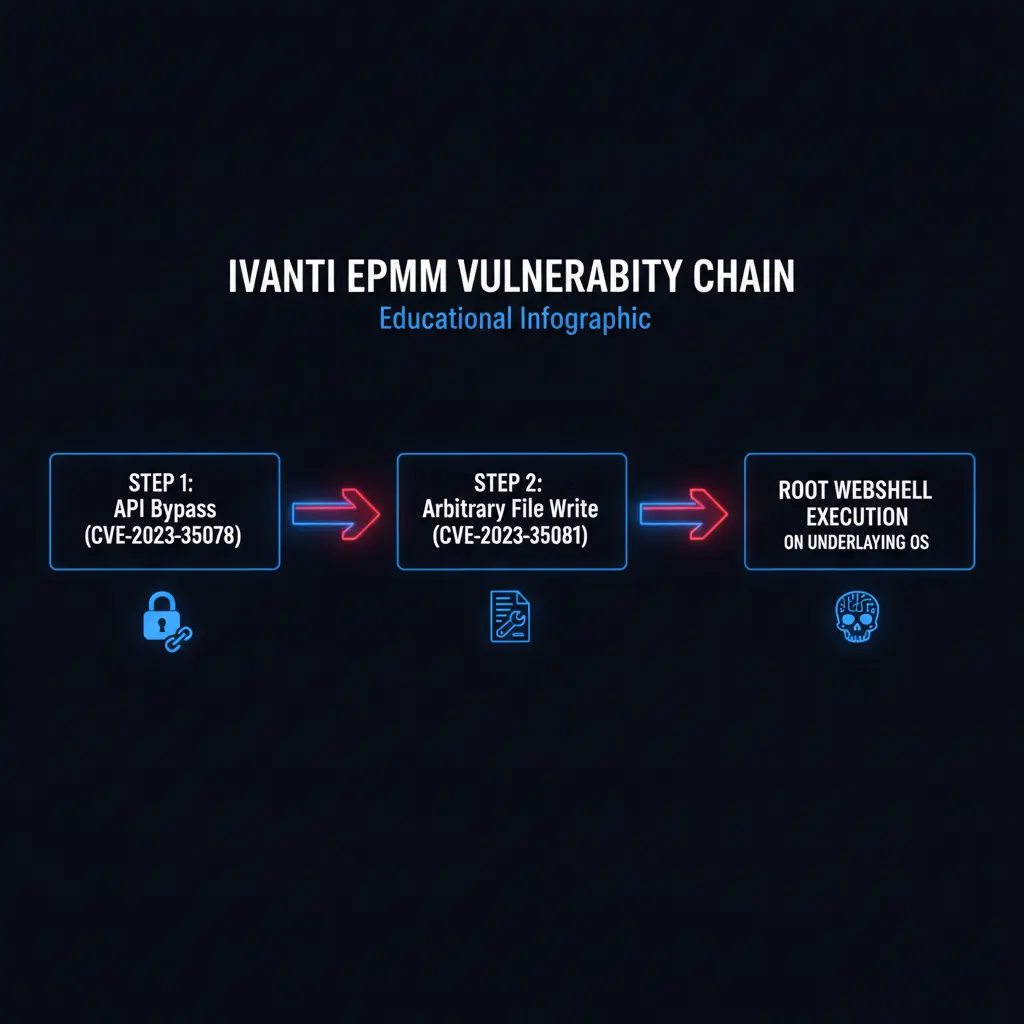
The Anatomy of Edge Vulnerability Chaining
To understand how an initial access vector on an appliance morphs into tenant-wide administrative takeover, one must dissect the vulnerability chaining architecture used by modern threat syndicates. Initial access operations mapped to MITRE ATT&CK Technique T1190: Exploit Public-Facing Application (opens in a new tab) routinely bypass perimeter defenses by chaining logic flaws that vendor engineering teams treated as disparate, minor anomalies.
In early campaigns, attackers paired the unauthenticated REST API access flaw CVE-2023-35078 (opens in a new tab) with path traversal flaw CVE-2023-35081 (opens in a new tab). The initial request targeted exposed /mifs/aad/api/v2/ endpoints, evading firewall inspection rules tuned strictly for administrative GUI pathways. By manipulating the internal state machine of EPMM, threat actors extracted complete directory trees without a single credential. The subsequent link in the chain executed an arbitrary file write directly into the /mifs/ webroot, dropping lightweight Java Server Pages (.jsp) webshells that operated under the appliance's application context.
More recent campaigns have shifted to chaining authentication bypass flaws like CVE-2025-4427 with command injection vectors under CVE-2025-4428 (opens in a new tab), and pre-authentication code injection via Apache HTTP Server's RewriteMap integration (affecting legacy Bash scripts located at /mi/bin/map-appstore-url). In these intrusions, single HTTP GET requests containing command substitution tokens instantly yield root-level interactive shells. For an enterprise that spent $4,000,000 on cloud access security brokers, the perimeter was unseated by an unquoted variable inside a twelve-year-old shell wrapper.
From Appliance Webroot to Hybrid Identity Compromise
Once an adversary establishes an interactive shell on an EPMM node, the operational theater immediately shifts from network compromise to identity exfiltration. Threat actors operating under the Storm-0501 and Storm-1289 playbooks do not linger on the Linux file system; they systematically harvest the trust artifacts required for hybrid lateral movement.
Ivanti EPMM appliances store vital enterprise secrets in local relational databases (such as MySQL or PostgreSQL) and internal configuration files. Under normal operations, EPMM communicates with on-premises Active Directory via Lightweight Directory Access Protocol (LDAP) and synchronizes device compliance records with cloud environments. An adversary possessing root access executes queries against local credential vaults to recover:
Plaintext or reversibly encrypted LDAP bind credentials used for enterprise directory enumeration.
OAuth client secrets and cryptographic application certificates tied to enterprise Microsoft Entra ID (formerly Azure AD) App Registrations.
Ivanti Sentry mutual-TLS (mTLS) client certificates used to authenticate administrative network traffic.
Device enrollment security tokens and internal API keys.
If you were the CISO observing these intrusions, your Security Information and Event Management (SIEM) dashboard would report zero perimeter alerts while the attacker quietly executes MITRE ATT&CK Technique T1078: Valid Accounts (opens in a new tab) using your legitimate cloud integration principals.
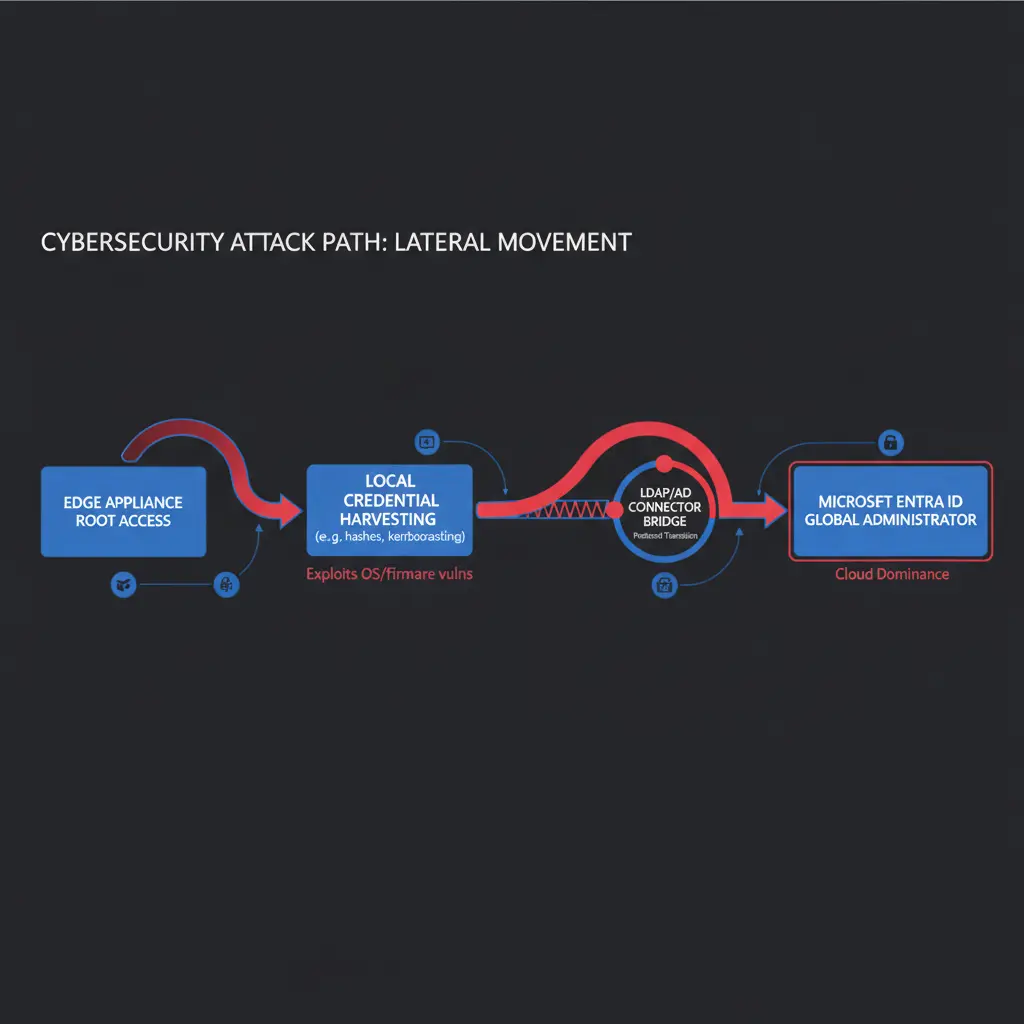
The Cloud Pivot: Bypassing Conditional Access and Escalating Tenant Privileges
With recovered Entra ID service principal secrets and Active Directory Connector credentials in hand, the adversary initiates lateral movement into the cloud control plane. The transition represents one of the most dangerous privilege escalation paths in enterprise computing.
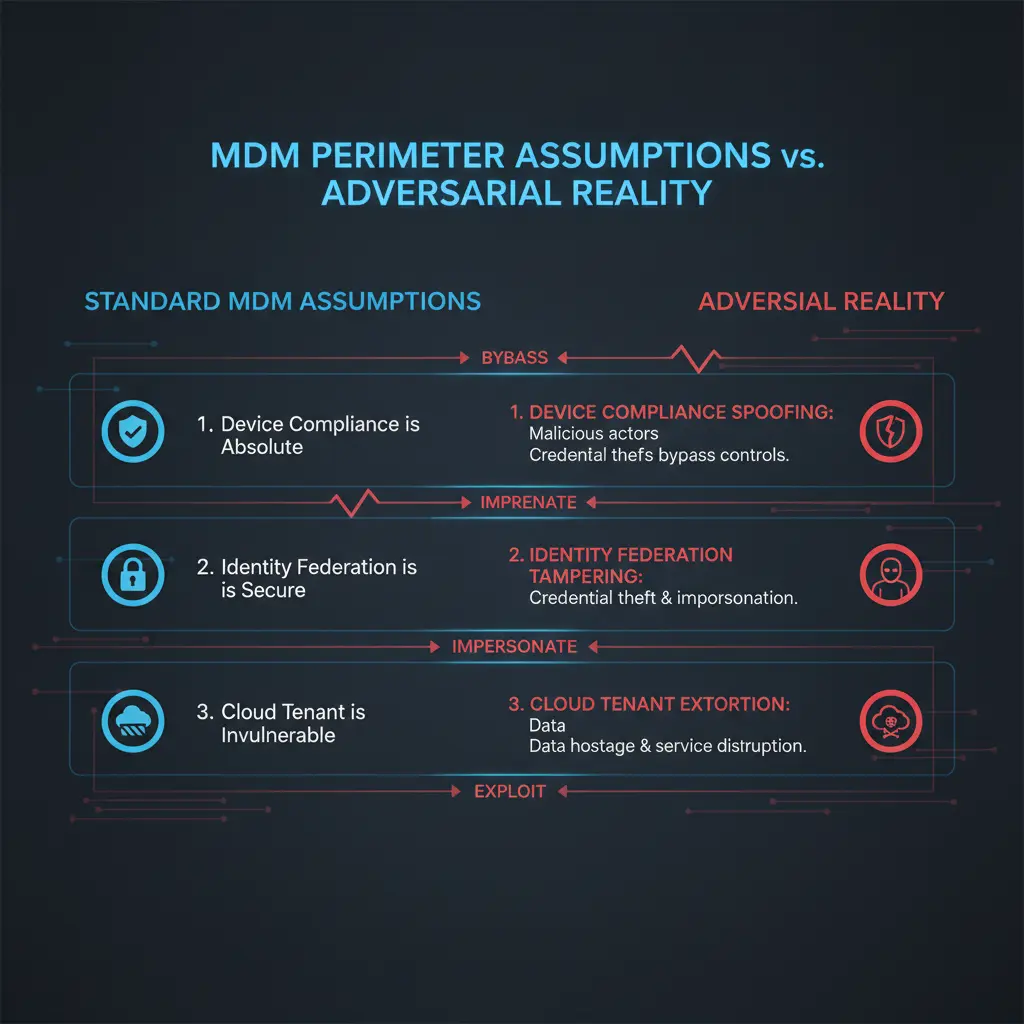
In standard hybrid identity deployments, Conditional Access policies enforce device health compliance: a user cannot access production cloud workloads unless their device is attested as compliant by an enrolled Mobile Device Management (MDM) provider. Because the adversary now commands the authoritative EPMM appliance, they simply invoke internal management APIs to spoof compliance states for arbitrary hardware or register attacker-controlled virtual endpoints as compliant corporate assets. Zero-trust device compliance checks are rendered entirely inert.
Simultaneously, threat actors utilize extracted Active Directory credentials to access internal servers hosting Microsoft Entra Connect (formerly Azure AD Connect). As documented by researchers studying Storm-0501, adversaries extract the MSOL_ service account password hashes or dump the internal LocalDB database (ADSync). Armed with directory synchronization privileges, attackers forge password writeback requests or elevate service accounts into administrative cloud roles pursuant to MITRE ATT&CK Technique T1098.001: Additional Cloud Credentials (opens in a new tab).
Once inside the tenant with elevated rights, the adversary invokes the Microsoft.Authorization/roleAssignments/write API action, assigning themselves Global Administrator or Subscription Owner privileges. The incident ceases to be an MDM exploit; it is now an irreversible cloud infrastructure takeover.
Persistence, Extortion, and Infrastructure Destruction
Tenant takeover is rarely the end state; it is the platform for extortion. Once Global Administrator privileges are consolidated, the adversary establishes redundant persistence mechanisms that survive credential rotations and appliance redeployments:
Adversaries register rogue federated identity domains (utilizing Active Directory Federation Services or SAML identity provider spoofing), allowing them to forge authentication tokens for any tenant user without traversing standard authentication flows. They generate additional service principals with RoleManagement.ReadWrite.Directory permissions, register secondary FIDO2 and authenticator authentication methods on legacy administrative accounts, and silently purge cloud immutable backup retention locks.
In multiple engagements, adversaries transitioned from identity persistence to destructive ransomware execution. Using Azure Resource Manager (ARM) APIs and cloud run commands, attackers deployed Embargo ransomware across hundreds of production virtual machines concurrently, while locking out enterprise security engineers by stripping their administrative role assignments. The entire sequence, from edge HTTP request to tenant lockout, routinely transpires in less than ninety-six minutes.
Proof of Concept: Validating Appliance Exposure and Cloud Tenant Exposure
The following technical walkthrough details the analytical procedure utilized by BreachModal adversary emulation teams to validate edge appliance vulnerability exposure and audit downstream Entra ID service principal privileges without executing weaponized payloads.
1. External Exposure and Endpoint Hygiene Verification Security practitioners must verify whether internal administrative paths are inadvertently exposed to external network segments. This test inspects the API interface without transmitting malicious payloads:
curl -k -s -I -X GET "https://epmm.target-enterprise.internal/mifs/aad/api/v2/ping" \
  -H "User-Agent: BreachModal-Security-Audit/1.0"
If the appliance returns HTTP/1.1 200 OK or HTTP/1.1 403 Forbidden rather than a routing drop or upstream proxy block (404 or connection reset), the appliance's internal administrative routing layer is accessible to untrusted networks.
2. Inspecting Local Keystore Permissions and Credential Protection On an audited EPMM host, verify whether configuration and keystore files maintain appropriate permission boundaries to prevent unprivileged credential extraction:
ls -la /mi/conf/keystore* /mi/conf/aad-config.xml
stat -c "%a %U %G %n" /mi/conf/* | grep -E "(aad|azure|ldap|cert)"
Permissions allowing read access to non-root system users or world-readable bits indicate severe local escalation risk, exposing directory service configurations.
3. Auditing Entra ID Enterprise App Permissions From an administrative PowerShell terminal, verify the permission scope granted to the Ivanti EPMM application registration inside Microsoft Entra ID:
Connect-MgGraph -Scopes "Application.Read.All","AppRoleAssignment.Read.All"
$App = Get-MgApplication -Filter "DisplayName eq 'Ivanti EPMM Connector'"
Get-MgServicePrincipalAppRoleAssignment -ServicePrincipalId $App.AppId | Select-Object ResourceDisplayName, PrincipalDisplayName
Review the assigned permissions: if the application registration includes excessive directory-level permissions such as Directory.ReadWrite.All or RoleManagement.ReadWrite.Directory, an appliance compromise immediately allows full tenant privilege escalation.
FINAL VERDICT
The vulnerability chaining observed across Ivanti EPMM deployments by actors like Storm-0501 and Storm-1289 reveals that the hybrid enterprise perimeter is fundamentally compromised at its integration seams. Organizations that continue to treat edge management appliances as isolated network appliances rather than tier-zero identity assets are operating under an illusion that adversaries dismantle in minutes. Responsibility for this systemic risk rests squarely on leadership teams that mandate zero-trust compliance for user laptops while permitting unmonitored, hyper-privileged legacy controllers to sit unsegmented on the public internet. Until every edge appliance integrated with Microsoft Entra ID is isolated behind strict Zero Trust Network Access architecture and audited under tier-zero security baselines, your cloud tenant is only as secure as the weakest Bash script on your perimeter.
To simulate advanced hybrid identity attack paths and secure your infrastructure against edge-to-cloud compromise, engage BreachModal Adversarial Simulation Services at breachmodal.com/services (opens in a new tab).